 Economy


Việt Nam, EU and Belgium seek deeper, practical cooperation
1.
|
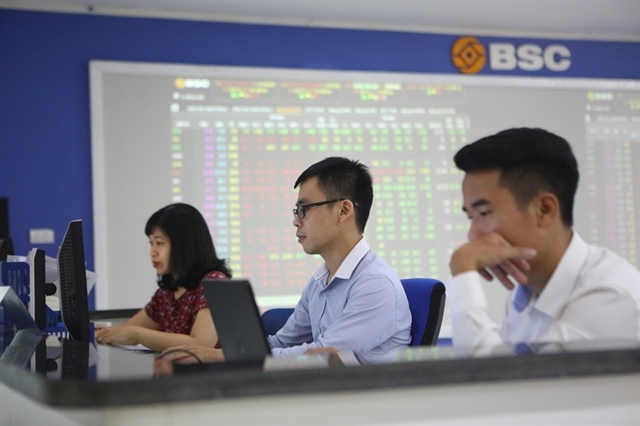
| Traders work in a trading room of a securities firm. — VNA/VNS Photo |
HÀ NỘI — The domestic stock market experienced its worst trading session in history, as a sweeping wave of panic selling flooded the market from the opening bell.
Heavy selling pressure emerged immediately, rapidly spreading as fear dominated the electronic trading boards. The selling intensified in the afternoon, resulting in an even broader decline across various indices as the market closed.
On the Hochiminh Stock Exchange (HoSE), the VN-Index tumbled 115.05 points, or 6.51 per cent, to 1,652.79 points. This marks the steepest drop ever recorded for the index on the southern bourse, eclipsing a previous adjustment of over 80 points that occurred in April of last year.
Throughout the trading day, green indicators nearly vanished from the screens, as the HoSE recorded up to 366 stocks declining, with 233 hitting the floor prices, and only 11 stocks ticked up.
The negative trend affected other indices, with the HNX-Index on the Hanoi Stock Exchange (HNX) falling by 18.28 points, or 7.2 per cent, to 235.36 points.
The pressure was particularly strong for large-cap stocks. All 30 stocks within the VN30 basket closed lower, with 24 logging the maximum daily losses, contributing significantly to the VN30-Index's loss of over 123 points, falling to approximately 1,780 points.
This plunge was a major factor behind the overall decline of the VN-Index.
Investors collectively withdrew from nearly all major sectors, including finance, securities, banking, real estate, consumer goods and firms linked to public investment and construction, all of which turned red on the trading screen.
Even once-sturdy stocks in the oil and fertiliser industries succumbed to heavy selling pressure, with many experiencing sharp declines during the afternoon session.
The dramatic drop in the primary index saw the market's total capitalisation evaporate by more than VNĐ700 trillion (US$27 billion).
Meanwhile, foreign investors continued to be net sellers on the HoSE, offloading VNĐ 348.45 billion. However, they net bought a value of nearly VNĐ107 billion on HNX.
Experts suggest that this downturn is heavily influenced by geopolitical uncertainties and the rising global oil prices. However, they urge investors to maintain composure, prioritise risk management and avoid panic selling of quality stocks within their portfolios.
Huỳnh Anh Tuấn, general director of Vikki Bank Securities, said that the current declines are not unique to Việt Nam but part of a global trend amid increasing uncertainties.
He added that assessing short-term market forecasts is exceptionally challenging given external volatility, particularly regarding conflicts in the Middle East and escalating oil prices.
"If oil prices hover around $90 per barrel, it might not pose a major issue. However, should they rise to $100, $110, or $120 per barrel, many companies and the economy could face significant strain," he said.
Previously, the market had anticipated an 18 per cent growth in corporate profits for the year. However, soaring oil prices are expected to significantly hike production, operational and transportation costs, affecting businesses directly and impacting overall economic sentiment.
The representative from Vikki Bank Securities pointed out that the current input data is difficult to estimate, complicating market scenario forecasting.
He said that the primary priority for investors should be to manage account risks, especially for those using high leverage. — BIZHUB/VNS
Economy
 Economy
 Economy
 Economy
 Economy
 Economy
 Economy
 Economy
 Economy
 Economy
 Economy
 Economy
 Economy
Economy
Economy
 Economy