 Economy



AIMCONNECT 2026 Held in Singapore, Bringing Global Automotive Leaders Together to Explore the Future of AI, Trust and Connected Mobility
1.
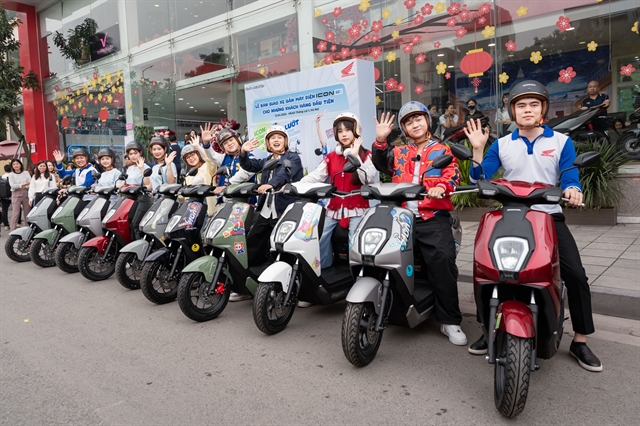 |
| New drivers at a promotional campaign for e-scooter in Hà Nội. VNA/VNS Photo |
HÀ NỘI — Electric motorbike sales in Việt Nam are expected to grow strongly in 2026 as manufacturers roll out new models, expand charging networks and compete more aggressively in a market long dominated by petrol-powered bikes.
Industry observers say a combination of policy changes, wider product choices and improved battery services could accelerate the shift from petrol-powered motorbikes to electric vehicles in the coming years.
According to figures released by VinFast, the company sold 406,453 electric motorbikes in the Vietnamese market in 2025, nearly five times higher than in 2024. Although few manufacturers publicly disclose sales figures for electric motorbikes, the result suggests that VinFast currently holds the largest share of the segment.
Among more than ten mainstream models sold by the company, the Evo series accounted for nearly half of total deliveries, with more than 250,000 units handed over to customers. The strong performance indicates that demand remains highest for compact and affordable electric motorbikes suitable for daily commuting.
VinFast has also expanded its nationwide distribution network in recent years. The company now operates more than 600 dealerships across provinces and cities, along with an increasing number of public charging stations and service centres. The wider network has helped make electric motorbikes more accessible to consumers and reduced concerns about charging convenience.
While electric motorbikes are gaining momentum, petrol-powered motorcycles still dominate the overall market. Data from the Vietnam Association of Motorcycle Manufacturers show that total motorcycle sales in 2025 by its five members, Honda, Yamaha, Piaggio, Suzuki and SYM, reached 2.615 million units, down 1.5 per cent compared with 2024.
Honda alone sold nearly 2.25 million motorcycles in Việt Nam last year, maintaining its dominant position in the domestic market.
Electric models were included in these sales figures, including Yamaha’s Neo’s and Honda’s ICON e:. However, their share remains relatively small as petrol motorcycles continue to account for most of the market.
Despite the modest share, the electric segment is gradually expanding as the Government promotes policies aimed at reducing emissions and encouraging the use of cleaner transport.
Honda also introduced another electric scooter, the CUV e:, although the company initially offered the model under a leasing scheme when it was launched in 2025.
At the beginning of 2026, Honda Vietnam announced official pricing for the CUV e:. The scooter is priced at about VNĐ45 million without the battery and VNĐ65 million when the battery is included.
The Japanese manufacturer has also introduced a new electric motorbike called UC3, which is expected to be assembled in Việt Nam and launched in 2026.
The UC3 is equipped with a rear-hub electric motor capable of producing up to 6,000 watts, allowing the bike to reach a top speed of around 80 kilometres per hour. According to the company, the vehicle’s acceleration from zero to 20 metres is comparable to that of a 160cc petrol motorcycle, making it suitable for everyday urban travel.
However, analysts say Honda may still face challenges in competing with VinFast in the electric segment in the short term. VinFast currently offers a wider range of models and has invested heavily in charging and battery-swapping infrastructure across the country.
Competition between the two companies is expected to intensify in the coming years as Honda plans to introduce more electric models in the Vietnamese market from 2027.
Looking ahead to 2026, VinFast has announced plans to further expand its electric motorbike portfolio. The company intends to introduce several battery-swapping models, including new versions of the Evo, Feliz and Viper series. It is also developing a pedal-equipped electric bike designed for students.
In addition to its mass-market products, VinFast is preparing several models aimed at the premium segment. These include fashion-oriented designs such as Rasad, Sadie and Saxil as well as sport-style electric motorcycles inspired by naked-bike, cruiser and supersport designs.
Infrastructure
Beyond vehicle models, manufacturers are also investing in supporting infrastructure to make electric motorbikes more convenient for users.
VinFast has already installed about 4,500 battery-swapping stations and plans to expand the system rapidly. The company aims to deploy around 45,000 battery-swapping cabinets nationwide by the end of the first quarter.
Meanwhile, Honda plans to introduce charging stations under the Honda Motor Charger Hub system as well as battery-swapping facilities branded Honda e: Swap Battery Station.
These stations will initially be installed at authorised dealerships selling electric vehicles and will first appear in major cities. Users will be able to locate stations and pay charging fees through the My Honda+ mobile application.
Honda Vietnam expects the charging stations to begin operating from June. The system will use the international CHAdeMO charging standard with a capacity of about 1,200 watts per charging port. Charging fees are expected to be announced closer to the launch date.
Other manufacturers are also preparing new services for electric motorbike users. Yamaha Motor Vietnam has announced plans to launch battery-swapping and charging services for electric motorbikes starting in 2026.
Initially, the service will apply to the company’s Neo’s electric scooter and will operate at Yamaha Town dealerships as well as through cooperation with ZuttoRide Vietnam. During the early stage, the programme will be available only in Hà Nội and Hồ Chí Minh City.
The service package will include battery swapping, battery rental, home battery delivery and 24-hour roadside assistance for users of the Neo’s model.
Although Yamaha is one of the most established motorcycle brands in Việt Nam, the company has been slower than some competitors in developing electric products. At present, Yamaha Motor Vietnam sells only the Neo’s electric scooter and the company has not yet announced plans for additional electric motorbike models.
Alongside the major manufacturers, the market also includes several emerging electric motorbike companies such as Yadea, Pega, Dat Bike and Selex Motors.
Policy developments are also expected to influence the growth of the electric motorbike market. From July 1, Hà Nội plans to introduce its first low-emission zone within Ring Road 1. Petrol-powered motorcycles may be restricted or banned from certain areas or during specific time periods as part of the city’s effort to reduce pollution.
Experts believe that with expanding infrastructure, more product choices and supportive policies, the electric motorbike market in Việt Nam could grow rapidly. — VNS
Economy
 Economy
 Economy
 Economy
 Economy
 Economy
 Economy
 Economy
 Economy
 Economy
 Economy
 Economy
 Economy
 Economy
 Economy