 Society

Top leader hails friendship association's role in nurturing Việt Nam–Denmark ties
1.
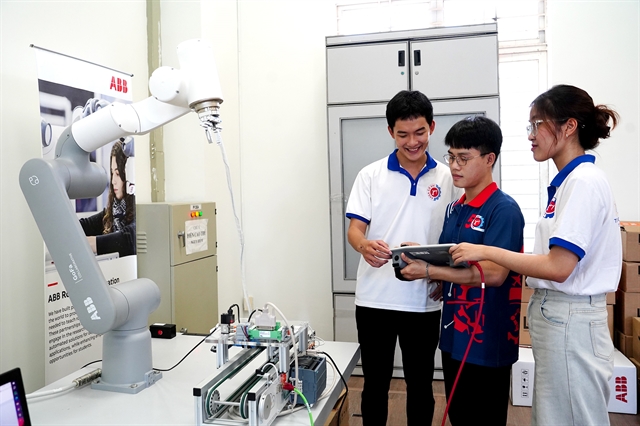 |
| Students at the National Key Laboratory of Mechatronics and Applications, University of Science and Technology under Đà Nẵng University. — VNA/VNS Photo Xuân Quý |
HÀ NỘI — The Law on Higher Education, which officially takes effect at the beginning of this year, is regarded as an important step in perfecting the institutional framework and creating a coherent legal corridor for higher education development in the new period.
By more clearly enshrining the roles, missions, autonomy and accountability of higher education institutions, the law has opened up numerous development opportunities, particularly for specialised institutions like national and regional universities.
However, during implementation, advantages are accompanied by difficulties, which must continue to be identified, analysed and resolved.
Important foundation
The Law on Higher Education 2025, comprising nine chapters and 46 articles, has established an important legal foundation to more clearly uphold the position and strategic role of these specialised universities within the national higher education system.
The law also aligns with the spirit of Resolution 71-NQ/TW, key policy issued by the Politburo of the Communist Party of Việt Nam on August 22 last year on breakthroughs in education and training development, clearly confirming the missions, legal status and leading role of specialised universities.
According to Professor Nguyễn Quý Thanh, Rector of the University of Education at Việt Nam National University Hà Nội, the law established national universities as special public educational institutions entrusted by the State with strategic tasks directly linked to sustainable development, national competitiveness and standing.
In that spirit, national universities are no longer viewed primarily as conglomerates of multi-disciplinary, multi-field training institutions, but are defined as strategic tools of the State in developing skilled workers and enhancing the fields of science, technology and innovation.
For the first time, the law clearly stipulates a mission for regional universities. It states: “Regional universities have the mission of mobilising resources, promoting regional links, supporting regional economic and social development and contributing to the implementation of national strategic tasks.”
This provision clearly embodies the orientation of Resolution 71 on linking higher education with regional development needs and workforce development to meet labour market demands, while ensuring access to higher education for people in difficult areas and ethnic regions.
In addition, the law fully institutionalises the Party’s major policies, creates a coherent, modern legal corridor, enhances the effectiveness and efficiency of State management and promotes the central role of higher education in the national innovation ecosystem.
It has also removed shortcomings in the Law on Higher Education 2018, establishing scientific and technological organisations within higher education institutions to fulfil the mission of developing skilled workers linked to scientific research, technology and innovation.
Thái Nguyên University Director and Associate Professor Dr Hoàng Văn Hùng noted that regional universities in Việt Nam were established in 1994 to form centres for training skilled workers in scientific research and advanced technology transfer.
They provide consultancy and policy critique to contribute to the sustainable economic, cultural and social development of the region.
Since their founding, regional universities have matured and grown within the national education system, making positive contributions to regional economic and social development.
The law also introduces several breakthrough innovations, such as shifting the focus from 'opening programmes' to 'training programme standards', developing digital higher education, provisions on concurrent lecturers and special mechanisms for finance and public assets.
Nguyễn Đình Hưng, head of the Finance Faculty at Việt Nam National University HCM City, said the establishment of a two-tier financial management model created favourable conditions for national universities to allocate, coordinate and use resources efficiently, implementing large, interdisciplinary and multi-field projects.
Resolving difficulties
 |
| A panoramic view of Trà Vinh University in Vĩnh Long Province. — VNA/VNS Photo Thanh Hòa |
Alongside the advantages, many experts have pointed out obstacles in implementing the Law on Higher Education 2025 to fully realise the spirit of Resolution 71, especially for national and regional universities.
Thái Nguyên University Director Associate Professor Hoàng Văn Hùng said: “There is not much difference between the regional university model and the general university model. It is difficult to define the ‘intermediate level’ in regional universities.”
Notably, Resolution 71 clearly requires “eliminating intermediate levels, ensuring streamlined, unified, effective and efficient governance.”
This is identified as a particularly important orientation for the organisational and governance models of national and regional universities.
However, in practice, the lack of clarity on what is meant by the 'intermediate level' in the university models has led to considerable confusion, giving rise to contradictions between centralised management requirements and the need to enhance autonomy, decentralisation and delegation of authority to member universities.
From a workforce training perspective, head of the Personnel Organisation Department at the University of Đà Nẵng Cao Xuân Tấn said that the regional university model “lacks separate regulations, leading to confusion in governance and decentralisation,” while “public sector remuneration is not attractive enough compared to the private sector and large enterprises.”
This makes it difficult to attract and retain high-calibre lecturers and scientists – the key factor in developing research universities in line with the spirit of Resolution 71.
Nguyễn Đình Hưng, head of the Finance Faculty at Việt Nam National University HCM City, also highlighted challenges in coordinating, sharing resources and managing governance risks in large, diverse systems amid efforts to promote decentralisation and grant autonomy to member units.
The Law on Higher Education 2025 has created an important legal framework, opening up many development opportunities for national and regional universities in the new era.
To fully realise the objectives set out in Resolution 71 and the law, it is necessary to continue perfecting sub-legal regulations, clarifying organisational models, clearly defining and progressively eliminating the 'intermediate level', while strengthening decentralisation and delegation of authority linked to accountability and appropriate control mechanisms.
This is a crucial condition for national and regional universities to truly become drivers of higher education development.
Only by removing these bottlenecks can national and regional universities completely fulfil their pivotal roles, effectively contributing to developing skilled workers in science and technology and advancing sustainable national development in the new era. — VNS
Society
 Society
 Society
 Society
 Society
 Society
 Society
 Society
 Society
 Society
 Society
 Society
 Society
 Society
 Society