 Society
Việt Nam reaffirms ASEAN support for UN radiation scientific committee
1.
|
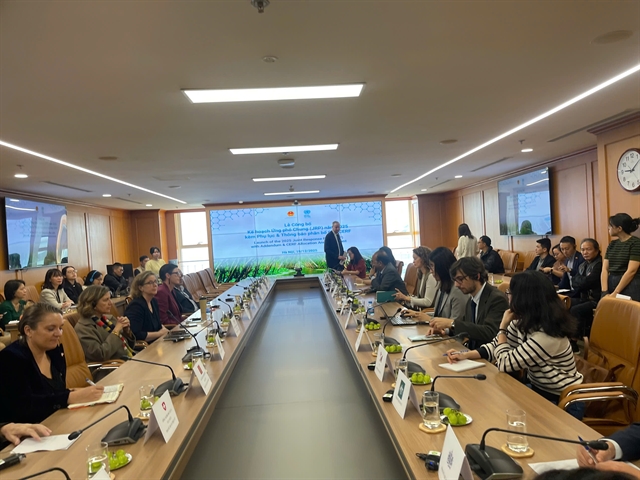
| Delegates at the event. — VNS Photo Như Trần |
HÀ NỘI — The United Nations has approved an emergency assistance package worth US$2.65 million to support Việt Nam’s response to an exceptionally severe year of natural disasters, underscoring mounting humanitarian needs as the country grapples with record-breaking storms and floods.
The funding, provided through the UN Central Emergency Response Fund, was announced on Friday at the launch of the 2025 Joint Disaster Response Plan, co-organised by the Ministry of Agriculture and Environment and the United Nations.
Around 56,000 people affected by disasters in the three central localities – Đắk Lắk and Gia Lai provinces along with Đà Nẵng City – will benefit from the support, which will be channelled through four UN agencies, including the UN Development Programme, the International Organisation for Migration (IOM), the United Nations Children’s Fund *UNICEF) and the Food and Agriculture Organization of the United Nations (FAO).
With this latest allocation, total international assistance for Việt Nam’s disaster prevention, response and recovery efforts in 2025 has risen to $23.5 million.
United Nations Resident Coordinator in Việt Nam Pauline Tamesis said the scale of need remains far greater.
According to the Joint Disaster Response Plan, Việt Nam will require more than $96 million next year to support around 1.4 million people affected by natural disasters, including over 660,000 who have been directly impacted and need urgent assistance.
She said the plan goes beyond short-term relief, prioritising longer-term recovery such as repairing and rebuilding homes, restoring livelihoods and rehabilitating essential public infrastructure. Strengthening the capacity of local organisations is also a key focus, aimed at boosting community resilience and supporting more sustainable recovery.
Tamesis said needs on the ground remain enormous while resources are still limited, highlighting the importance of effective coordination and aid delivery. She called on international partners to continue working closely with Việt Nam in disaster response and recovery.
Speaking at the event, Nguyễn Văn Tiến, Deputy Director General of the Department of Dyke Management and Disaster Prevention and Control under the Ministry of Agriculture and Environment, said 2025 has set a series of unprecedented records.
The East Sea (internationally known as the South China Sea) recorded the highest number of typhoons and tropical depressions ever observed, including several of exceptional intensity and with unusual landfall patterns. For the first time, a storm tracked from the Indian Ocean into the Pacific before entering the East Sea.
Flooding also caused extensive damage, with rivers across northern, central and southern regions exceeding historic flood levels and triggering widespread inundation. Provinces and cities such as Huế and Quảng Trị experienced unseasonal flooding during the dry season. Bản Vẽ Reservoir recorded flood levels exceeding a 5,000-year return period, while rainfall at Bạch Mã station in Huế reached a record 1,740mm in a single day, the second-highest daily total globally.

|
| Officers and soldiers build and repair homes for residents in Đắk Lắk Province affected by flooding. — VNA/VNS Photo |
According to Tiến, disasters this year claimed 419 lives, damaged or destroyed hundreds of thousands of homes and severely disrupted livelihoods, particularly in agriculture. Economic losses are estimated at around VNĐ100,000 billion, the highest figure ever recorded.
Regarding the use of aid, he said local authorities will hold community meetings so residents can help identify households most in need, with commune-level governments responsible for verification. Authorities will also invest in building and upgrading concentrated evacuation sites, including schools and community houses, to improve preparedness for future severe floods.
The UN’s 2025 Joint Disaster Response Plan estimates total funding needs of $96.2 million to address the most urgent humanitarian and recovery requirements, while also strengthening long-term resilience and climate adaptation. The plan identifies around 3.1 million affected people across 15 priority provinces, of whom 1.4 million require assistance and nearly 659,000 are in the direct target group.
Tamesis said the plan serves as a key framework guiding coordinated action between the Government of Việt Nam and international partners, with a strong emphasis on the principle of building back better.
Rebuilding housing and restoring livelihoods are critical investments to help people stabilise their lives and recover sustainably, she added.
In the coming period, the United Nations and its partners will conduct post-action reviews to draw lessons from this year’s response and refine preparedness ahead of the 2026 storm season, while finalising contingency plans.
Tiến said Việt Nam will prioritise repairing and rebuilding homes, restoring livelihoods and rehabilitating public infrastructure, alongside strengthening local institutions and community resilience.
The goal is to ensure no one is left behind, particularly women, children, older people, ethnic minorities and people with disabilities, as the country faces increasing climate risks, he said. — VNS
Society
 Society
 Society
 Society
 Society
 Society
 Society
 Society
 Society
 Society
 Society
 Society
 Society
 Society
 Society