 Society

AIMCONNECT 2026 Held in Singapore, Bringing Global Automotive Leaders Together to Explore the Future of AI, Trust and Connected Mobility
1.
|
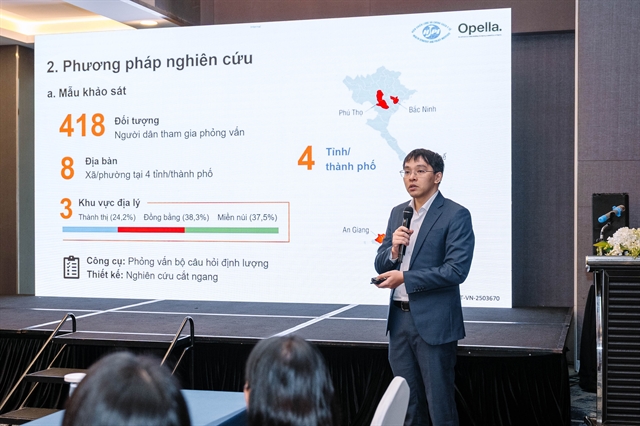
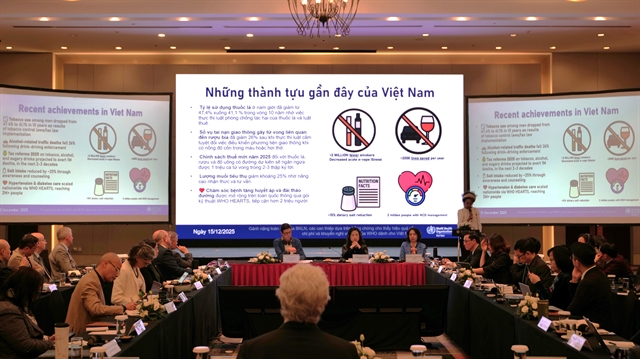
| A representative of the Health Strategy and Policy Institute shares the results of a study titled “Assessment of Vietnam’s Readiness for Self-Care and Its Influence Factors” on December 15. — Photo courtesy of the organiser |
HCM CITY — Việt Nam ranks fourth in international comparisons for self-care readiness, with an overall score of 3.04 out of 4, behind only Singapore, Australia and Germany, according to a recent study.
Self-care is an essential component of primary healthcare, with WHO defining it as the ability of individuals, families and communities to promote and maintain health, prevent disease and cope with illness with or without the support of healthcare professionals.
The Ministry of Health’s Health Strategy and Policy Institute, in collaboration with Opella Vietnam, announced the findings of the study, titled “Assessment of Việt Nam’s Readiness for Self-Care and Its Influencing Factors” on December 15.
Conducted since June it applied the Global Self-Care Federation’s Self-Care Readiness Index, which comprises four key enablers and 14 component indicators.
The assessment framework has been used in 20 countries worldwide. The research combined desk reviews with field studies in four localities representing different regions of Việt Nam: Phú Thọ, Bắc Ninh, Huế City, and An Giang.
Fieldwork employed both qualitative and quantitative methods, including five exhaustive interviews with policymakers, 28 focus group discussions involving health officials, healthcare providers and the general public and structured questionnaire interviews with 171 healthcare providers and 418 consumers.
Việt Nam’s scores across the four key enablers were: Stakeholder Support and Adoption (2.79), Consumer and Patient Empowerment (3.06), Self-Care Health Policy (3.05), and Regulatory Environment (3.26).
Of the 14 component indicators, nine recorded scores between 3 and 3.75, indicating relatively strong overall readiness, although development remains uneven across different areas.
Although Việt Nam’s readiness for self-care is relatively strong compared to the region, the study highlights the need to further enhance public awareness, strengthen healthcare workers’ counselling capacity and improve access to reliable information.
Priority areas include expanding mainstream communication on self-care, accelerating the rollout of electronic health records integrated with VNeID to enable people to access medical histories, test results and medication information, promoting electronic labelling for medicines, particularly over-the-counter products; and piloting community-based self-care models as a foundation for a future national self-care strategy.
Dr Nguyễn Khánh Phương, director of the Health Strategy and Policy Institute, said the findings show that Việt Nam has built a solid foundation for advancing self-care, while also identifying clear opportunities to strengthen mainstream communication, healthcare counselling and safe access to reliable information.
“This provides a strong basis for developing practical models and national directions for self-care in Việt Nam.”
Dr Valentina Belcheva, country head of Opella Vietnam and Cambodia, described the study as an important milestone, noting that it offers, for the first time in Việt Nam, a systematic view of the needs and barriers people face in their self-care journey. — VNS
Society
 Society
 Society
 Society
 Society
 Society
 Society
 Society
 Society
 Society
 Society
 Society
 Society
 Society
 Society