 Society
84 individuals investigated for transnational online frauds
1.
|
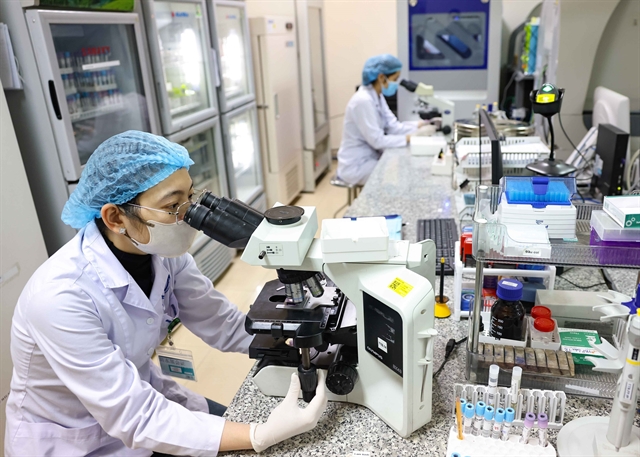
| Scientists conduct research at the National Hospital of Endocrinology in Hà Nội. — VNA/VNS Photo Thanh Tùng |
HÀ NỘI — The full-time scientific research, technology development and innovation workforce in Việt Nam will reach 12 people per 10,000 by 2030, becoming a particularly important productive force.
It is one of the targets in the National Strategy for Intellectual Workforce Development to accelerate the country’s industrialisation and modernisation until 2030, with a vision to 2045, approved by Deputy Prime Minister Nguyễn Chí Dũng.
Decision No 2711/QĐ-TTg states that the strategy’s objective is to develop a high-quality Vietnamese intellectual workforce with a rational structure.
They will play a key driving role in rapidly developing modern productive forces, leading digital transformation, innovation and creativity, international integration and serving as a pivotal driver for Việt Nam to achieve the goal of becoming a developing country with modern industry and upper-middle income by 2030 and a developed country with high income by 2045.
By 2030, the target is to develop the intellectual workforce in both quantity and quality, focusing on highly qualified intellectuals in key and critical sectors, ensuring balance across industries and fields and paying attention to remote areas, disadvantaged regions and particularly difficult areas.
The proportion of students in basic sciences, engineering and technology fields will reach at least 35 per cent, including at least 6,000 doctoral students and 20,000 participants in talent programmes.
The strategy aims to increase the proportion of intellectual labour in high-tech and strategic industries to 25 per cent, ensuring at least 40 per cent of women and ethnic individuals participate in positions in work, research, teaching and leadership in science, technology and innovation.
It also targets attracting about 1,000 outstanding Vietnamese intellectuals abroad in various fields to take part in scholar exchanges, research cooperation, training and technology transfer domestically through flexible working arrangements.
In addition, specialised networks will be built to connect Vietnamese experts and intellectuals abroad by priority fields, with at least 50 per cent of public-sector intellectuals under 45 trained and fostered under programmes to enhance professional, management and leadership skills.
By 2045, the Vietnamese intellectual workforce is expected to develop strongly, with high quality and a rational structure, ranking among the top in the region and approaching the level of developed countries.
Solutions and targets
To achieve these objectives, the strategy proposes five main groups of solutions, including institutions and governance; human resource generation and building an ecosystem for intellectual workforce development; valuing, remunerating and honouring intellectuals; globalising intellectuals by bringing Vietnamese intellectuals to the world and world intellectuals to Việt Nam; and measuring and evaluating the effectiveness of intellectual workforce development.
The decision assigns specific tasks to ministries, sectors, localities and relevant agencies to implement the strategy.
In the first three months of next year, ministries, government agencies, sectors, localities, the Việt Nam Union of Science and Technology Associations and the Việt Nam Union of Literature and Arts Associations will issue action plans to implement tasks, solutions and targets for intellectual workforce development.
The Ministry of Science and Technology will take the lead in developing a set of criteria to evaluate the effectiveness of intellectual workforce development, to be completed in the third quarter of next year.
At the same time, it will build the Việt Nam Intellectual Workforce Database System, to be completed in the second quarter, and regularly update the database by sector and field.
The ministry will also lead the organisation of strategic science and technology programmes and projects, selecting outstanding international experts and Vietnamese individuals at home and abroad to lead or participate as members.
The Ministry of Public Security will coordinate with the Ministry of Foreign Affairs and relevant ministries and sectors to research, review and propose amendments and improvements to regulations and simplified administrative procedures on entry and exit, visa issuance and residence to attract Vietnamese intellectuals, highly qualified international scientists and experts and their families to work and live in Việt Nam.
Việt Nam Television, the Voice of Việt Nam and multimedia press agencies will regularly develop programmes and activities to publicise the role and contributions of the intellectual workforce and commend outstanding intellectuals.
They will also spread popular knowledge and promote the 'Vietnamese Intellectuals in the Digital Transformation Era' campaign. — VNS
Society
 Society
 Society
 Society
 Society
 Society
 Society
 Society
 Society
 Society
 Society
 Society
 Society
 Society
 Society