 Society

Vietnamese creators vie for honours at TikTok’s first Southeast Asia Awards
1.
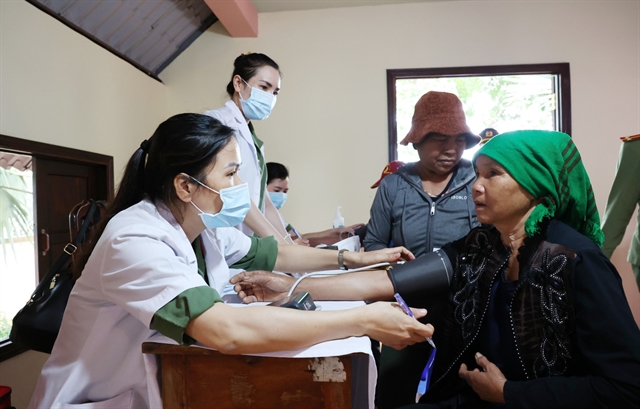 |
| An ethnic woman in Đắk Lắk Province receives a free health check-up as part of a campaign by the provincial police's hospital. — VNA/VNS Photo Tuấn Anh |
ĐẮK LẮK — For people in disadvantaged areas, the National Assembly (NA)’s recently adopted resolution on public health is seen as a crucial step towards equitable health care services.
The resolution on groundbreaking mechanisms and policies to protect and improve public health was passed by the 15th NA on December 11, during its 10th session.
Of these public health measures, a policy of providing free periodic health check-ups nationwide from 2026, with a vision towards basic hospital fee exemptions by 2030, has raised expectations among residents of Đắk Lắk Province.
Set to take effect from January 1, 2026, the document is seen as an important and humane milestone for the country, and particularly for disadvantaged groups. It is also a specific measure to implement the Politburo’s Resolution 72-NQ/TW on public health dated September 9.
H’Đăm Niê, a resident of Đắk Lắk’s Cư Bao Commune, was excited to hear the news about free periodic health check-ups. With recurring health problems, she often has to visit the local health station for examinations and medication.
H’Đăm said she hopes that the new policy will help her detect illnesses early and reduce financial pressure on her family.
H’Nghiệp Niê, another resident from Cư Bao Commune, also regularly visits the local health station for treatment of high blood pressure and vestibular disorders. She was delighted to learn that by 2030, people will be exempted from basic hospital fees.
Living in a remote area with a limited economy, she believes the policy will greatly reduce the financial burden on people in poverty when they need medical care.
The new resolution has also been warmly welcomed by local health care workers in Đắk Lắk. According to medical staff, it will serve as a source of motivation for them while contributing to a more equitable health system that better meets people’s basic health care needs.
Dr H’Juet Niê, deputy head of the Cư Pui Commune Health Station, said the locality is classified as a disadvantaged area with a population of more than 27,000, over 75 per cent of whom belong to ethnic communities.
The station still lacks a lot of essential equipment, such as ultrasound, laboratory testing and X-ray machines, and currently has only one general practitioner. Additional support in equipment, facilities and professional training will help the facility staff better serve local residents, the doctor said.
Meanwhile, Dr Đinh Hữu Phương, who runs the Cươr Đăng Commune Health Station, noted that public health communication and outreach are a demanding task in this area.
The commune has more than 5,500 residents, nearly 80 per cent of them part of ethnic communities, but the local health facility only has eight medical staffers.
As part of the local health system, commune health stations play a crucial role in implementing health care policies. To meet rising demand, Dr Phương said the station hopes to continue receiving support in terms of staffing, equipment and facilities so it can continue improving health care service quality for residents.
According to the Đắk Lắk Province Department of Health, medical examination and treatment services at the local level have seen steady progress in recent years in terms of medical techniques, equipment, bed occupancy rates and the number of patient visits.
In 2020, local health facilities across the province conducted medical examinations for more than 1.8 million people and provided inpatient treatment for over 210,000.
By 2024, these figures had risen to more than 3.7 million outpatient visits and nearly 441,000 inpatient treatments – approximately double the 2020 level.
In the near future, the provincial health sector is set to pursue strong reforms and fulfil the resolutions set out, particularly by improving the quality of public health care services and building a more developed health system in Đắk Lắk to meet the requirements of the new era. — VNS
Society
 Society
 Society
 Society
 Society
 Society
 Society
 Society
 Society
 Society
 Society
 Society
 Society
 Society
 Society