 Sci-Tech
Seven Vietnamese export product groups at risk of trade remedy investigations
1.
 |
| E-commerce revenue was estimated at $36 billion in 2025, tripling the 2020 level and maintaining 22–25 per cent annual growth, the highest in the region. — VNA/VNS Photo |
HÀ NỘI — Việt Nam's digital technology industry solidified its role as a major economic driver in 2025, delivering strong financial and export performance that far surpassed targets, according to the latest report by the Ministry of Science and Technology.
The industry’s total revenue hit an estimated $198 billion, marking a 26 per cent jump from last year and coming in 16 per cent above the annual target. Its GDP contribution reached VNĐ1.075 quadrillion (nearly $40.9 billion), up 10 per cent from 2024. Operational efficiency stayed strong, with profits estimated at over VNĐ371 trillion.
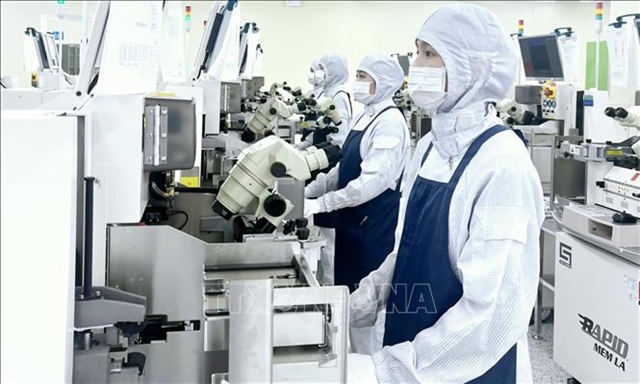
Hardware and electronics exports reached $178 billion, representing a 35 per cent year-over-year increase and surpassing the annual target by 12 per cent, firmly sustaining their place as one of the country’s key foreign currency earners.
E-commerce achieved a standout surge, with revenue estimated at $36 billion in 2025, tripling the 2020 level and maintaining 22–25 per cent annual growth, the highest in the region.
Active digital technology firms numbered 80,052, a 10 per cent rise from 2024, highlighting the sector's vitality and expanding domestic ecosystem.
Last year, Vietnam's digital economy was worth around $39 billion in gross merchandise value, posting an expansion of 17 per cent – the second fastest growth in Southeast Asia.
Minister of Science and Technology Nguyễn Mạnh Hùng said Việt Nam’s digital economy in 2025 remained largely focused on digitising existing processes rather than fully shifting to new growth models. While the digital share of GDP grew rapidly, local value creation was limited by reliance on foreign platforms, and many SMEs were still not fully integrated into digital supply chains.
Boosts needed for the digital economy
From a data economy viewpoint, Director of the National Data Centre Nguyễn Ngọc Cường described accurate, standardised, and regularly updated resident data as a prerequisite for secure, efficient, and scalable digital business operations.
Sectors such as e-commerce, digital finance, digital health, and digital education must rely on electronic identification and authentication systems to verify users, helping prevent fraud and foster trust in transactions. Moreover, when data is exploited and analysed using AI and Big Data technologies, it can generate economic value many times greater than its original worth.
Arnaud Ginolin, Managing Director of Boston Consulting Group (BCG), noted that the low-altitude economy is emerging as a new and highly promising frontier, with growth driven by digital commerce, digital transportation, network infrastructure, industry, as well as defence and security. Vietnam, he said, needs to seize this opportunity.
Phạm Tuấn Anh, CIO and CEO of Becamex Telecommunications and IT Corporation, recommended Government-led hubs of green and digital transitions for businesses, especially SMEs, alongside tax and land incentives for FDI companies tied to domestic technology adoption and supply chain localisation. He advocated indirect backing via local infrastructure or technology firms and deeper supply chain integration to secure mutual growth for domestic enterprises and investors.
Lê Hồng Việt, CEO of FPT Smart Cloud, proposed public – private partnership mechanisms to bring computing capacity to all segments of society, forming a shared “factory” for research and development (R&D).
Cao Anh Sơn, Deputy CEO of Viettel, urged prompt guidelines for efficient state budget allocation toward R&D investments. Priorities should be given to research programmes and projects that focus on foundational and inclusive technologies with high spillover effects, such as semiconductor, low-altitude satellite, and dual-use technologies serving national defence, security, and economic development. — VNS
Sci-Tech
 Sci-Tech
 Sci-Tech
 Sci-Tech
 Sci-Tech
 Sci-Tech
 Sci-Tech
 Sci-Tech
 Sci-Tech
 Sci-Tech