 Sci-Tech

Việt Nam reaffirms ASEAN support for UN radiation scientific committee
1.
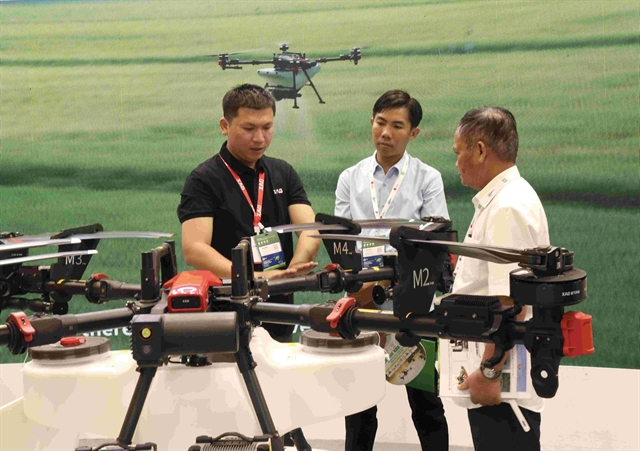 |
| Local businesses study agricultural equipment at an international agritech fair in Việt Nam. The agriculture and environment sector will promote application of AI in quality management of farming product. — VNA/VNS Photo |
HÀ NỘI — Science and technology are expected to become strategic pillars for breakthrough growth in Việt Nam’s agriculture and environment sector.
According to Deputy Minister of Agriculture and Environment Phùng Đức Tiến, despite facing numerous domestic and international challenges in recent years, the agriculture and environment sector has achieved notable results.
However, rapid growth in certain sub-sectors, commodities, and localities has also exposed insufficiency in quality control of farming products and environmental protection.
Many challenges for the entire sector have emerged, including environmental pollution in some production areas, increasing losses caused by disasters and diseases, and growing risks from technical barriers, green standards and low-emission requirements imposed by import markets.
Việt Nam's current agricultural growth still relies heavily on expanding scale, increasing output, exploiting natural resources, and the use of chemical inputs.
Meanwhile, major markets such as the US, the EU, Japan, and China are tightening requirements on food safety, traceability, emissions control, environmental protection, and social responsibility.
These standards apply not only to final products but to the entire value chain, from raw material zones and production processes to processing, circulation, and distribution.
Without effective quality control from the outset, uncontrolled growth could increase export risks, trigger trade disputes, damage the reputation of Vietnamese agricultural products, and cause long-term negative impacts on the environment.
Therefore, the sector must continue restructuring towards higher added value, lower emissions, efficient resource use, and stronger environmental protection, rather than pursuing output growth alone.
In the environmental field, science and technology play an increasingly important role in monitoring and assessing environmental quality, forecasting disasters, adapting to climate change, and managing natural resources. These capabilities provide a foundation for proactive risk prevention instead of reactive damage control.
As international standards become more stringent, traceability is considered one of the most critical tools for quality control and value-chain transparency.
Under the Plan for Implementing Traceability of Agro-Forestry-Fishery Products for 2026-30, with a vision towards 2035, the Ministry of Agriculture and Environment aims to build a unified nationwide traceability system, gradually expanding its coverage to key agricultural products and agricultural inputs.
This system is designed not only to meet market requirements but also to support state management, prevent trade fraud, and combat counterfeit and substandard goods.
By standardising and digitalising information on production areas, cultivation processes, harvesting, preliminary processing, processing and distribution, quality risks can be detected early and addressed promptly, avoiding large-scale consequences for the sector.
Based on traceability data, the agriculture and environment sector will progressively deploy analytical, monitoring, and early warning tools, moving towards the application of artificial intelligence (AI) in quality management, food safety, market forecasting, and production governance. This marks a significant shift from traditional management models to data-driven and evidence-based governance.
Currently, science and technology are increasingly embedded across the sector, from research on key crop varieties, biotechnology applications and gene editing, to the development of microorganisms and vaccines in aquaculture, industrial-scale offshore farming technologies, circular economy models, forest carbon, and carbon credits.
Representatives from government agencies, research institutes, universities, and businesses agree that cooperation among the State, scientists and enterprises is the key to translating science and technology into practice.
Director General of the Directorate of Fisheries and Fisheries Surveillance Trần Đình Luân emphasised the need to intensify research and development of environmentally friendly farming models and to continue implementing three major science and technology programmes in the coming period.
Associate Professor Phí Hồng Hải, Deputy Director of the Vietnam Academy of Forest Sciences, said the institute will focus on addressing major issues in the forestry sector, covering both planted forests and natural forests.
For planted forests, priorities include breeding hi-tech forestry varieties, developing advanced and sustainable intensive forestry solutions, restoring degraded soils, improving forest health, promoting forest certification, and building and managing plantation forest codes.
For natural forests, focus will be placed on improving forest quality, restoring ecosystems and biodiversity, strengthening multifunctional forest management, and researching the development of non-timber forest products under forest canopies.
Meanwhile, Khuất Hoàng Kiên, Deputy Director of the Department of Digital Transformation and Environmental Resources Data Information, said that the implementation of Resolution 57-NQ/TW on breakthroughs in science, technology, innovation, and national digital transformation in 2025 has largely fulfilled assigned tasks, though these results represent only initial achievements.
To ensure effective and synchronised implementation in line with the resolution's requirements, the department has proposed accelerating the completion of sectoral data standards and regulations, promoting AI application in agriculture and environment, and advancing initiatives related to the development and utilisation of the sector’s digital data resources. — VNS
Sci-Tech
 Sci-Tech
 Sci-Tech
 Sci-Tech
 Sci-Tech
 Sci-Tech
 Sci-Tech
 Sci-Tech
 Sci-Tech
 Sci-Tech
 Sci-Tech
 Sci-Tech
 Sci-Tech
 Sci-Tech
 Sci-Tech