 Sci-Tech

TokenPulse Opens Singapore APAC Operating Hub
1.
 |
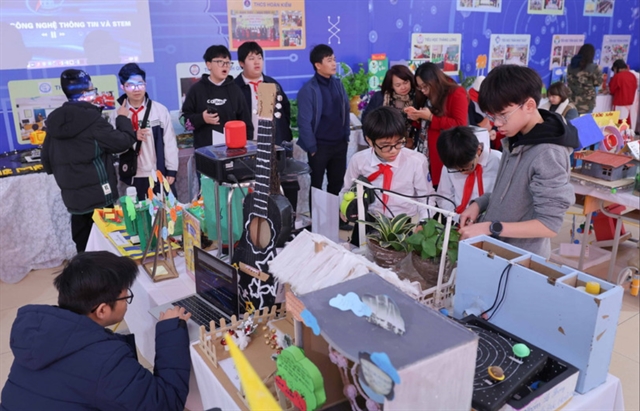
| The VEX V5 Robotics Team booth from Cao Bằng Specialised High School made a strong impression at the VEX 2025 World Robotics Championship. — Photo giaoducthoidai.vn |
HÀ NỘI — From online classes in remote schools to digital library models and STEM initiatives in mountainous regions, the digital transformation of education is gradually addressing the 'information poverty'.
When knowledge is digitalised and spread from school to community, escaping from poverty will be more sustainable.
Reducing information poverty
Among the levels of multi-dimensional poverty, the lack of information and skills to access knowledge is seen as a major barrier in many ethnic and mountainous communities.
Students struggle to access new knowledge, teachers face limited conditions to innovate teaching methods and local people lack information about policies, science and technology and the labour market.
According to experts, if 'information poverty' is not addressed, support for infrastructure or livelihoods is very likely to remain short-term in nature.
For this reason, Project No.6 under the National Target Programme for Sustainable Poverty Reduction for the 2021–25 period has identified communication and digital transformation as foundational solutions to enhance people’s capacity to access information, with education playing a particularly important role.
Minister of Education and Training Nguyễn Kim Sơn said that in disadvantaged regions, digital transformation is precisely the 'leverage' to narrow gaps in educational quality between regions.
In practice, in many highland schools, digital transformation has moved from awareness to action, he said.
At satellite school sites, teachers proactively use online learning platforms and shared digital learning resources of the sector to support teaching; students are able to access more vivid lessons, hands-on experiments, and richer learning content than that provided by traditional textbooks.
In Tuyên Quang Province, educational digital transformation has been identified as a breakthrough.
Most educational institutions have been connected to the internet and have implemented electronic records, digital report cards, and school management software. Reducing administrative pressure allows teachers to focus more on professional work. At the same time, the province prioritises investment in facilities, especially in disadvantaged areas.
Many schools have been newly built, renovated or upgraded, gradually improving classrooms, libraries and semi-boarding and boarding facilities, creating better conditions to enhance teaching and learning quality.
The application of information technology in teaching is becoming increasingly widespread, making lessons more engaging while expanding opportunities for students in disadvantaged areas to access knowledge.
Previously, students almost exclusively learned from textbooks.
Many rural and mountainous schools have now installed smart classrooms, interactive boards, and satellite internet. As a result, students have opportunities to study foreign languages, STEM, and programming.
Thanks to digital transformation in education, students can access learning materials, life-skills books, and scientific and social knowledge suited to their age and local characteristics. For highland students, this is an important gateway to a much broader world of knowledge.
Highland teachers 'transforming themselves'
A notable aspect of the educational digital transformation process in highland areas is the spirit of self-learning and self-renewal among teachers.
Many have proactively learned new technologies and used digital platforms to design engaging lessons suited to the learning capacities of ethnic minority students.
In Trùng Khánh Commune of the northern mountainous province of Cao Bằng, teacher Đàm Thị Uyên is a vivid example.
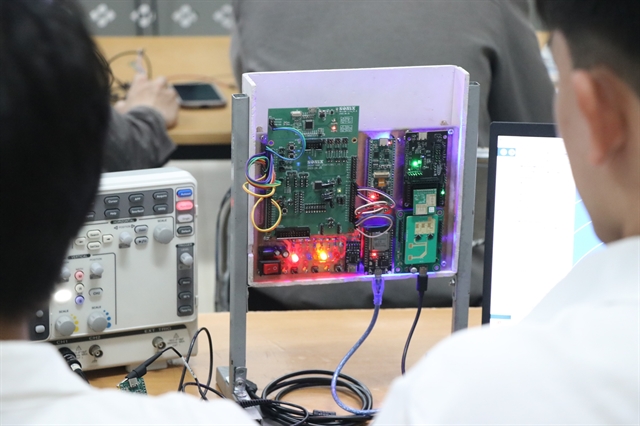
Despite limited equipment, she and her students make STEM projects from recycled materials, creating water filtration models and gas warning systems.
Not stopping there, she taught herself programming, mobilised social resources, and established a Robotics Club at the Cao Bằng Specialised High School so that students could 'learn by doing'.
In 2025, her robotics team won the 'National Inspiration Award', bringing the image of highland students to a national technology arena.
Currently, the education sector in Cao Bằng has implemented free virtual robotics teaching using VEX VR; more than 500 schools have received STEM–Robotics training, and 100 per cent of upper secondary schools have been equipped with robots.
That students from Cao Bằng High School for the Gifted have for many consecutive years participated in the VEX World Robotics Championship, has become a convincing evidence of the effectiveness of digital education in disadvantaged areas.
Educational digital transformation does not stop within schools but also spreads to the community through community learning centres and digital skills classes for local people.
People are guided in using smartphones to access online public services, look up health and education information, learn new cultivation techniques, and promote products on digital platforms.
This represents an important shift from 'passive support' to empowering people with the capacity to access information.
Foundation for sustainable poverty reduction
According to education and social development experts, digital transformation in highland education has long-term impacts on reducing multidimensional poverty.
Sociologist Phạm Minh Hiền told giaoducthoidai.vn: “To achieve sustainable poverty reduction, investment in education must be flexible, modern and well connected. In particular, focus should be placed on employment skills and technology, as these are the keys to the future.
“In reality, educational digital transformation is contributing to improving the effectiveness of Project No.6, creating clear changes in awareness and in people’s capacity to access information in disadvantaged areas.
“When students are equipped with digital skills and have an open mindset, their ability to access future employment and learning opportunities will be higher, thereby reducing the risk of falling back into poverty.
“Reducing 'information poverty' is no longer merely a slogan, but a sustainable driving force for highland development.”
Digital transformation helps narrow regional disparities and ensures that learners in highland areas can access knowledge on a level comparable to more advantaged regions. — VNS
Sci-Tech
 Sci-Tech
 Sci-Tech
 Sci-Tech
 Sci-Tech
 Sci-Tech
 Sci-Tech
 Sci-Tech
 Sci-Tech
 Sci-Tech
 Sci-Tech
 Sci-Tech
 Sci-Tech
 Sci-Tech
 Sci-Tech