 Society

Lotte, Phát Đạt combine strengths in Thu Thiem project
1.
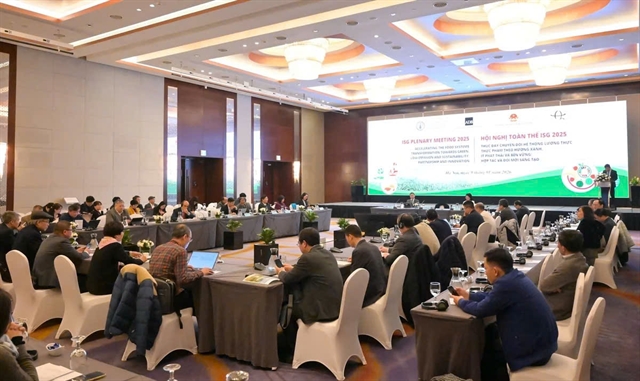 |
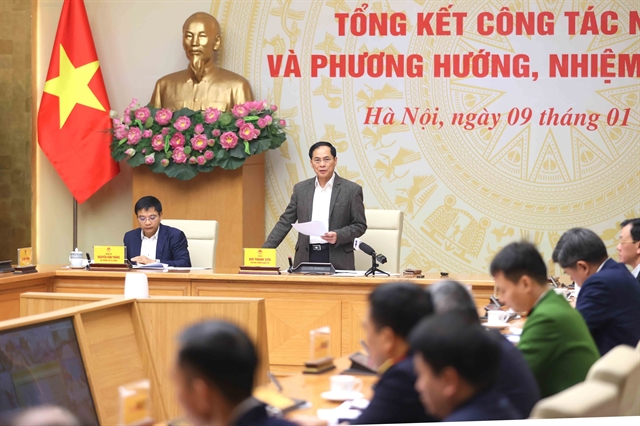
| Officials and experts attend the International Support Group (ISG) plenary conference on food system transformation in Hà Nội on Friday. — VNS Photo Trần Như |
HÀ NỘI — Facing growing pressures from climate change, resource depletion and environmental degradation, Việt Nam recognises that agricultural growth cannot be sustained without safeguarding nature, making the transition to a green, low-emission and sustainable food system an inevitable path forward.
This topic was the centre of discussion at an International Support Group (ISG) plenary conference, organised by the Ministry of Agriculture and Environment (MAE) in Hà Nội on Friday.
Speaking at the event, Minister of Agriculture and Environment Trần Đức Thắng said that in 2025, despite severe impacts from natural disasters and epidemics – with total damage estimated at around VNĐ102 trillion (US$3.9 billion) – Việt Nam’s agriculture and environment sector still met and exceeded all targets assigned by the Government.
Sectoral GDP growth reached 3.78 per cent, while exports of agricultural, forestry and fishery products hit a record $70.09 billion. Forest coverage stood at 42.03 per cent, and 95 per cent of urban solid waste was collected and treated to standards.
According to the minister, these achievements not only reflect the sector’s internal efforts but also demonstrate the effective support of the international community over recent years.
However, he noted that with the limited agricultural land of 10.3 million hectares and increasing pressures from climate change, pollution and resource degradation, Việt Nam must transform its food system to ensure food security, protect the environment and improve economic growth.
In addition to shifting from a reactive to a prevention approach in food safety, Việt Nam must also change its mindset from “productivity and output” to “multi-value agriculture,” with innovation, science and technology, digital transformation and international cooperation as key drivers.
The overarching goal is to develop ecological agriculture, modern rural areas and farmers, while actively contributing to global climate efforts.
In 2025, the Vietnamese Government continues to focus on three strategic breakthroughs, which are institutional reform, infrastructure development and human resources. Accordingly, the agriculture and environment sector has swiftly adapted its organisational structure following the administrative merger, conducted legal revisions, enhanced decentralisation and delegation of authority in line with the two-tier local government model, and accelerated administrative reform to improve policy implementation and promptly address bottlenecks.
According to the MAE, this year’s ISG plenary conference focuses on three main objectives: updating and sharing new domestic and international policies related to sustainable agriculture and food system transformation; proposing initiatives and areas of cooperation on low-emission production and responsible, sustainable consumption; and strengthening coordination among partners while mobilising resources for agriculture and food system transformation for the 2026-30 period.
A key highlight of the conference was the expansion of the Partnership for Transparent, Responsible and Sustainable Food System Transformation in Việt Nam. First signed in October 2024 with 47 partners, the agreement has since been expanded to include new collaborators.
FAO Representative in Việt Nam Vinod Ahuja said the next five years will be decisive for the country’s food system transformation. Decisions made during this period will shape production, distribution and consumption models for future generations.
Under the guidance of FAO’s Country Programming Framework in Việt Nam, the UN agency commits to continuing close cooperation with the Government and partners to accelerate the transition to green, low-emission and climate-resilient agri-food systems. The goal is to strengthen food security, improve livelihoods, enhance resilience and support sustainable economic growth alongside the protection of natural resources and the environment.
Within the framework of the conference, the International Year of the Woman Farmer 2026 was also introduced, highlighting the pivotal role of women in building inclusive and resilient food systems, while promoting gender-responsive policies, investments and partnerships.
From a finance and investment perspective, the Asian Development Bank (ADB) Country Director for Việt Nam Shantanu Chakraborty affirmed that agri-food system transformation is one of ADB’s top priorities, with financial commitments of up to $40 billion for the sector across the Asia-Pacific region.
According to ADB, the transition requires a comprehensive approach centred on modernising agri-food value chains, investing to enhance system resilience, upgrading infrastructure for sustainable production, integrating nutrition and healthy diets, and strengthening social welfare and regional cooperation.
In Việt Nam, ADB is working closely with ministries, sectors and localities to build sustainable, transparent and economically efficient agri-food systems.
In this process, land resource protection has been identified as a foundational pillar. Land is increasingly becoming a decisive factor in ecological agriculture in Việt Nam. Under the growing impacts of climate change, population pressure and rising food demand while farming practices remain insufficiently sustainable, land resources are facing serious degradation risks.
Prolonged overuse of chemical fertilisers and pesticides has also degraded soil structure, reduced organic matter, disrupted microbial balance and increased environmental risks, directly affecting soil quality, water resources and agricultural ecosystems.
From a scientific and management perspective, Dr Trần Minh Tiến, deputy director of the Việt Nam Academy of Agricultural Sciences (VAAS), stressed that protecting and restoring soil health must be the core of sustainable agricultural development strategies.
Soil not only serves production but is also a living ecosystem that directly determines productivity, product quality and the resilience of agricultural systems, he said.
Tiến proposed building a national database on soils and crops as a foundation for scientific, accurate and long-term land management. This should be accompanied by the wider adoption of sustainable farming techniques, precision agriculture technologies and next-generation agricultural inputs to restore soil health, enhance production efficiency and reduce negative environmental impacts.
From a value-chain perspective, a representative from the International Centre for Tropical Agriculture (CIAT) underscored that the success of sustainable agriculture depends on the ability to effectively connect production and consumption, and ensure a balance of interests among stakeholders throughout the agricultural value chain.
In practice, many barriers remain in scaling up sustainable agriculture models. Although awareness of safe and environmentally friendly food is rising, most consumers are still unwilling to pay higher prices for ecologically grown agricultural products. Meanwhile, producers, especially smallholder farmers, must bear environmental costs, transition costs and market risks.
To harmonise interests across the value chain, experts suggest that policies should focus on building transparent, accessible certification systems tailored to Vietnamese farming conditions.
At the same time, shifting toward integrated data management would help improve governance efficiency and reduce transaction costs across the value chain. In addition, diversifying agricultural value chains is seen as a key solution to provide healthier food products at more affordable prices for consumers. — VNS
Society
 Society
 Society
 Society
 Society
 Society
 Society
 Society
 Society
 Society
 Society
 Society
 Society
 Society
 Society