 Society

Việt Nam fosters comprehensive cooperation with Uruguay
1.

|
| Students at Nghĩa Tân Primary School in Nghĩa Đô Ward, Hà Nội, don't have to wear uniform during cold days. VNA/VNS Photos Nguyễn Cúc |
HÀ NỘI — As winter tightened its grip on the capital and temperatures plunged, many primary and kindergarten schools in Hà Nội have pushed back the start of the school day by 15 to 45 minutes to shield pupils from the worst of the recent cold spell.
On Friday, outdoor temperatures in several areas fell to around 10 degrees Celsius, bringing biting conditions from early morning. In response, numerous schools adjusted class schedules so students did not have to arrive too early in harsh weather.
Teachers, however, continued to be on duty from the usual start time to receive and supervise pupils whose parents brought them to school earlier than the revised hours.
At Nghĩa Tân Primary School in Nghĩa Đô Ward, the school announced timetable changes for January 9 and 10, make-up school days following the New Year holiday. Under the revised schedule, the first lesson began at 9am.
Nguyễn Thị Bích Nga, principal of Nghĩa Tân Primary School, said the move followed guidance from the Hà Nội Department of Education and Training on responding to severe cold weather.
“The school has flexibly adjusted start times to safeguard students’ health,” she said.
During cold days, teachers are also instructed to keep classroom doors closed to prevent draughts and to limit outdoor activities.
On the same morning, parents at Yên Hòa Primary School in Yên Hòa Ward were told the school day would begin 45 minutes later. However, as many parents still work standard office hours, they continued to bring their children to school as usual, where students were received, supervised and cared for by teachers.
This flexible approach has helped reassure parents, ensuring students are consistently looked after during the morning hours.
|
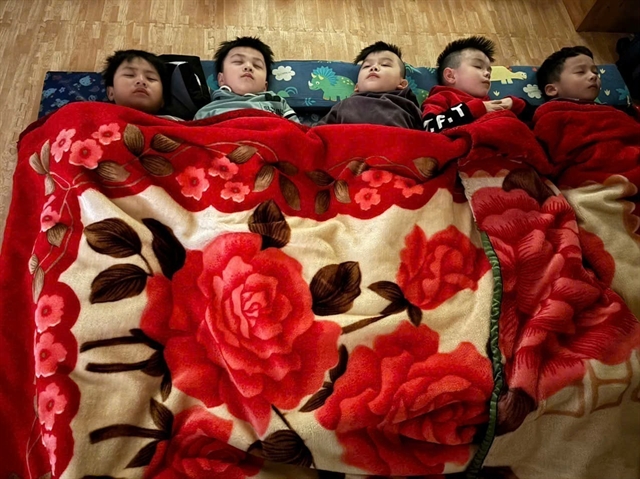
| Students during nap time at Quan Hoa Kindergarten in Nghĩa Đô Ward, Hà Nội. |
Vũ Mai Liên, a parent in Yên Hòa Ward, said that while midday temperatures were warmer, mornings remained bitterly cold, making the adjusted schedules reasonable.
“If schools closed completely, many families would struggle to arrange childcare, especially parents who work far from home or on fixed schedules,” she said.
At kindergarten level, schools have continued to apply flexible arrangements for drop-off and pick-up times.
Nguyễn Thị Lê Huyền, principal of Dịch Vọng Kindergarten in Cầu Giấy District, noted that early childhood education has its own characteristics.
“Even under normal conditions, some children arrive late. During severe cold spells, the number of late arrivals increases,” she said.
“Parents only need to inform the school in advance so meals can be prepared. The reception and care of children are always ensured, allowing parents to go to work with peace of mind.”
At Nam Phương Tiến Kindergarten in Xuân Mai Commune, staff continue to arrive on time during cold days. Even when children arrive later than usual, the school maintains normal daily routines.
Nguyễn Thị Thanh Tâm, the school’s principal, said teachers pay close attention to attendance and children’s health throughout the day, especially during handover times, to promptly detect any unusual signs and coordinate with families on care.
According to guidance from the Hà Nội Department of Education and Training, schools are required to regularly monitor temperature forecasts for the capital at 6am on VTV1 and Hà Nội Radio and Television (H1). Based on these forecasts, schools may proactively decide to suspend in-person classes or switch to online learning when temperatures drop to dangerous levels.
Under current regulations, kindergarten and primary school students are allowed to stay home when temperatures fall below 10 degrees Celsius, while lower secondary school students may do so when temperatures drop below 7 degrees Celsius.
In cases where parents are unable to care for their children, schools must arrange to receive and care for students on campus, ensuring their safety.
Beyond schedule adjustments, schools have been instructed to inspect and repair facilities to ensure classrooms, functional rooms and boarding areas are draught-free, well lit and adequately heated. For schools offering boarding services, particular attention is being paid to providing hot meals, warm drinking water and sufficiently warm rest areas for midday breaks.
Schools are also coordinating with parents to remind students to dress warmly, maintain proper nutrition and allow flexibility in uniform requirements during periods of severe cold. — VNS
Society
 Society
 Society
 Society
 Society
 Society
 Society
 Society
 Society
 Society
 Society
 Society
 Society
 Society
 Society