 Society

Vincom Retail Partners with South Korean Premium Buffet Giant QooQoo
1.
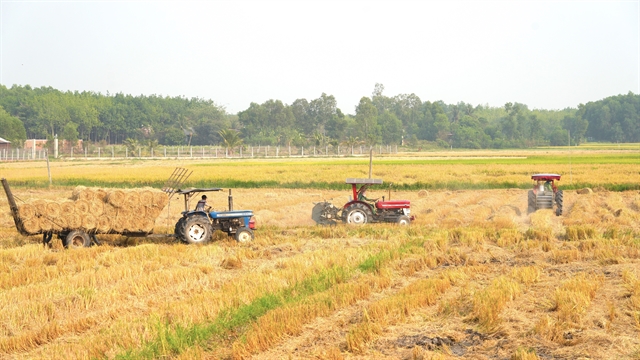 |
| Farmers apply machinery in harvesting rice in Tây Ninh Province. — VNA/VNS Photo Minh Phú |
Tây Ninh — Many farmers in the southern province of Tây Ninh, located to the northwest of Hồ Chí Minh City have applied high technology and shifted to green production, developing high efficiency farming models.
Nguyễn Văn Sáu in Phước Chỉ Commune has converted 10ha of a low-yield alum-contaminated rice field into growing Queen pineapples since 2010.
Despite initial difficulties due to a lack of experience and flooding, his farming model achieved great success thanks to a flood-control dyke system and Vietnamese good agricultural practices (VietGAP) standards.
Currently, with 60ha of pineapples combined with fish farming, his family earns an annual profit of over VNĐ3.7 billion (US$141,000).
Sáu’s farming model ensures environmental protection by using agricultural chemicals as recommended. He also creates jobs for 42 workers and helps 25 households escape poverty.
He has also actively contributed to repairing dozens of kilometres of rural roads, assisting households in remote areas to access electricity, building houses for needy households, and supporting funds for poor and disadvantaged students.
He contributed more than VNĐ1.3 billion ($49,400) to social welfare activities from 2017 to 2024.
In the aquaculture sector, Võ Thanh Liêm, born in 1983 and from Hưng Thuận Commune, has succeeded with a model of raising cá lăng đuôi đỏ (Hemibagrus microphthalmus) in a 8,000sq.m alum-affected farming area.
Since 2019, he has sold to the market more than 80 million fry, 1.8 million fingerlings, and 3-5 tonnes of commercial fish annually, earning a profit of over VNĐ3.5 billion ($133,000) per year.
He is currently expanding the farming area to 7.3ha, applying a circular farming model that combines the cultivation of fish, tubifex worms, and aquatic vegetables to reduce emissions.
Accounting for approximately 60 per cent of the population, farmers in the province work hard and try new ideas and their lives are getting better. The emulation movement called "Farmers compete in good production and business" has spread extensively, and this has contributed to a sharp decline in the poverty rate in rural areas.
Ngô Thanh Tuyền, deputy chairman of the provincial Farmers Association, said: “Stories like those of Nguyễn Văn Sáu and Võ Thanh Liêm are not only vivid evidence of the will to rise and get rich legitimately, but also play a particularly important role in the emulation movement and in building new-style rural areas.”
The province has promoted the transfer of science and technology through training classes to tens of thousands of farmers.
It has also supported the development of 48 high-tech farming models, such as the model of growing honey-dew melon in net houses with an Israeli drip irrigation method, and raising snakehead fish in canvas-lined floating tanks.
It has strengthened the inspection and supervision of farming area codes and packing facility codes to meet demanding international standards in recent years.
Therefore, the province’s agricultural products have successfully entered major markets such as Japan, South Korea, the EU, the US, and China.
Creative farming models
In recent years, alongside the strong transformation of Tây Ninh’s agricultural sector, Phước Lý Commune has seen clear changes from the movement of restructuring crop and livestock cultivation, and the application of science and technology in production.
The commune has developed many creative and effective farming models that create momentum for local people to improve their livelihoods.
Among them, the clean jujube growing model combined with tourism services run by Lưu Hoàng Phúc in Long Hưng Hamlet is considered a standout example.
Phúc has pioneered the switch from vegetables to growing green-skinned jujube in net houses. Using organic fertilisers and biological products, his jujube orchard not only produces quality fruit but has also become a unique experiential sightseeing spot.
“The number of visitors ranges from 100 to 300 guests on Saturdays and Sundays on average. Most come here to visit and experience things like checking in at the orchard. In the coming time, I will continue to replicate the model for many other business households to develop the local brand together,” he said.
Trần Văn Xuân, chairman of the Phước Lý Commune Farmers’ Association, said: “The commune has strongly implemented a movement to support farmer members in start-ups and innovation in production.”
From this movement, many good models and new approaches have emerged, and Phúc’s farming model stands out, he said.
This is the first model in the area to apply the technique of growing jujube in net houses combined with opening the door for visitors to experience the orchard, he said.
Besides being active in production, Phúc also effectively utilises social networks to promote products and create connections with consumers, he said.
This is a very positive signal for the creative startup movement of farmers in the commune, he added. — VNS
Society
 Society
 Society
 Society
 Society
 Society
 Society
 Society
 Society
 Society
 Society
 Society
 Society
 Society
 Society