 Society
Cần Thơ Hospital and Family Medical Practice partner to strengthen pre-hospital emergency care
1.
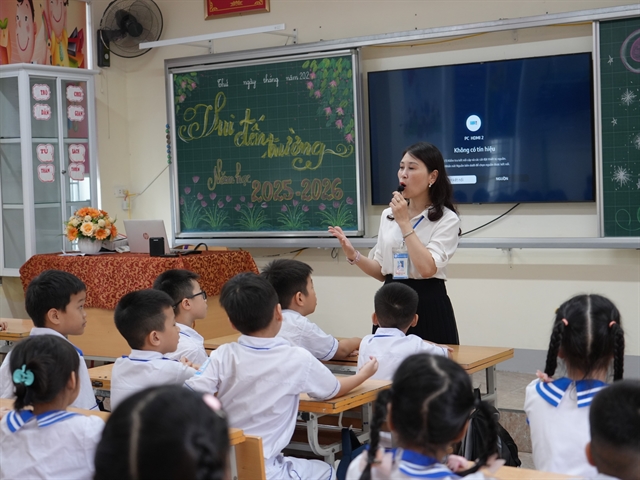 |
| A teacher and her students at a primary school in Nghệ An Province. — VNA/VNS Photo Bích Huệ |
HÀ NỘI — From the 2026–27 school year, Việt Nam will move to a single, uniform set of textbooks for general education nationwide, a shift the Ministry of Education and Training (MoET) says will cut costs, improve equity and bring greater stability to classrooms from grade 1 to grade 12.
The decision has swiftly won broad support from schools, teachers and parents. Beyond easing the financial burden of buying new books, it is seen as ensuring equal access to knowledge, allowing pupils across the country to study the same coherent content throughout their schooling.
In many localities, schools welcomed the announcement as soon as it was formalised in MoET’s Decision No.3588/QĐ-BGDĐT.
Huỳnh Thị Hòa Bình, headteacher of Lạng Giang High School No.1 in Bắc Ninh Province, said: “Using a single set of textbooks makes it easier for the school to organise teaching, assessment and evaluation, while also helping to cut waste for families.”
She noted that choosing textbooks had previously been time-consuming and resource-intensive. Schools had to form specialist groups, assign teachers to research and attend training, and compare different sets to figure out their teaching methods and the way to deliver content.
Keeping the same set already in use will allow teachers and pupils to build on their familiarity with lesson structures and approaches, fostering stability and confidence in teaching and learning.
From a parent’s perspective, Nguyễn Việt Hà, whose child is an eighth grader at Ngô Sỹ Liên Junior Secondary School in Hà Nội, said standardisation would make it easier for families to find supporting materials and digital resources.
“When learning content is standardised nationwide, parents can easily source materials and digital resources to support their children without worrying about different sets,” she said.
“For children of workers or families who frequently relocate, a uniform set ensures they quickly catch up without knowledge gaps. It also allows reusing books, further reducing family costs.”
According to the MoET, the choice of a single nationwide textbook set was guided by principles aligned with the General Education Programme 2018. These include scientific, pedagogical and legal quality, continuity, reduced reform burdens, budget savings and minimal disruption for teachers, pupils and society.
The move is consistent with the Politburo’s Resolution No.71-NQ/TW dated August 22 last year on breakthroughs in education and training development and the Government’s Resolution No.281/NQ-CP issued on September 15 last year.
After reviewing existing textbook sets against the selection criteria, the MoET concluded that the “Kết nối tri thức với cuộc sống” (Connecting knowledge to life) series best met and exceeded requirements.
The set offers complete, synchronised coverage of all subjects and educational activities across primary, lower secondary and upper secondary levels. Its scientific and pedagogical quality is demonstrated by its adoption in 34 provinces and cities and by having the largest pupil enrolment among current textbook sets.
Associate Professor Nguyễn Văn Tùng, a member of the board of the Việt Nam Education Publishing House, said preparations were already under way.
“Immediately after the decision was issued, the entire Việt Nam Education Publishing House system shifted to urgent mode, revising content in some books adjusted by the programme, preparing bidding plans for printing, developing teacher training schemes and organising nationwide textbook supply,” he said.
The publishing house has committed to optimising production processes and cutting costs to further reduce textbook prices from the 2026–27 school year. It will also accelerate the development of digital learning resources using information technology and artificial intelligence (AI).
To ensure effective use, the MoET said it has instructed and will continue to organise training and professional development courses to help teachers adapt quickly to a single textbook set. Training will focus on methods, assessment, digital resource use and flexible, effective application of textbooks, with the aim of avoiding rote, book-bound teaching.
Using one uniform set does not mean rigid or formulaic instruction, the ministry stressed. The General Education Programme remains the mandate, with textbooks serving as core learning materials while teachers decide how lessons are organised.
Other approved sets, such as Cánh diều and Chân trời sáng tạo, may still be used by localities and schools as reference and supplementary materials to support innovation in teaching and teacher training, helping to avoid waste of social resources.
When used nationwide, the Kết nối tri thức với cuộc sống set will not be closed. It will be reviewed, updated and revised when genuinely necessary in line with legal regulations and educational realities.
The MoET also affirmed that a uniform textbook set will not change current examination, assessment or testing principles. Assessment will continue to be based on the programme’s attainment targets, not on the specific textbooks used by pupils.
Deputy Minister Phạm Ngọc Thưởng said the ministry is focusing on four key task groups to ensure effective implementation from the 2026–27 school year: ensuring textbook quality and teacher capacity, organising efficient and cost-saving distribution, advancing textbook digitisation and shared digital learning ecosystems, and strengthening communication to build social consensus.
This includes reviewing, evaluating and, if needed, refining the Kết nối tri thức với cuộc sống set to ensure it meets nationwide scientific and pedagogical standards. The MoET will also work with localities to adjust budget structures, shifting from support for multiple sets to direct aid for pupils, with the goal of providing free textbooks by 2030.
Centralised printing and distribution through legal bidding will be used to further lower prices and ensure equitable access for all pupils, the ministry said. — VNS
Society
 Society
 Society
 Society
 Society
 Society
 Society
 Society
 Society
 Society
 Society
 Society
 Society
 Society
 Society