 Society

AIMCONNECT 2026 Held in Singapore, Bringing Global Automotive Leaders Together to Explore the Future of AI, Trust and Connected Mobility
1.
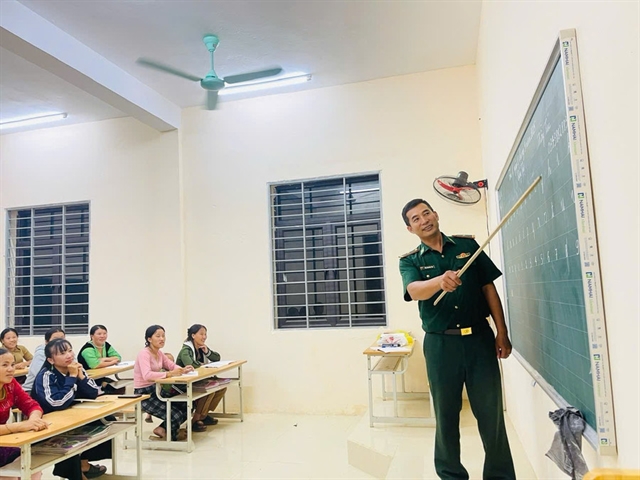 |
| Major Đào Nguyên Túc teaching Mông ethnic people. Photo giaoducthoidai.vn |
THANH HOÁ — A literacy class in a remote ethnic hamlet of Thanh Hoá Province organised by soldiers of the Tam Chung Border Guard Station has awakened the desire to escape poverty of the Mông ethnic people.
The class in Ón Hamlet, Tam Chung Commune, was held three days a week in September for students aged 30-60 and taught by Major Đào Nguyên Túc.
Uneasy journey
Thào Thị Tông, 50, is still determined to go to class after hours of hard work in the fields.
Years of hardship have made her calloused hands more accustomed to hoes and shovels than pens and ink.
The shame of not being able to write her own name pushed her to go to school.
For 26-year-old Sùng Thị Náng, the deeper motivation was the pain of being unable to help her children with their homework.
In the first days of class, her hands trembled as she tried to write. Yet she reminded herself to stay determined
“I am very glad to learn how to write and read. Now I feel more confident,” Náng told giaoducthoidai.vn.
On the first day of class, elderly students like Tông and the younger ones like Náng, struggled for hours to write their full names.
Now, the thing that the people of Ón Hamlet are most happy about when coming to class is that they can write their names and calculate simple calculations.
“At first, the people were very hesitant. They said learning was very difficult and they are too old to learn,” said Major Túc.
“We had to go to each household and encourage them to participate in the class.”
"After two months, they could write simple words. This was a good sign that created a premise to approach socio-economic development policies.”
Ón Hamlet’s Head Giàng A Chống said that since the literacy classes opened, the hamlet has seen positive changes.
“Once they can read and write, the people can do administrative procedures like birth registration and health declaration themselves instead of asking the commune officials to do as before,” said A Chống.
Not only teaching, but the soldiers also incorporate legal education, guiding the villagers on how to identify drug-related crimes, protect forests and safeguard border markers.
The class has 27 students and is full every evening.
“During breaks, we ask the officers how to identify suspicious people and learn about common tricks in online scams. So going to class is really fun,” Tông said.
Protecting the land and its people
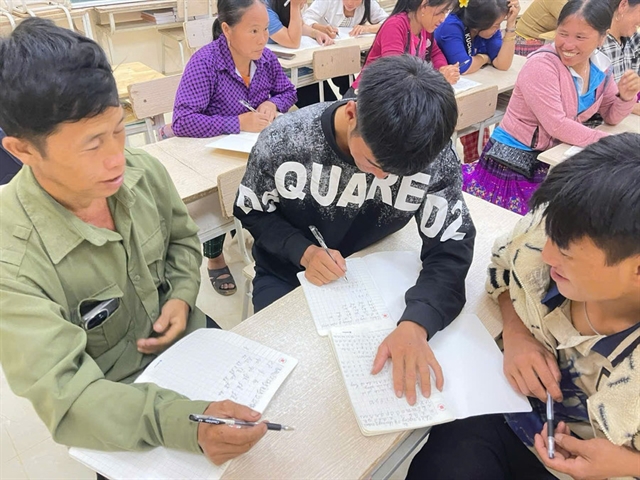 |
| Mông ethnic people learning how to read and write. Photo giaoducthoidai.vn |
For Mông ethnic villagers in the vast border mountains, literacy is not only a gateway to knowledge but also a source of trust that strengthens the symbolic 'letter markers' protecting the Fatherland.
Thanks to these literacy classes, the bond between soldiers and civilians has become stronger. Officers can more easily disseminate legal knowledge, while villagers help maintain security and order and participate in safeguarding border markers.
Túc understands that illiteracy has long perpetuated poverty in the area.
“Never before has teaching literacy become such a real ‘battle’, Túc said.
"The harsh weather, rugged terrain, elderly learners and limited proficiency in the national language yet everyone is eager to learn how to read and write.”
That eagerness is the greatest motivation for Túc to go to class each night to teach. He knows that the duty of a border guard soldier is not only to protect every sacred inch of the country but also to support the people, helping nurture the flame of learning. When people are literate, they build the foundation for a stronger border region.
“Fighting illiteracy is also fighting backwardness," Túc added.
"When people understand, when they can read and write, our borders become stronger. Teaching literacy is a way to build a firm people’s defence posture.”
Thanks to the annual literacy classes, many parents in the village now proactively send their children to school at the proper age, and the situation of children leaving school to work on slash-and-burn fields has largely disappeared.
Looking at faces of all ages gathering each night quietly to learn, its easy to see that a light is gradually illuminating every household and every face in this border region. That light does not only shines on the pages of textbooks but also brightens the path of knowledge, opening new hope for villages along the country’s frontier.
For soldiers like Túc, their mission not only extends beyond safeguarding the border but also lifts up disadvantaged lives.
From these modest night classes, a 'border of the heart' is being built - steadfast and enduring - just like the soldiers who silently remain in the villages, standing by the people day and night. VNS
Society
 Society
 Society
 Society
 Society
 Society
 Society
 Society
 Society
 Society
 Society
 Society
 Society
 Society
 Society