 Society

Top Vietnamese leader highlights new horizon for Việt Nam–Denmark cooperation
1.
|
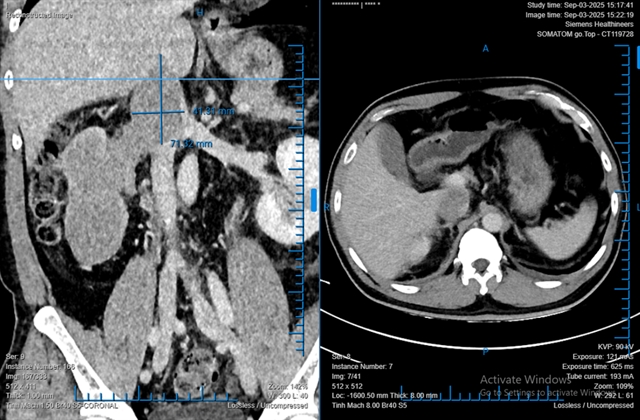
| Bình Dân Hospital’s CT scan image shows renal cell carcinoma with an extensive tumour thrombus in patient T.D.L. — Photo courtesy of the hospital |
HCM CITY — Doctors at Bình Dân Hospital in HCM City have successfully carried out a fully robot-assisted operation to remove a large kidney tumour accompanied by an extensive tumour thrombus extending 76mm into the inferior vena cava, marking a major breakthrough in the treatment of advanced renal cell carcinoma (RCC) in Việt Nam.
This is the largest tumour thrombus ever removed entirely by robotic surgery in the country, without the need for combined open surgery, as was previously required in similar cases.
The patient, identified as T.D.L., a 48-year-old man from Quảng Trị Province, was diagnosed during a routine health check-up.
Imaging revealed a tumour occupying nearly the entire right kidney, measuring 68 x 86 x 138mm, with a tumour thrombus extending into the renal vein and inferior vena cava.
Doctors warned that without timely intervention, the patient’s life expectancy could have been limited to just a few months.
The eight-hour operation involved four specialised teams in urology, hepatobiliary surgery, cardiovascular surgery and anaesthesiology.
Surgeons mobilised the liver, exposed the retrohepatic inferior vena cava and removed the entire kidney along with the tumour thrombus, all performed using robotic surgery.
Dr Phạm Phú Phát, head of the Urology A Department at Bình Dân Hospital, said the surgery benefited from the precision and flexibility of robotic technology.
“This is the largest RCC tumour thrombus I have treated. With robotic surgery and close multidisciplinary coordination, we were able to remove the tumour completely without open surgery,” he said.
Blood loss during the procedure was limited to 600ml, and no transfusion was required. The inferior vena cava was preserved.
The patient recovered well and was discharged 10 days after surgery. He will continue regular follow-ups to monitor kidney function and the risk of recurrence or metastasis.
Reflecting on his experience, L. said the operation was life-changing for him and his family. As the main breadwinner, he stressed the importance of early detection and timely treatment.

|
| Bình Dân Hospital doctor provides post-operative guidance to patient T.D.L. following his robot-assisted kidney cancer surgery. — Photo courtesy of the hospital |
Dr Phát said early-stage RCC can often be detected through ultrasound when tumours are small and treatment outcomes are far more favourable.
"However, the disease frequently progresses silently with few symptoms in its early stages."
RCC is the sixth most common cancer in men and the tenth in women globally.
A 2022 report estimated nearly 435,000 new cases and more than 155,000 related deaths worldwide.
Tumour thrombus formation in the renal vein or inferior vena cava occurs in about 4-10 per cent of RCC patients and is associated with a high risk of complications and mortality if left untreated.
According to international treatment guidelines, surgery remains the first-line treatment for RCC with venous tumour thrombus.
However, the procedure is technically demanding and requires a multidisciplinary approach, particularly when the thrombus extends deeply into major blood vessels.
Bình Dân Hospital was the first medical facility in the country to introduce robotic surgery for adults in 2016.
Since 2021, robot-assisted radical nephrectomy combined with tumour thrombus removal has been performed at the hospital, with seven cases completed successfully to date.
The successful application of fully robotic surgery in this complex case represents a significant advancement in the management of advanced kidney cancer in Việt Nam, offering new hope for patients with high-risk disease. — VNS
Society
 Society
 Society
 Society
 Society
 Society
 Society
 Society
 Society
 Society
 Society
 Society
 Society
 Society
 Society