 Society

AIMCONNECT 2026 Held in Singapore, Bringing Global Automotive Leaders Together to Explore the Future of AI, Trust and Connected Mobility
1.
|
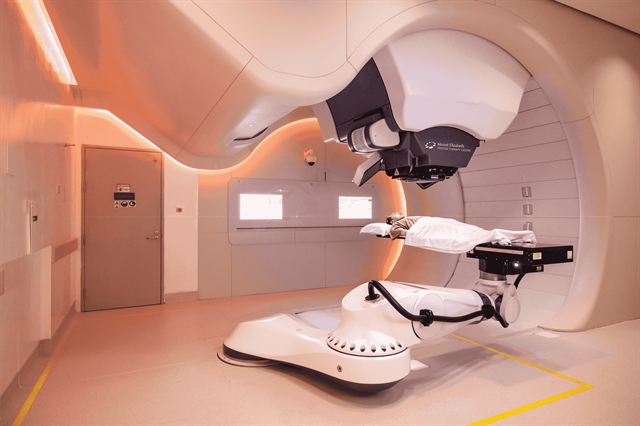
| A proton machine in a hospital in Singapore. Proton beam therapy provides more options for cancer patients. — Photo courtesy of IHH Healthcare Singapore |
HCM CITY — When meeting 12-year-old Bảo Ngọc, a strong and happy girl in HCM City, no one would have guessed that she had just bravely battled cancer.
In a heart-wrenching turn of events, Ngọc learned that her cancer had returned, causing her world to shrink, burdened with uncertainty that no child should ever have to endure.
Having previously undergone treatment in Việt Nam for cervical neuroblastoma, a rare pediatric cancer, the resurgence of the tumor near critical areas such as the carotid artery, trachea, and essential nerves presented her family with a daunting new reality.
Ngọc was flown to Mount Elizabeth Novena Hospital in Singapore, a part of the IHH Healthcare Singapore (IHH SG) network, where she not only found a new medical solution but also a renewed sense of hope. Her treatment involved proton therapy, an advanced form of radiation therapy known for its precise targeting of tumors.
Undergoing 18 sessions of proton therapy over two months, Ngọc's treatment experience was unexpectedly gentle, allowing her to maintain her daily activities with minimal side effects. Now back at home, she has resumed her studies, reconnected with classmates, and is gradually rediscovering the simple joys of childhood.
Ngọc's recovery serves as a testament to the transformative potential of proton therapy in offering hope to cancer patients.
Unlike conventional X-ray radiation that passes through the body, proton beams halt precisely at the tumor site, making a crucial difference for pediatric patients whose organs are still developing.
Fu Jin Feng, head of Radiation Oncology at IHH SG, proton therapy allows doctors to treat aggressive tumors while reducing both short-term and long-term harm to surrounding healthy tissue.
“For children like Ngoc, precision is everything,” he explained. “We aim not only to eliminate the cancer but also to protect their future quality of life.”

|
| Fu Jin Feng, head of Radiation Oncology at IHH SG shares the information about proton therapy at a meeting in HCM City. — Photo Courtesy of IHH SG |
The scarcity of clinical proton facilities worldwide highlights the significance of advancements in cancer radiation therapy such as proton therapy in improving treatment outcomes and enhancing patient well-being.
However, there is a limited number of clinical proton facilities in the world. In detail, there are 46 facilities in North America; 32 in EU and 38 in Asia.
In Việt Nam over the past decade, significant advancements in cancer radiation therapy have enabled the implementation of various advanced radiation therapy techniques with promising outcomes. Despite these advancements, the progress in cancer radiation therapy, including proton therapy, continues to evolve.
In recent years, Việt Nam's Ministry of Health has held numerous meetings with relevant units to assess the progress in developing proton therapy centres in the country. The project for establishing proton therapy centres is set to commence preparations in 2025 and aims for completion between 2026 and 2030.
In detail, the Ministry of Health has tasked units with implementing the project to construct proton therapy centres at three major hospitals in the North, Central, and South regions of Việt Nam, namely Hospital K, Chợ Rẫy Hospital, and Huế Central General Hospital.
Additionally, health authorities are addressing issues related to treatment indications, health insurance payments, and particularly emphasising the need to clarify the socio-economic efficiency of the project. This initiative aims not only to enhance the capacity and quality of cancer treatment in Việt Nam but also to alleviate the economic burden on patients seeking treatment abroad.
For now, proton therapy in Singapore gives Vietnamese patients an alternative treatment option.
Sherrie Lim, CEO of Mount Elizabeth Novena Hospital, said: “Technology guides our precision, but compassion guides our purpose. We walk with patients and their families through every step, medically, emotionally, and practically. That is how healing truly happens, and we truly want to care for good.”
In addition, IHH Healthcare Singapore continues to serve as a regional leader in advanced oncology care, combining clinical excellence with technologies such as proton therapy, robotic-assisted surgery, and AI-enabled diagnostics. Patients from Việt Nam and across Southeast Asia benefit from comprehensive treatment pathways that include pre-treatment planning, multidisciplinary evaluations, personalised therapy, and post-treatment follow-ups. — VNS
Society
 Society
 Society
 Society
 Society
 Society
 Society
 Society
 Society
 Society
 Society
 Society
 Society
 Society
 Society