 Society

AIMCONNECT 2026 Held in Singapore, Bringing Global Automotive Leaders Together to Explore the Future of AI, Trust and Connected Mobility
1.
|
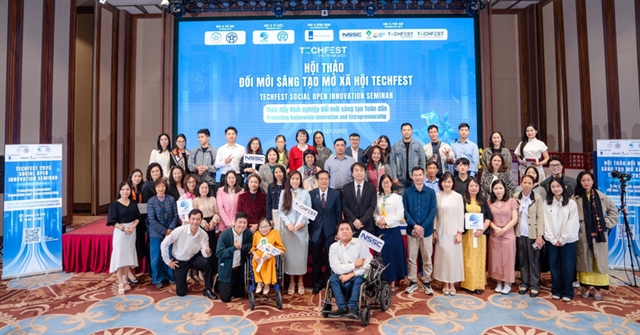
| Participants at workshop "Social Open Innovation – Advancing Innovation and Entrepreneurship for All” on December 12, 2025 in Hà Nội. — VNA/VNS Photo |
HÀ NỘI — The National Agency for Technology Entrepreneurship and Commercialisation Development (NATEC) and the National Startup Support Centre (NSSC) on Friday held a workshop in Hà Nội, titled "Social Open Innovation – Advancing Innovation and Entrepreneurship for All".
In his opening remarks, Phạm Hồng Quất, director general of NATEC, emphasised that open innovation is now a central pillar of Việt Nam’s development strategy. He said the country’s innovation ecosystem is strongest when it draws on collective engagement and community support.
Quất said Việt Nam is confronting structural constraints ranging from the middle-income trap and demographic ageing to environmental pressures and the growing burden on major urban areas. In this context, the formation of the Social Open Innovation Community within TECHFEST 2025 is expected to accelerate the adoption of new technologies and generate practical socio-economic value for communities nationwide.
Dutch Ambassador Kees van Baar highlighted social open innovation as an important bridge between economic progress and community wellbeing. He commended Việt Nam for driving nationwide innovation and digital transformation, describing these efforts as essential to meaningful development in the digital age. Referencing Resolution 57-NQ/TW on breakthroughs in science, technology, innovation and national digital transformation, he stressed that technology must remain human-centred, with a focus on ensuring equal digital access for youth, women and vulnerable groups.
According to Nguyễn Phương Linh, executive director of the Management and Sustainable Development Institute (MSD – United Way Việt Nam), the country must consolidate five pillars for a resilient and sustainable innovation ecosystem: innovation, openness, connectivity, inclusion and lift-off. She noted that social open innovation has become a global trend because it offers a structured, collaborative way to address complex challenges such as inequality, climate change and rapid urbanisation.
Sun Sukkun, director of Shinhan Square Bridge under the Shinhan Financial Group Hope Foundation, outlined the social open innovation model used by Shinhan in Korea and expanded to Việt Nam in 2021. He underscored that effective communication is essential when startups collaborate with large companies, with mentors serving as intermediaries who help navigate expectations and overcome barriers. He added that social open innovation produces both economic and social returns, aligning with ESG objectives and broader impact priorities.
At the workshop, MSD – United Way Việt Nam officially introduced the Social Open Innovation for All Resilience (SOAR) model for assessing and measuring social impact. SOAR is structured around four pillars. The first focuses on sustainable business models that integrate social and environmental impact with commercial viability and embed ESG principles into startup development.
The second centres on community co-creation, applying co-design and co-implementation methods and using Community-Generated Data to ensure solutions reflect real needs.
The third promotes win-win-win open innovation, linking the challenges faced by enterprises, investors, social organisations and communities with appropriate innovative solutions.
The fourth pillar establishes transparent systems for assessing social impact, monitoring ESG indicators and tracking broader systemic change.
The event brought together representatives from government agencies, embassies, international organisations, enterprises, universities, research institutes, startups, investors and social organisations. Their broad participation reflected a shared recognition that sustainable innovation requires cooperation across sectors, as well as a willingness to exchange expertise and resources to build an open and inclusive innovation ecosystem. — VNS
Society
 Society
 Society
 Society
 Society
 Society
 Society
 Society
 Society
 Society
 Society
 Society
 Society
 Society
 Society