 Society
HCM City addresses manufacturing, land hurdles for Q4 growth push
1.
 |
| Harvested grape clusters at the 'Ông Ngoại Chớp' vineyard in Đan Phượng Commune, Hà Nội. Photos courtesy of Ông Ngoại Chớp and Tuệ Viên Organic Farm. |
Khánh Linh
HÀ NỘI — Facing rapid urbanisation and a shrinking agricultural land base, Hà Nội is redefining its approach to agriculture.
Moving away from purely high-output farming, the capital city is embracing multi-value agriculture, closely integrated with urban planning, eco-tourism and environmental protection, aiming for a sustainable, green agricultural model that reflects Hà Nội’s unique identity.
Today, agriculture in Hà Nội is not just about producing food. It also provides green spaces, tourist attractions, experiential learning, and a living showcase of the city’s cultural heritage.
This innovative approach demonstrates that even amid a bustling urban centre, agriculture can thrive, remain productive and help shape a distinct identity: a green, clean, and vibrant capital.
Small in size, big in value
Nguyễn Hữu Vinh, a farmer in Đan Phượng Commune, is pruning the vines in his 1,000 square metres of Hạ Đen grape garden. Vinh, owner of the 'Ông Ngoại Chớp' vineyard, recently completed his second grape harvest of the year.
Due to complex weather patterns, he harvested only 300kg of grapes, earning VNĐ45 million (US1,710), compared to 1 tonne in previous seasons, which brought in VNĐ150 million ($5,702).
 |
| The Hạ Đen grape vineyard in Đan Phượng Commune has become an eco-tourism destination for many Hà Nội residents. |
Last month, Vinh’s vineyard attracted numerous visitors who came to take photos as well as buy grapes. Beyond cultivation, he also offers eco-tourism experiences for guests.
His vineyard, along with others in Đan Phượng, has become a popular weekend destination for Hà Nội residents.
“The dual income from green farming and tourism provides a more stable revenue for my family,” Vinh said.
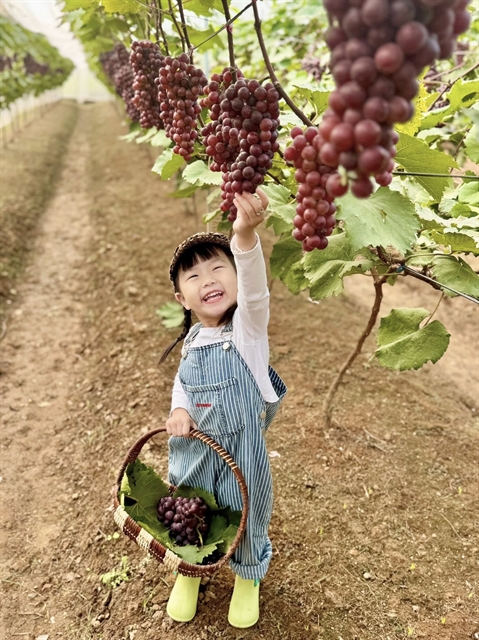 |
| Open vineyards welcoming visitors, generating dual income for local farmers in the commune. |
Combining grape cultivation with visitor experiences creates a 'double benefit' for local farmers. It ensures a reliable market as visitors purchase directly from the farm, reducing transportation costs and labour.
This model also leverages social media to promote produce, enhance visual appeal, and boost eco-tourism.
“When the grapes start ripen, I post the updates on social media groups, and interested visitors would come automatically," Vinh said.
"They like buying directly from the vineyard, and seeing how the grapes are grown and cared for. This gives them reassurance about the quality of the product.”
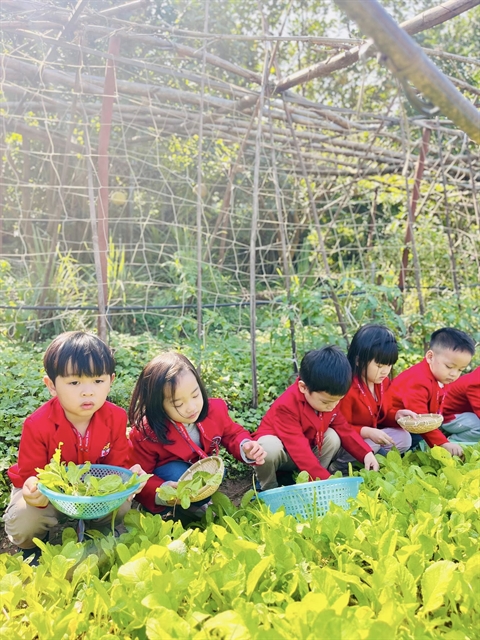 |
| Children learn how to grow green vegetables at Tuệ Viên Organic Farm in Long Biên Ward. |
In Long Biên Ward, Tuệ Viên Organic Farm exemplifies the trend of 'agriculture combined with experiential tourism'. Covering over two hectares, the farm uses closed-loop organic cultivation, creating a balanced ecosystem, fertile soil and significantly lower pest levels.
Nguyễn Thanh Phương, the farm’s business manager, said: “As urban demand for green living grows, we offer hands-on experiences. Each month, dozens of school groups and families visit to learn how to plant and harvest vegetables.”
Visitors not only participate in harvesting but also gain a first-hand insight into planting techniques, care for new plant varieties and the value of clean produce and the effort behind it.
In addition to supplying approximately five tonnes of organic vegetables per month to Hà Nội’s markets, Tuệ Viên serves as a research site for students and international organisations. Recently, its 'I am Herbs' project launched a line of herbal-based personal care and cleaning products, expanding the ecological value of organic farming.
Hà Nội’s Deputy Director of Agriculture and Rural Development Tạ Văn Tường said the city has shifted from traditional farming to green, circular agriculture, catering to consumers who demand safety and traceability.
Today, Hà Nội hosts 406 high-tech agricultural models, contributing around 40 per cent of the city’s total agricultural output.
Multi-value agriculture
With rising demand for clean food and the growth of eco-tourism, combining agriculture with tourism has become a key strength. Farm visits, hands-on farming experiences and local food tasting create a circular value chain of 'planting-harvesting-experiencing' for visitors.
However, developing circular agriculture in Hà Nội faces challenges, namely small-scale production, limited waste treatment technology, high costs and insufficient incentives to attract businesses.
 |
| Visitors experience planting and caring of new crops, gaining an insight into the value of organic produce. |
Vice Chairman of Hà Nội’s People’s Committee Nguyễn Mạnh Quyền emphasised that the city aims to develop agriculture as a 'high-quality living space', integrating landscape, ecology and green experiences to shape the capital’s sustainable lifestyle.
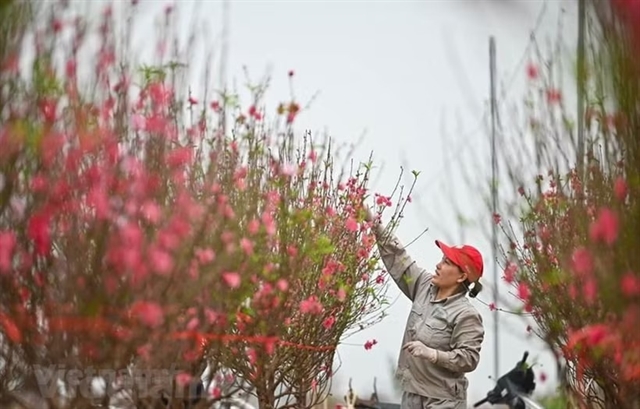
Under new planning, Hà Nội will establish seven specialty rice-growing zones (each 200 to 500 hectares) for research and high-quality seed development. Less productive rice areas will be converted to fruit trees, flowers, ornamental plants and urban greenery.
To promote investment and cooperation in urban eco-agriculture, the Hà Nội Center for Investment Promotion and Enterprise Support (SCE) teamed up with the Việt Nam Organic Agriculture Association to host a forum on sustainable agriculture.
SCE Director Ngô Minh Toàn stressed that green transition, eco-organic agriculture and technological applications are strategic priorities, with collaboration among government, scientists, businesses and farmers driving sustainable agricultural development.
Phạm Thi Hạnh Thơ, Deputy Director of the Centre for Agricultural Systems Research and Development, noted that combining agriculture with eco-tourism and culinary culture is a sustainable approach, particularly for smallholder farmers. Visitors can actively participate in planting and harvesting while learning about local culture, creating stable income opportunities and nature experiences for communities.
Still, the challenge is scaling these models sustainably and ensuring they truly spread beyond pilot projects.
Mai Văn Trịnh, Director of the Institute of Agricultural Environment, points out that Hà Nội lacks spaces for residents, especially children, to engage with nature and hands-on farming.
Some households have redesigned their entire farms as open experiential tourism sites, allowing people to participate directly in planting, caring, and harvesting, fostering appreciation for agriculture and the environment.
With a firm commitment to green, ecological, circular agriculture and collaboration among businesses, scientists, and farmers, Hà Nội is shaping a multi-value urban agricultural ecosystem: modern yet close to nature, small in scale but rich in value, contributing to a green, clean and liveable capital. — VNS
Society
 Society
 Society
 Society
 Society
 Society
 Society
 Society
 Society
 Society
 Society
 Society
 Society
 Society
 Society