 Society

ZOOD Real Estate launches Élevée, a $667 million project in north Riyadh
1.

|
| Experts stress that investing in children is both a social duty and a key strategy for Việt Nam’s long-term sustainable development. — Photos vietnamplus.vn |
HÀ NỘI — As Việt Nam prepares its socio-economic development plan for 2026–30, experts are urging policymakers to give far greater attention to the needs of children, warning that climate change is creating new risks and exposing long-standing inequalities.
Việt Nam is pushing ahead with its ambition of becoming a modern, high-income industrialised nation by 2045. Yet with global instability rising and climate impacts intensifying, specialists argue that the next five-year plan must go beyond growth figures and ensure vulnerable groups, particularly children, are properly protected.
These concerns were raised at a workshop held on Thursday by the Academy of Policy and Development in collaboration with UNICEF Việt Nam, which brought together policymakers, researchers and development partners to discuss how to make future planning more climate-responsive and inclusive.
Rising risks for children
Experts at the event stressed that child-focused investment is essential for long-term national resilience.
Associate Professor Dr Trần Trọng Nguyên, Director of the Academy of Policy and Development, said the discussions are timely as Việt Nam designs new strategies linked to the fourteenth National Party Congress, including reforms in education and healthcare. He called for child protection, education, nutrition and social welfare to be embedded more firmly in the country’s development planning.
UNICEF Việt Nam’s Deputy Representative, Michaela Bauer, noted that children are among those most affected by climate change, yet their needs often remain overlooked. She said deeper cooperation is needed to ensure development policies genuinely work for children.
Evidence presented at the workshop showed how uneven the impacts have become. Children under five carry 88 per cent of the global climate-related disease burden.
In Việt Nam, one in five adolescents faces mental health challenges, while violence, early labour, abuse and child marriage continue to be reported. Only 1.4 per cent of children currently benefit from cash assistance through the social protection system.
|
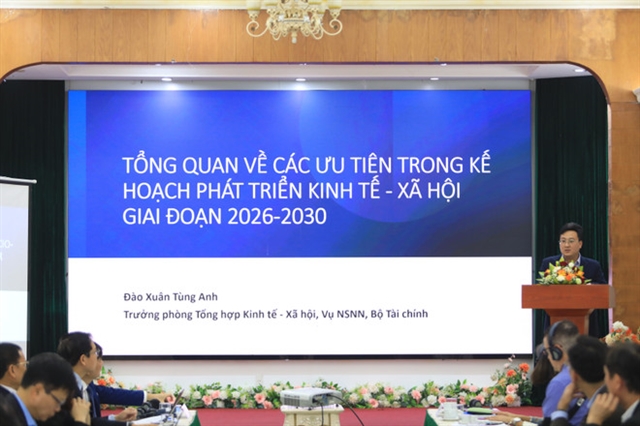
| Đào Xuân Tùng Anh of the State Budget Department under the Ministry of Finance, speaks at the meeting. |
Đào Xuân Tùng Anh of the State Budget Department under the Ministry of Finance, outlined Việt Nam’s draft 2026-30 plan, which targets average GDP growth of at least 10 per cent and GDP per capita of around US$8,500 by 2030.
But he also warned of mounting pressures, including global volatility, technological lag risks, an ageing population and more frequent natural disasters and disease outbreaks.
Experts argued that protecting children effectively will require clearer mechanisms and stronger resources.
Dr Nguyễn Thế Hùng, Deputy Director of the Academy of Policy and Development, said child-related public spending is currently scattered and inadequately tracked, leading to resource gaps in disadvantaged regions.
He proposed that the Politburo adopt a National Strategy on Children to 2045, providing a unified framework to guide ministries and provinces. Additional recommendations included developing indicators for monitoring child-related public spending, directing more investment to child-sensitive disaster risk reduction projects, and delivering key education and healthcare reforms aligned with Politburo Resolutions 71 and 72.
Bridging the gap between policy and practice
Research presented by Dr Nguyễn Quỳnh Hoa of the National Economics University, focusing on Cần Thơ and Cà Mau, revealed that while national strategies emphasise inclusivity, provincial plans often lack specific targets and dedicated budgets for vulnerable groups. The participation of children and women remains largely symbolic, she noted, resulting in a mismatch between policy commitments and on-the-ground outcomes.
To address this, she recommended aligning local development plans more closely with national climate policies, turning broad pledges into concrete, funded programmes. Strengthening meaningful consultation mechanisms would also allow community voices to influence decisions more effectively.
Dr Hoa said development partners should continue supporting provincial pilots and scaling up inclusive models such as green schools, mangrove-based livelihood initiatives and climate-resilient housing. Innovative financing, including blended finance, climate bonds and improved access to international funds, will also be key. — VNS
Society
 Society
 Society
 Society
 Society
 Society
 Society
 Society
 Society
 Society
 Society
 Society
 Society
 Society