 World
World

Singaporeans Feeling the Pressure: Cost Concerns Rise as Household Optimism and Government Ratings Weaken - Blackbox Research Study
1.
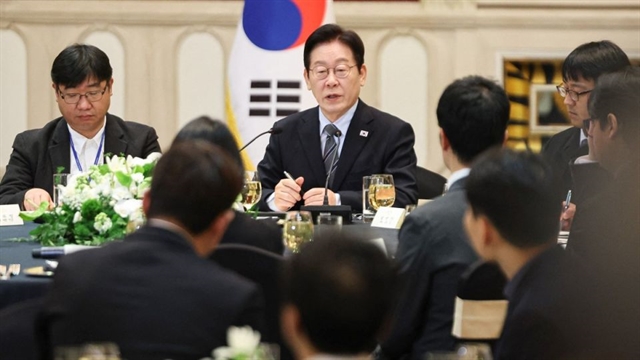 |
| South Korea's President Lee Jae Myung (C) speaks to journalists at a hotel in Shanghai on January 7, 2026, as he wrapped up his visit to China. — YONHAP/AFP Photo |
SEOUL — South Korean President Lee Jae Myung said Wednesday that he has asked China to help convey Seoul’s “genuine intent” on denuclearizing the Korean Peninsula to North Korea, emphasising Beijing’s potential role as intermediary.
“North Korea and (South Korea) are in a situation where all routes are blocked, and the trust level is at zero,” Lee told a group of Korean reporters in Shanghai following his Monday summit with Chinese President Xi Jinping. “In that context, I proposed to President Xi that it would be helpful if China could act as a mediator for peace on the Korean Peninsula.”
Lee confirmed that the request was made during extensive discussions in Beijing focused on regional stability and ways to ease enduring tensions over North Korea’s nuclear and missile programmes.
Lee reiterated South Korea’s commitment to a phased approach to denuclearisation.
“We believe the first step should be halting additional nuclear material production and then moving toward reductions step by step,” Lee said. “Our ultimate goal is a nuclear-free Korean Peninsula. This is not a policy for political show, but a sincere strategy for peace.”
While specific details on how China might communicate Seoul’s position to Pyongyang were not immediately available, Lee said Chinese officials responded positively to the idea of taking on a larger role.
“The Chinese side said they would try to make efforts and asked for patience,” Lee said, adding that he sensed “a degree of agreement from Beijing on the need to resume dialogue with North Korea.”
Speaking in Shanghai, Lee stressed that public understanding would be essential if diplomacy with the North is to progress.
“Denuclearisation cannot happen overnight,” he said. “What matters is consistency, creativity and trust-building. If China can help explain our position faithfully to the North, it could open new possibilities.”
Lee’s appeal to Beijing comes as Pyongyang appears to be navigating a more complex geopolitical landscape marked by deepening cooperation with both China and Russia.
Recent reporting indicates that North Korea is seeking to consolidate improving ties with China while also sustaining cooperation with Russia, even as it remains isolated from much of the international community.
North Korea’s leadership under Kim Jong-un has celebrated closer military and political ties with Russia, including strategic partnership agreements and personnel exchanges, and analysts note that such cooperation gives Pyongyang added diplomatic flexibility and potential leverage in its dealings with Beijing.
The request to Beijing also comes as Seoul and China are working to normalise bilateral ties across multiple fronts following the political fallout of South Korea’s 2016 deployment of the US Terminal High Altitude Area Defense antimissile system.
Against the backdrop, Lee emphasised the need for sustained high-level engagement to manage tensions surrounding North Korea.
“South Korea and China share a common interest in preventing conflict on the peninsula,” Lee said. “Denuclearisation, alliance coordination and regional diplomacy should never be shaken by emotion or politics.”
“We will move forward gradually, step by step, in a way that benefits both sides,” he added. — THE KOREA HERALD
World
 World
World
 World
World
 World
World
 World
World
 World
World
 World
World
 World
World
 World
World
 World
World
 World
World
 World
World
 World
World
 World
World
 World
World