 Society
Education in the age of AI: ensuring people remain in control
1.
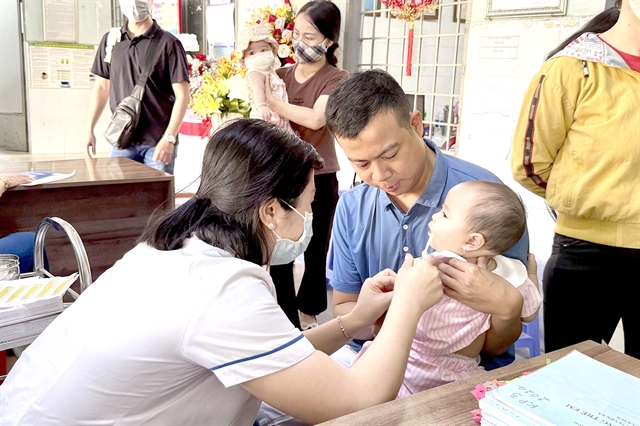 |
| A medical worker gives vaccination to prevent measles for a baby in Đồng Nai Province. — VNA/VNS Photo Lê Xuân |
HÀ NỘI — Việt Nam has taken a decisive step towards safeguarding public health with the adoption of a new Law on Disease Prevention, driven by urgent real-world demands and lessons from recent health crises, Deputy Minister of Health Nguyễn Thị Liên Hương said on Monday.
Speaking at a press conference in Hà Nội announcing the President’s Orders on 13 laws passed by the National Assembly at its 10th session, Deputy Minister Hương outlined the key contents of the law and the rationale behind its promulgation.
She noted that the National Assembly officially passed the Law on Disease Prevention on December 10, 2025, describing it as a law of special importance that promptly institutionalises the Party and State’s policies and guidelines on protecting, caring for and improving public health in a new context.
The law marks a fundamental shift in Việt Nam’s healthcare system, moving from a mindset of responsive treatment to one of proactive prevention, with prevention established as the foundation of public health.
It gives concrete legal form to Resolution No. 20-NQ/TW dated October 25, 2017, of the 12th Central Committee of the Party and Resolution No. 72-NQ/TW dated September 9, 2025, of the Politburo on strengthening the protection, care and improvement of public health, alongside comprehensive healthcare reform.
According to Deputy Minister Hương, the law responds to rapidly evolving and increasingly complex disease patterns in Việt Nam, including the emergence of new infectious diseases, the re-emergence of existing ones, rising rates of non-communicable diseases and mental disorders.
Climate change, the risk of large-scale epidemics and profound lessons learned from the COVID-19 pandemic have underscored the urgent need to strengthen preventive health care capacity and pursue proactive and sustainable disease prevention.
Legal framework
The Law on Disease Prevention is promulgated to perfect the legal foundation for disease prevention, contributing to improvements in physical and mental health, stature, life expectancy and overall quality of life for the Vietnamese people.
It provides comprehensive regulations covering the prevention and control of infectious diseases, non-communicable diseases and mental disorders, as well as nutrition in disease prevention and the conditions required to ensure effective implementation.
The law applies to domestic and foreign agencies, organisations and individuals operating in Việt Nam, reflecting its comprehensive and unified scope and alignment with international practices.
Comprising six chapters and 46 articles, the law is built on the inheritance, amendment and development of appropriate provisions from the Law on Infectious Diseases Prevention and Control.
It retains five articles relating to the scope of regulation, terminology and the national reserve regime for medicines, vaccines and medical biological products.
At the same time, it amends 38 articles addressing general provisions and measures for infectious disease prevention and control, including biosafety surveillance, vaccine use, border medical quarantine, epidemic declaration and reporting, personal protective measures and medical quarantine organisations.
The law also adds 17 new articles focusing on biosecurity in testing, the development of preventive services and the research and application of science, technology, innovation and digital transformation in disease prevention.
Breakthrough changes
One of the most notable features of the Law on Disease Prevention is its clear shift in mindset.
The law affirms proactive prevention as the core principle, places people at the centre and emphasises comprehensive healthcare throughout the life course.
Its scope is expanded beyond infectious diseases to fully address emerging public health challenges.
The law establishes a sustainable financial mechanism for prevention, with the State budget ensuring regular and investment funding for preventive healthcare. It also creates a dedicated Prevention Fund to secure stable and long-term resources for prevention activities.
People’s rights are significantly strengthened through policies on periodic health check-ups, free screening for priority groups, equitable access to vaccines and medical biological products and special attention to nutrition during the first 1,000 days of life.
In addition, the law introduces incentives for personnel working in preventive health care, particularly at grassroots and community levels.
It encourages participation from the non-public sector in delivering prevention services and allows preventive health care facilities to determine additional income levels from lawful revenue sources.
Priority policies are also tailored for border areas, islands, ethnic minority regions, mountainous areas and other particularly disadvantaged locations.
The Law on Disease Prevention will take effect from July 1 this year. The Ministry of Health is currently coordinating with relevant ministries and sectors to develop and finalise detailed regulations and implementation guidelines, while stepping up communication efforts to help people and families understand their rights and responsibilities in proactively preventing disease.
Guided by the principle that prevention is better than cure, the law reflects the strong commitment of the Party, National Assembly and Government to public health, aiming to build a sustainable, equitable and effective healthcare system in which public health is the ultimate measure of success. — VNS
Society
 Society
 Society
 Society
 Society
 Society
 Society
.jpg) Society
Society
 Society
 Society
 Society
 Society
 Society
 Society
 Society