 Society
Malaysian tourist rescued after falling into 10-metre-deep hole in Đà Lạt
1.
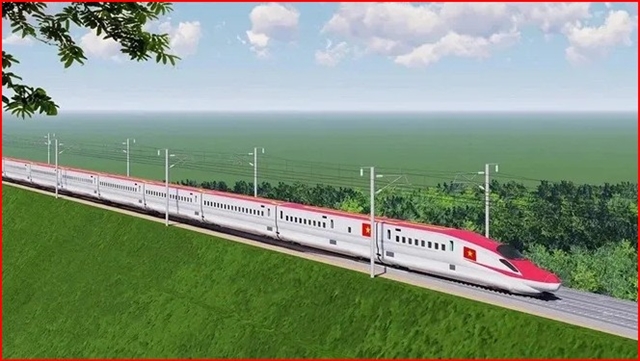 |
| Illustrative image of the North–South high-speed railway project. Photo: baochinhphu.vn |
HÀ NỘI — The Government Standing Committee has urged stronger and more decisive action to clear institutional, administrative and resource bottlenecks as it pushes to accelerate the rollout of major railway projects nationwide.
Wrapping up a meeting on January 4 to review progress in railway development, the Standing Committee said ministries, sectors and localities had made concerted efforts to improve institutional and policy frameworks.
These include work on a revised Railway Law, the National Assembly’s resolution on urban railways in Hà Nội and HCM City and investment decisions for flagship projects such as the Lào Cai–Hà Nội–Hải Phòng railway and the North–South high-speed rail line, according to the committee.
A number of implementing decrees have been issued, while construction has begun on Component Project 1 of the Lào Cai–Hà Nội–Hải Phòng railway and three urban railway lines in Hà Nội and HCM City. Authorities have also approved a national scheme to train and develop Việt Nam’s railway workforce.
In addition, common standards for the North–South high-speed rail project have been promulgated. The first meeting of the Việt Nam–China Joint Committee on Railway Cooperation has been held and a plan for developing the railway industry has been issued.
Alongside these advances, however, the Standing Committee acknowledged lingering uncertainties at the Ministry of Construction and relevant agencies in implementing the North–South high-speed rail project, particularly in researching and assessing suitable investment models.
For the Lào Cai–Hà Nội–Hải Phòng railway, the Standing Committee directed the Ministry of Construction to speed up preparation of the feasibility study for Component Project 2, along with the signing of a rail connectivity agreement and construction of a cross-border railway bridge, with completion targeted for March 2026.
The appraisal of the feasibility study dossier for Component Project 2 must be finalised by July 2026 to allow construction to begin. Relevant ministries, sectors and localities were urged to promptly appoint representatives to the appraisal council at the request of the Ministry of Construction so it can be established in line with regulations.
The Ministry of Construction was tasked with strictly managing investment costs, promptly issuing unit prices and cost norms under applicable standards and accurately determining alignments, boundary markers and cadastral extracts to ensure lawful compensation plans and prevent losses and waste.
The ministry will also coordinate with the Ministry of Education and Training and the Việt Nam Railways Corporation to effectively implement the national railway human resources development scheme through 2035, with a vision to 2045.
A clear roadmap and concrete training plan must be drawn up to ensure the timely supply of personnel for railway construction, management and operations, particularly for the Lào Cai–Hà Nội–Hải Phòng line, and submitted to the Prime Minister by January 15, 2026.
Local authorities and Việt Nam Electricity Group were instructed to actively carry out site clearance and the relocation of power infrastructure with voltages of 110 kV and above, in line with mechanisms approved by the National Assembly.
For the North–South high-speed rail project, the Standing Committee required the Ministry of Construction to instruct the Railway Project Management Board to complete the selection of an international consultant by January 2026, prepare the project’s feasibility study and report to the Prime Minister by January 15.
The ministry will remain responsible for developing lawful compensation plans and avoiding waste and losses.
Working with the Ministries of Science and Technology and Foreign Affairs, alongside other relevant agencies and expert consultants, the Ministry of Construction was also assigned to review Vietnamese and international standards, global experience and domestic conditions to select the most appropriate technology for the project.
It must further coordinate with relevant bodies to develop criteria, procedures and assessments for choosing the most effective and optimal investment model. Any additional special mechanisms or policies must follow due process, include thorough impact assessments and be reported to the Government Standing Committee by January 10.
Localities were urged to urgently review and accurately report funding needs to the Ministries of Construction and Finance to ensure timely allocation and coordination and to avoid delays in site clearance caused by funding shortfalls.
For urban railway projects in Hà Nội and HCM City, the Standing Committee called on municipal People’s Committees to proactively implement rail lines within their authority while ensuring both progress and quality.
HCM City was specifically instructed to speed up completion of required procedures to break ground on railway lines linking to Long Thành International Airport, including the Bến Thành–Tham Lương, Bến Thành–Thủ Thiêm and Thủ Thiêm–Long Thành routes. — VNS
Society
 Society
 Society
 Society
 Society
 Society
 Society
 Society
 Society
 Society
 Society
 Society
 Society
 Society
 Society