 Society

General Secretary and President Tô Lâm witnesses exchange of Việt Nam-Denmark cooperation agreements
1.

|
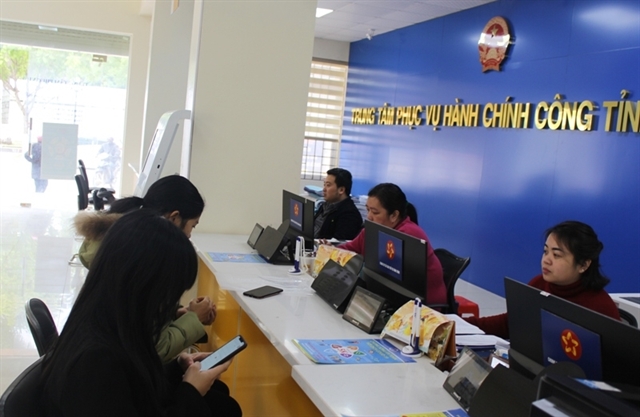
| An officer guides a resident with administrative procedures at the Phượng Sơn Ward Public Administration Service Centre, Bắc Ninh Province. Photos courtesy of Bắc Ninh Province |
BẮC NINH — Even before the merger of the two provinces, both Bắc Giang and Bắc Ninh placed strong emphasis on digitising administrative records, considering it an essential step in the digital transformation process.
Immediately after the merger into a single Bắc Ninh, this policy was implemented even more decisively.
Since October 2025, the northern province has stopped accepting paper submissions for many administrative procedures that are eligible for online public services, including 25 essential public services such as birth registration, marriage registration, marriage status certification, reissuance of health insurance cards, electricity registration, accounting–finance procedures and procedures under the police, justice, and civil status sectors.
Thanks to digitally authenticated citizen information stored in the national population database, citizens now only need to scan a QR code or provide their citizen ID number for officials to instantly retrieve their civil status, residency and marital information.
Processing times have been cut by nearly half, errors have been nearly eliminated, and public satisfaction has increased significantly.
‘Citizen ID is enough’
Dương Thị Thùy from Ranh Hamlet, Mỹ Thái Commune, Bắc Ninh Province said: “Online procedures are very quick and convenient. They save a lot of time, and I don’t need to prepare many documents. Just my citizen ID card is enough.”
In addition to personal information, the results of many administrative procedures have also been digitised, allowing citizens to reuse their electronic data for future applications.
This not only saves time but also ensures that documents are stored in secure personal digital archives, making data retrieval easier, preventing loss and enabling automatic verification when needed.
Nguyễn Thị Phương, an officer at the Bắc Giang Ward Public Administration Service Centre in Bắc Ninh, said: “When we guide citizens to submit applications online, the VNeID platform already integrates and stores their essential documents.
"When they return for other procedures, the process is much more convenient because they no longer need to submit additional paperwork."

|
| Officers at the Bắc Ninh Provincial Public Administration Service Centre assist residents with administrative procedures. |
To date, Bắc Ninh has digitised 94.82 per cent of its administrative results, and more than 86.8 per cent of required data has been sourced and reused from national databases on population, business registration, land, taxation and social insurance.
In the justice sector alone, the province has cleaned more than 15,000 data records by cross-checking with the population database. It has also conducted a 90-day review of marriage data.
The provincial People’s Court has reviewed over 70,000 divorce records and more than 400,000 marriage records. Commune and ward-level authorities have completed corrections for all 5,000 erroneous entries in the electronic civil status database.
Overall, Bắc Ninh has digitised more than 2.87 million civil status records. Data of over 3.5 million social and health insurance participants has also been synchronised with the population database, creating major benefits for medical treatment using citizen ID cards.
In the land management sector, one of the most complex data domains, the province has cleaned nearly 3 million records and converted all information from old identity cards to new citizen ID numbers to ensure consistency and interoperability.
Digital identification has also expanded significantly, with more than 2.1 million e-ID accounts activated across the province, enabling faster and more accurate online procedures.

|
| An officer at the Tân Yên Commune Public Administration Service Centre receives and processes administrative applications. |
Recognising that data is a critical digital resource and a decisive factor in successful digital transformation, Bắc Ninh has launched extensive campaigns to standardise, reconcile, and clean up the data.
Twelve key databases, including land, finance, health, education and civil status, have been prioritised for completion.
Bắc Ninh is also among the first 16 localities nationwide to complete the connection between its Intelligent Operations Centre (IOC) and the national population database.
The province has also piloted two-way data sharing between its administrative service system and land and electronic tax databases. These integrations are an important step toward deeper digitisation of records and minimising the paperwork required from citizens.
Challenges remain
Although Bắc Ninh currently leads the nation in four index groups, including public transparency, openness of data, processing progress of online services and satisfaction levels, its fifth-place ranking in the records-digitisation component shows that stronger reforms are needed for the province to maintain its overall leading position in digital public service delivery.
In practice, many challenges remain at the grassroots level.
Nguyễn Thị Phương said: “When we look up information using the VNeID e-ID system, some data is still missing. For example, a citizen may have registered their marriage, but the information has not yet been integrated into their ID profile.
"In such cases, we advise them to visit the police to update their marriage or divorce information.”
Đỗ Thị Huyền, Deputy Director of the Phúc Hòa Commune Public Administration Service Centre, added: “The land sector is the most challenging because the paperwork required from citizens is still extensive. Even with our guidance, people still have to make multiple trips to update and complete their documents.”
Nguyễn Ngọc Nam, Director of the provincial Public Administration Service Centre, said: “In the coming period, we will prioritise addressing backlogs in land-related applications in central wards and communes where residents and businesses currently have to queue for long hours, sometimes overnight, to complete procedures.
“We will advise the provincial authorities, and coordinate with the Department of Agriculture and Environment as well as local governments to eliminate these bottlenecks. Importantly, administrative procedures will soon be processed entirely based on data rather than documents.
"This means citizens and businesses will no longer need to provide paper documents, as the State will proactively retrieve digitised information to handle their applications. This marks a fundamental shift in how administrative procedures are resolved, and Bắc Ninh is determined to be among the leading provinces implementing this policy.” — VNS
Society
 Society
 Society
 Society
 Society
 Society
 Society
 Society
 Society
 Society
 Society
 Society
 Society
 Society