 Society

Top Vietnamese leader meets with Belgian Senate Speaker, House President
1.
|
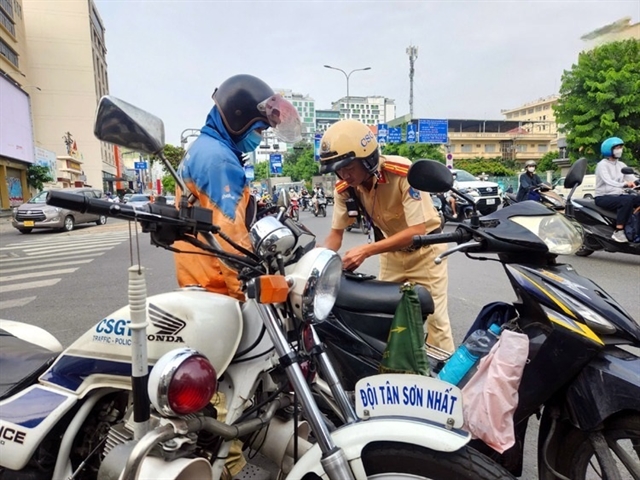
| A traffic police officer issues a fine to a violator in HCM City. — VNA/VNS Photo |
HÀ NỘI — After years of battling gridlock with wider roads and stricter rules, HCM City has found that traffic chaos is tougher to tame than congestion. Now the city is shifting gears, betting on education to succeed where enforcement has failed.
A crisis of behaviour
Through Decree 168, which took effect on January 1, Việt Nam has introduced sweeping new penalties for reckless driving, drink-driving and drug use behind the wheel.
The fines are among the toughest in decades, reaching up to VNĐ40 million (US$1,528) and two-year licence suspensions for high blood alcohol levels, along with point deductions for repeat offenders.
At first, the law appeared to work. Police reported a brief drop in violations early in the year, but the reprieve was short-lived. Within months, old habits resurfaced.
From December 2024 to October 2025, HCM City police recorded nearly 600,000 traffic violations — about 2,000 cases a day. Alcohol was the leading cause, accounting for more than a quarter of all offences.
Another 94,000 cases involved speeding, 46,000 were for illegal parking and nearly 8,000 for driving the wrong way or on pavements.
“Many drivers treat their licence like a permit to argue with police, not as proof they know how to drive safely,” said a senior officer with the city’s traffic division. “They study for the test but forget the lesson the moment they pass.”
The result, he said, is a cycle that enforcement alone cannot break.
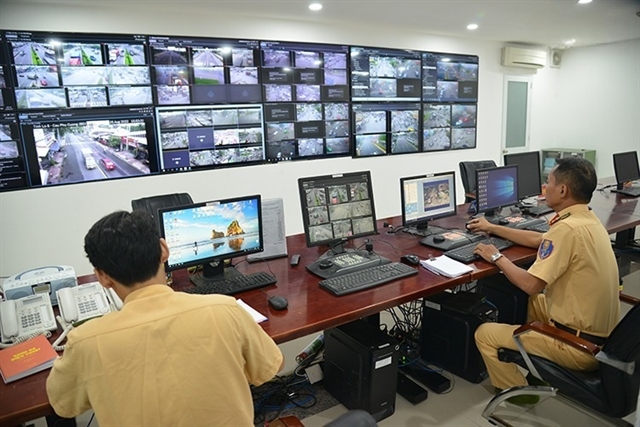
To help curb reckless behaviour, HCM City has turned to technology. Over the past year, authorities have installed more than 1,200 surveillance cameras on major roads, 31 of them equipped with artificial intelligence.
These AI systems can detect violations such as running red lights, lane cutting, speeding, using mobile phones and failing to wear seatbelts, automatically transmitting footage to a command centre for processing.
|
| Two traffic police officers monitor city streets through the camera surveillance system in HCM City. — VNA/VNS Photo |
The pilot network covers key intersections such as Điện Biên Phủ, Võ Thị Sáu and Hai Bà Trưng, where traffic is heaviest. The system began operating in September and, within its first five weeks, logged more than 3,000 infractions.
Early data suggest it is working. In the first nine months of 2025, road accidents in HCM City fell by 31 per cent compared with the same period last year.
Fatalities were down 8 per cent and injuries down more than 40 per cent. For the first time in years, no particularly severe crashes were reported in September.
Still, officers admit that cameras can only do so much.
“Technology helps us catch violations,” said the same official. “But what we really need is to stop them from happening in the first place.”
That realisation has shifted the focus from enforcement to education. With 14 million residents and more than 12 million vehicles, HCM City’s roads are not just infrastructure; they are a shared social space. Changing how people drive means changing how they think.
At Lương Thế Vinh Primary School in Cầu Ông Lãnh Ward, traffic education begins before most children can legally cross the street alone.
The topic features in assemblies, art lessons and after-school clubs. Students design posters, stage short plays about road safety and quiz each other on traffic signs.
Parents are also part of the programme. Each term, they sign pledges with their children to obey traffic laws, promising to wear helmets, stop at red lights and use the correct lanes.
If they are caught violating those rules near the school, they are invited to meet with administrators.
Principal Lê Thị Diệu Ái said the goal is not to punish parents but to raise awareness, encouraging them to think about the example they set for their children. When parents ignore traffic rules, she added, the lesson of safety is lost.
From classrooms to campuses
Universities have adopted the same approach. At Nguyễn Tất Thành University, road safety has been woven into student life through practical workshops, simulation exercises and talks by traffic police.
Lecturer Nguyễn Thị Thu Thảo said the university aims to build understanding rather than fear, noting that while punishment may work once, awareness endures.
She also said that when students violate traffic laws, the university meets with them to discuss the incident and sometimes involves them in awareness campaigns so they take ownership of the message.
Beyond schools, local governments are testing new ways to reinforce good habits. In Cầu Ông Lãnh Ward, officials have signed agreements with 11 schools to coordinate traffic-safety education for students and parents.
Neighbourhood heads receive basic road-safety training and youth groups organise interactive street performances highlighting the dangers of drink-driving and speeding.
“It’s about repetition,” said ward official Nguyễn Võ Uyên Linh. “When children see helmets and stoplights as normal, not as rules to bend, they remind their parents to do better. And slowly, the pattern starts to shift.”
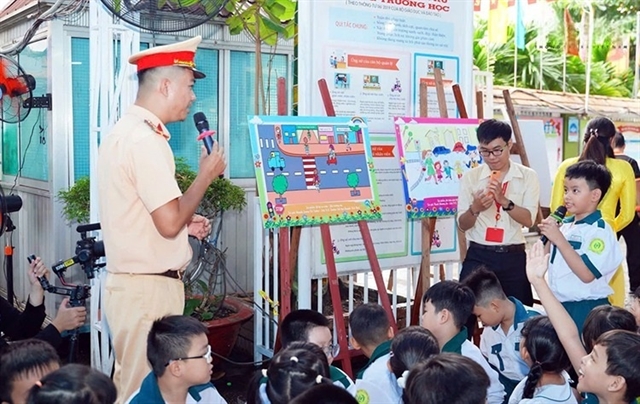
Police have expanded those efforts by working with schools and local authorities to run visual campaigns and interactive programmes designed to make traffic-safety messages easier to absorb.
|
| A traffic police officer teaches road safety to students at Lương Thế Vinh Primary School in HCM City through paintings. — VNA/VNS Photo |
For city planners, the goal is not just to reduce accidents but to build what they call a 'civilised traffic culture.'
Officials argue that modernity is not measured by high-rises or highways but by the respect people show on the road — whether they yield, signal or simply wait.
Decades of growth have made private vehicles a symbol of freedom and success. Owning a motorbike or car often feels like a personal triumph, while following rules, to some, still feels like submission.
That mindset is slowly evolving. As accident rates fall and more schools join the campaign, there is a growing sense that the city might finally be turning a corner. — VNS
Society
 Society
 Society
 Society
 Society
 Society
 Society
 Society
 Society
 Society
 Society
 Society
 Society
 Society
 Society