 Politics & Law

SBV to curb property price inflation, enforce lending rate rules
1.
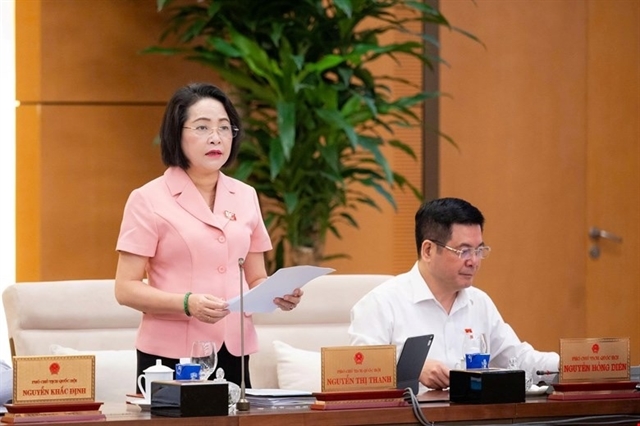 |
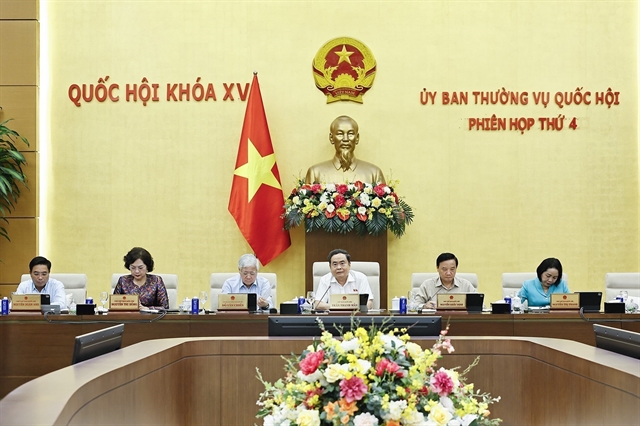
| National Assembly's Vice Chairwoman Nguyễn Thị Thanh speaks at the meeting on Wednesday, July 15, in Hà Nội. — Photo vov.vn |
HÀ NỘI — The National Assembly Standing Committee (NASC) reviewed the draft amending and supplementing several articles of the Law on Vietnamese Guest Workers under Contract at the meeting on Wednesday in Hà Nội.
The aim is to ease financial burdens, simplify administrative procedures and strengthen post-licensing oversight to better protect Vietnamese workers seeking employment abroad.
Presenting the Government's proposal, Minister of Home Affairs Đỗ Thanh Bình said the draft would amend 22 of the current law's 74 articles.
One of the most significant changes is the abolition of the administrative procedure requiring enterprises to register labour source preparation under Article 18.
Under the proposal, enterprises would be given full autonomy to conduct preliminary recruitment, provide career counselling and deliver vocational skills and foreign language training for workers.
Instead of seeking prior approval from State authorities, enterprises would only be required to notify the commune-level People's Committee where recruitment and counselling activities take place, enabling local authorities to monitor and inspect operations and ensure that only duly licensed entities are carrying out such activities.
The draft also substantially simplifies the conditions and procedures under articles 31, 34 and 39 for three specific categories: Vietnamese enterprises that win or undertake overseas construction projects; Vietnamese organisations and individuals investing abroad; and enterprises sending workers overseas for vocational training and skills development.
Bình explained that these three forms of overseas employment are non-commercial and non-profit in nature, and service fees may not be charged to workers.
The draft introduces a lighter regulatory framework than that applied to labour export service enterprises, reflecting the lower level of risk while facilitating implementation for all parties concerned.
To prevent regulatory circumvention, the draft also strengthens the licensing requirements under Article 10. The proposed provision would prevent enterprises or legal representatives whose licences have been revoked from reapplying for a licence or establishing a new enterprise to continue operating.
It is expected to be submitted to the 16th NA for consideration and approval at its first extraordinary session in August 2026.
Presenting the preliminary verification report, Chairman of the National Assembly's Committee for Culture and Social Affairs Nguyễn Đắc Vinh said the reviewing body highly appreciated the draft's implementation of the policy of decentralisation and its shift from a pre-approval model to post-licensing supervision.
However, the committee recommended that the drafting body continue reviewing the bill to ensure consistency with the Law on Employment, the Law on Enterprises, the Law on International Treaties, the Law on Investment and other relevant legislation.
Regarding the proposal to include new categories of workers, such as seasonal workers, workers employed under cooperation agreements between localities and cross-border workers without contracts, the committee noted that these were emerging practical issues, with some still under pilot implementation.
In particular, cross-border workers without employment contracts fall outside the scope of the current law. The drafting body was therefore urged to continue evaluating pilot programmes before incorporating such provisions into a comprehensive revision of the law, while improving the regulatory framework to avoid legal loopholes.
On licensing conditions for labour export service providers, the committee generally supported the proposed conditions governing licence reissuance following revocation and the professional qualifications required of staff.
However, it recommended introducing a specific waiting period before revoked enterprises may reapply and reviewing provisions authorising the Government to detail staff qualification requirements to ensure that no additional business conditions are created.
Concluding the meeting, NA Vice Chairwoman Nguyễn Thị Thanh said the NASC had requested the Government to focus on four major issues in finalising the draft law.
First, it should ensure legal consistency while concentrating amendments on core policy issues.
Second, licensing conditions should be tightened while strengthening post-licensing supervision.
Third, the law should strengthen comprehensive protection for workers throughout the entire overseas employment process.
Finally, the drafting body was instructed to refine provisions governing the national database system by clearly assigning responsibilities for updating, correcting and maintaining audit trails for information, while ensuring data security and preventing misuse.
Thanh requested the Government to continue incorporating the NASC 's recommendations and the official verification report of the Committee for Culture and Social Affairs before submitting the revised draft to the NA for consideration at its August session. — VNS
Politics & Law
 Politics & Law
 Politics & Law
 Politics & Law
 Politics & Law
 Politics & Law
 Politics & Law
 Politics & Law
 Politics & Law
 Politics & Law
 Politics & Law
 Politics & Law
 Politics & Law
 Politics & Law
 Politics & Law