 Politics & Law

Two Australian entertainment names revealed behind the scenes of Symphony of the Sea Season 3 in Phú Quốc
1.
|
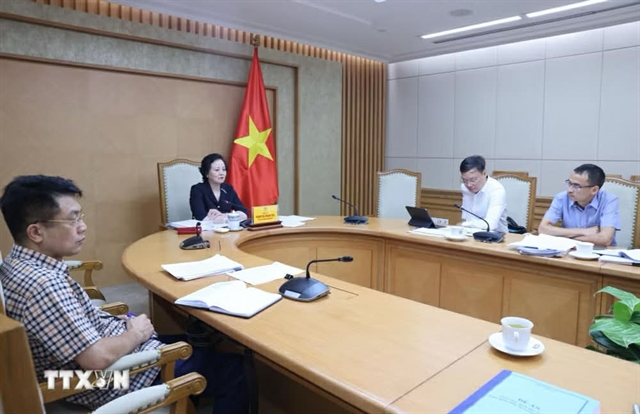
| Deputy Prime Minister Phạm Thị Thanh Trà works with the Ministry of Home Affairs on the draft National strategy for attracting and utilising talent in the new era. — VNA/VNS Photo Lâm Khánh |
HÀ NỘI — The national strategy for attracting and utilising talent must concentrate on key sectors that drive rapid and sustainable growth.
Deputy Prime Minister Phạm Thị Thanh Trà made the remarks during a meeting with the Ministry of Home Affairs (MoHA) on Tuesday afternoon, when she gave feedback on the draft National strategy for attracting and utilising talent in the new era.
The Deputy PM praised the MoHA for preparing a thorough, responsible and well-documented draft.
To transform the country’s development model, the core focus remains the advancement of science and technology, innovation and digital transformation, while also promoting the digital economy, the green economy, circular economy, and knowledge-based economy.
Therefore, the draft must adhere closely to the central leadership’s directions and clearly define the scope of targeted talent.
According to the Deputy PM, the strategy is being developed with a vision to 2045, aiming to attract and deploy talent to serve the country’s goals of rapid, sustainable development and to fulfil the centenary objectives.
The political basis for preparing the draft includes the Resolution of the 14th National Congress, specialised resolutions of the Politburo, and the draft Resolution on renewing the national development model.
The practical basis is the country’s stated objective of rapid and sustainable development, primarily to achieve double-digit growth. This underlines the necessity of attracting and utilising talent in certain priority fields.
Deputy PM Trà identified groups of strategic, priority fields that should be focused on to create breakthroughs.
First is the group of fields that will drive new economic growth: artificial intelligence, big data, cloud computing, digital technologies, digital infrastructure, cyber security, semiconductor technology, robotics, automation, smart manufacturing, quantum technologies, and platform technologies for the Fourth Industrial Revolution.
For this group, the aim is to attract leading experts who can provide leadership and stimulate new economic growth.
Second is the group relating to science, technology and innovation, focusing on biotechnology, biomedical technology, new materials, environmental technology, agricultural technology and marine technology.
This group should mainly target top scientists, technology experts, innovators and skilled engineers capable of leading and advancing these industries.
Third is attracting talent to strategic technologies that support development of a green economy: high technologies, enabling technologies, green economy, circular economy, digital economy and data-driven economy.
The Deputy PM asked the MoHA to follow closely the guiding remarks of General Secretary and State President Tô Lâm at the national conference reviewing the first 18 months of implementation of Resolution No. 57-NQ/TW on science and technology breakthroughs.
She emphasised that development of science, technology and innovation must be tightly linked with the creation of new knowledge, mastery of technology and conversion into new societal value.
The focus should be on resources that enable mastery and development of strategic technologies.
“Choose the right emphasis on science, technology, innovation and digital transformation when selecting priority targets,” the Deputy PM instructed.
She also suggested including other necessary target groups such as leading experts in economics, finance, national governance and the environment.
After selecting the priority groups, principles must be set for identifying the sectors and fields to be targeted, and an assessment conducted of the current state of high-quality human resources across ministries, agencies and localities.
Build open environment
Ordering a change of mindset and a shared understanding that attracting and using talent is a political task for every agency and unit, Deputy PM Trà also mentioned creating mechanisms for the circulation of talent between the public and private sectors, and between the state and research institutes, universities and enterprises.
Drawing on China’s experience, the Deputy PM asked the MoHA to study mechanisms and policies for attracting, rewarding and protecting talent.
She stressed building an open research and innovation environment where talent is empowered, protected and given conditions to realise their full potential.
At the same time, attention should be paid to social welfare policies and working conditions to motivate the attraction, retention and development of this workforce, and to create an ecosystem connecting domestic and overseas talent – a hub that gathers experts.
The MoHA said the draft adheres to the Party’s views on developing high-quality human resources, science and technology, innovation and digital transformation; it regards talent as a particularly important resource and a key driving force for rapid, sustainable development.
The draft is driven by the urgent practical needs of the country in this new stage of development, as science, technology, innovation, digital transformation, the knowledge economy and leading industries increasingly become the main drivers of growth.
To achieve rapid, sustainable development, raise labour productivity, enhance national competitiveness and participate more deeply in global value chains, Việt Nam needs a sufficiently strong and capable pool of talent that is properly placed and utilised. — VNS
Politics & Law
 Politics & Law
 Politics & Law
 Politics & Law
 Politics & Law
 Politics & Law
 Politics & Law
 Politics & Law
 Politics & Law
 Politics & Law
 Politics & Law
 Politics & Law
 Politics & Law
 Politics & Law
 Politics & Law