 Politics & Law
Top Vietnamese leader meets with Belgian Senate Speaker, House President
1.
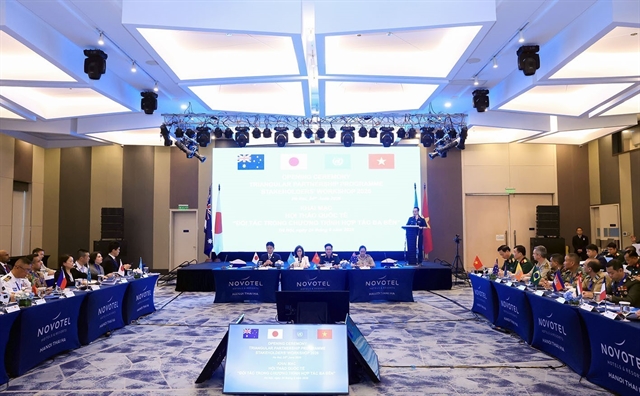 |
| The Triangular Partnership Programme (TPP) Stakeholders’ Workshop is held in Hà Nội on Wednesday. — VNA/VNS Photo Tuấn Anh |
HÀ NỘI — Việt Nam stands ready to work closely with all partners to continue the crucial role of Triangular Partnership Programme (TPP) in peacekeeping efforts, said Director of Việt Nam’s Department of Peacekeeping Operations Major General Phạm Mạnh Thắng.
He was addressing the TPP Stakeholders’ Workshop in Hà Nội on Wednesday, which was hosted by Việt Nam and co-chaired with the United Nations (UN) and the Australian and Japanese governments.
The TPP aims to enhance peacekeepers’ capacity in engineering, medical, and C4ISR (command, control, communication, computer, and intelligence simulator system) and camp security technologies through the provision of training and operational support.
The event reviewed the results of the TPP and aimed to strengthen ties among existing and new partners, including countries that are contributing troops to peacekeeping operations of the UN and the African Union, as well as those providing expertise and resources to the programme.
Delegates also discussed new areas of cooperation, including stronger engagement with regional organisations and measures to improve the programme’s impact, effectiveness and efficiency in the near future.
This year’s workshop marks the return of TPP activities to Việt Nam – the first ASEAN country to host the programme’s activities and training courses in 2019 and the initiator of a rotating ASEAN hosting mechanism for TPP events. This mechanism has since been continued by Cambodia, following Việt Nam and Indonesia.
The event was also the first TPP Stakeholders’ Workshop held in the ASEAN region, reflecting the growing role of regional partners in enhancing peacekeeping capacity and advancing cooperation for peace and security.
Addressing the event, Major General Thắng noted that Việt Nam has deployed 1,352 military personnel and police officers to UN peacekeeping missions over the past decade.
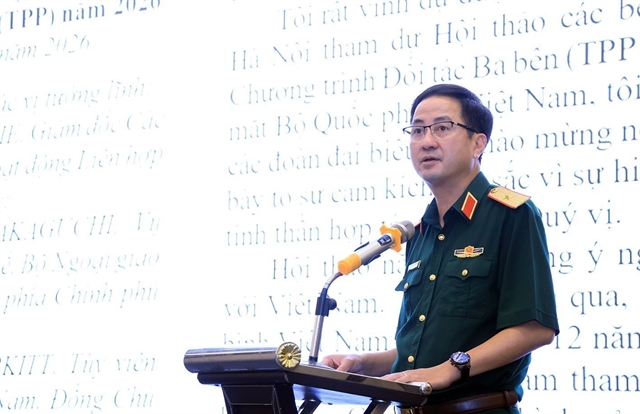 |
| Director of Việt Nam’s Department of Peacekeeping Operations Major General Phạm Mạnh Thắng addresses the workshop. — VNA/VNS Photo Tuấn Anh |
These achievements were not only the result of national efforts but also of sustained support from the UN and international partners, with the TPP playing a particularly important role, he stressed.
Since joining the programme, Việt Nam has received substantial support in training, capacity building and operational deployment. As host of this year’s workshop, Việt Nam demonstrates its contribution to the strategic direction of the TPP in the years ahead, said Thắng.
Emphasising the importance of ensuring peacekeepers are equipped to respond to current and emerging challenges, Australian Defence Attaché to Việt Nam Colonel Alana Burkitt said practical cooperation has long been a core element of Australia’s regional engagement, including programmes with Việt Nam to strengthen peacekeeping capabilities before deployment.
Sustainable partnerships are the foundation of effective peacekeeping, making the role of the TPP more critical than ever, she said, adding that countries must continue working together toward the shared goal of building and sustaining lasting peace.
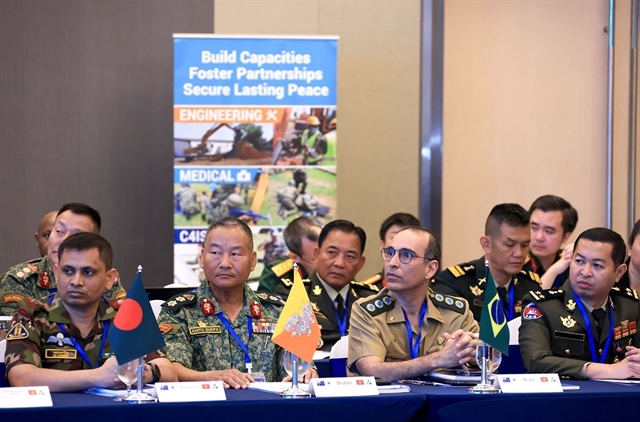 |
| Delegates at the workshop in Hà Nội on Wednesday. — VNA/VNS Photo Tuấn Anh |
Director of the United Nations Policy Division at Japan’s Ministry of Foreign Affairs Takuma Sakaguchi said the event provided an opportunity for participating countries to exchange practical experiences, share the lessons learned and discuss ways to expand partnership networks and strengthen cooperation with regional organisations.
Noting that 2026 marks the 70th anniversary of Japan’s accession to the UN, Sakaguchi said this year offers an opportunity for the country to reaffirm its commitment to multilateralism and international cooperation.
Representing the UN, Giovanna Ceglie, director of the Division for Special Activities at the UN Department of Operational Support (DOS), described the TPP as a flagship initiative of the DOS and the UN’s largest programme for capacity building and operational support in peacekeeping.
Through training activities, knowledge sharing and professional partnerships, the programme has helped member states develop essential skills that directly support mission mandates and enhance peacekeeper safety, she said. The programme has also continuously evolved to reflect member states’ priorities and operational needs.
According to Ceglie, this adaptability has been one of the key factors behind the TPP’s success and will remain crucial as future capability requirements are assessed.
Participants at the workshop discussed the impact and effectiveness of the TPP, regional partnerships and lessons learned from the programme implementation, innovation in UN peacekeeping operations, and the TPP’s development direction for 2027-30. — VNS
Politics & Law
 Politics & Law
 Politics & Law
 Politics & Law
 Politics & Law
 Politics & Law
 Politics & Law
 Politics & Law
 Politics & Law
 Politics & Law
 Politics & Law
 Politics & Law
 Politics & Law
 Politics & Law
 Politics & Law




