 Politics & Law
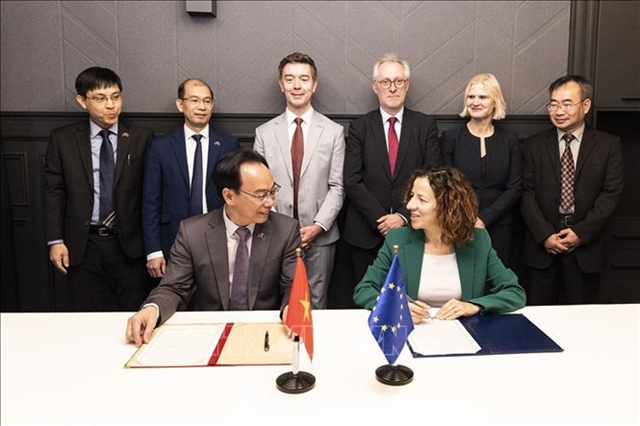
Việt Nam, EU sign Letter of Intent on Education and Training
1.
|
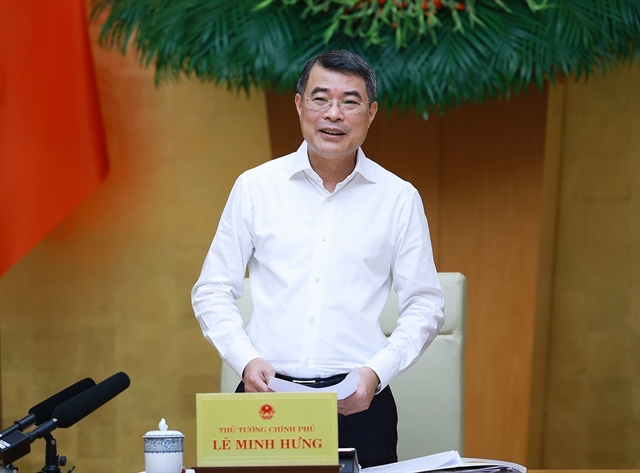
| Prime Minister Lê Minh Hưng speaks at the Government's regular monthly meeting for July 2026 on Monday. VNA/VNS Photo |
HÀ NỘI — Prime Minister Lê Minh Hưng has called on ministries, sectors and localities to move swiftly in translating Government directives into concrete action plans, stressing that resolving bottlenecks and maintaining reform momentum are essential to achieving Việt Nam's goal of double-digit economic growth.
Chairing the Government's regular monthly meeting for July on Monday, the Prime Minister urged ministries and local authorities to intensify efforts to accelerate economic expansion, with public investment remaining a key driver.
He instructed agencies, particularly those with public investment disbursement rates below 10 per cent, to speed up capital allocation and implementation, aiming for full disbursement of the annual plan.
The Government will continue implementing coordinated monetary measures to keep interest rates stable, ensure adequate liquidity and safeguard monetary and foreign exchange markets.
The PM also ordered authorities to crack down on unfair interest rate competition, tighten credit management in high-risk sectors, accelerate the settlement of bad debts and push ahead with restructuring the banking system.
On fiscal policy, the Prime Minister set a target of increasing State budget revenue by at least 10 per cent in 2026 compared with the estimated 2025 figure. He said tax, fee and charge exemptions, reductions and payment extensions would remain in place to support households and businesses, while efforts would continue to develop the capital and stock markets in line with the country's market upgrade roadmap.
In the energy sector, he instructed relevant ministries to closely monitor global fuel price movements when managing domestic petroleum prices.
The PM also called for urgent measures to ensure adequate supplies of ethanol (E100) for blending E5 and E10 gasoline, preventing disruptions to biofuel production and major energy projects.
The Prime Minister highlighted the need to maximise the benefits of free trade agreements (FTAs) by promoting exports while tightening control over imports of non-essential goods to reduce the trade deficit and maintain a sustainable trade balance.
Beyond economic priorities, Hưng directed ministries and localities to effectively implement the 500-Day Campaign to search for, recover and identify the remains of fallen soldiers.
He also called for thorough preparations for the 2026–27 academic year, including the September 5 opening ceremony, which will coincide with the inauguration of new boarding general education schools in land border communes.
The Government will continue pursuing its goal of providing all citizens with free periodic health check-ups or health screenings by the end of 2026.
The Prime Minister also instructed agencies to organise activities marking the 81st anniversary of the August Revolution and National Day on September 2, maintain national defence, security and social order, and proactively prepare for the Party and State leadership's external activities scheduled for August.
Concluding the meeting, PM Hưng instructed ministries, sectors and localities to immediately convert the Government's directives into measurable tasks, with clear targets, timelines and expected outcomes, accompanied by stronger inspection and supervision.
He said the implementation results would serve as a key benchmark for evaluating the quality of leadership, governance and policy execution, as well as the accountability of heads of ministries, agencies and local administrations.
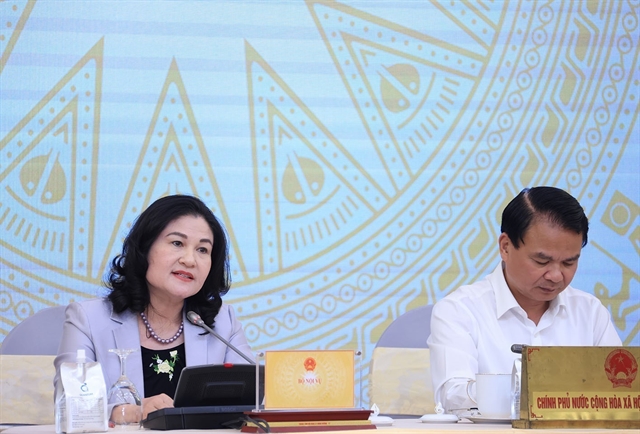
At the press briefing held after the monthly meeting, Minister and Chairman of the Government Office Đặng Xuân Phong said the macroeconomy remained broadly stable, with inflation under control.
The consumer price index (CPI) fell by 0.1 per cent in July from the previous month, while average inflation in the first seven months of the year was estimated at 4.39 per cent year-on-year, remaining within the Government's full-year target.
Monetary policy, exchange rates and interest rates were managed proactively and flexibly. State budget revenue in the first seven months was estimated at VNĐ1.83 quadrillion (US$69.8 billion), equivalent to 72.5 per cent of the annual target and up 16 per cent year-on-year. Public investment disbursement reached VNĐ425.3 trillion, fulfilling 41.9 per cent of the year's plan.
Registered foreign direct investment (FDI) totalled US$38.06 billion during the January-July period, up 50.9 per cent from a year earlier, while realised FDI reached US$15.2 billion, an increase of 11.8 per cent. Total import-export turnover was estimated at US$659.6 billion, up 28.1 per cent year-on-year.
During the first seven months, the Government and the Prime Minister issued 387 legal normative documents.
Phong also highlighted a number of notable achievements. The Prime Minister launched a nationwide campaign to strengthen support for people who had rendered service to the nation, mobilising nearly VNĐ12 trillion in donations from individuals and businesses.
Meanwhile, the 500-Day Campaign has recovered nearly 1,500 sets of fallen soldiers' remains and seven collective graves.
Progress on social housing and rental housing has also accelerated, with 875 social housing projects currently under implementation nationwide. Of these, 289 projects have been completed, providing about 197,300 apartments.
Despite the positive results, Phong pointed to several challenges. Many projects continue to face localised labour shortages, while labour and construction material costs have remained high.
He also warned that room for inflation management had become more limited. Lending interest rates have continued to rise, and the banking system is facing mounting liquidity pressure as credit demand typically accelerates toward the end of the year.
He added that delays in issuing detailed implementing regulations for laws and resolutions that have already taken effect remain a persistent problem. — VNS
Politics & Law
 Politics & Law
 Politics & Law
 Politics & Law
 Politics & Law
 Politics & Law
 Politics & Law
 Politics & Law
 Politics & Law
 Politics & Law
 Politics & Law
 Politics & Law
 Politics & Law
 Politics & Law
 Politics & Law