 Politics & Law

Masan’s earnings more than double in Q3
1.
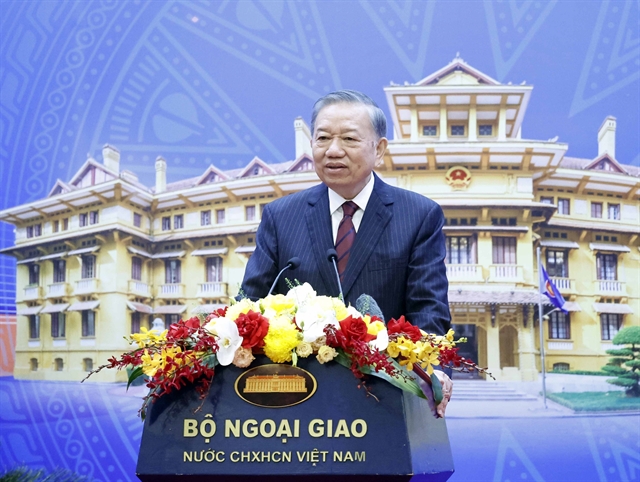 |
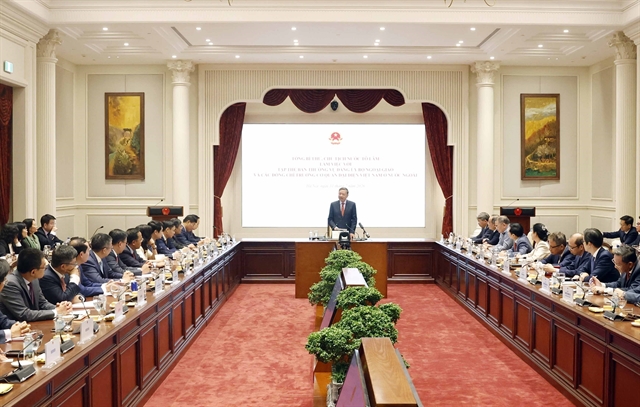
| Party General Secretary and State President Tô Lâm speaks at the opening ceremony of the 33rd Diplomatic Conference in Hà Nội on Saturday morning. — VNA/VNS Photo Thống Nhất |
HÀ NỘI — Party General Secretary and State President Tô Lâm has outlined six key priorities for the future growth of the diplomatic sector at the opening ceremony of the 33rd Diplomatic Conference, held in Hà Nội on Saturday morning.
With the theme 'Promoting the pioneering role and fulfilling the crucial and regular task of Việt Nam's external affairs in the new era', the conference lasts until August 7, during which leaders of the diplomatic sector and the political system exchange views on foreign affairs.
Speaking at the session, top leader Tô Lâm stressed that the conference is being held at a significant time as Việt Nam enters a new stage of development.
“After more than 80 years of nation-building and 40 years of reform, for the first time, the resolution of the 14th Party Congress has identified foreign diplomacy as a crucial and ongoing task of the country,” he said.
Despite the rapid and complex changes exceeding conventional predictions that the world has undergone since the 32nd Diplomatic Conference was held in 2023, Việt Nam’s foreign affairs and international integration have still been carried out effectively and achieved many important results, he added.
Việt Nam has established Comprehensive Strategic Partnerships with nine countries, Strategic Partnerships with 11, and Comprehensive Partnerships with five. Relations with neighbouring countries, major powers, ASEAN members and important partners of traditional friends continue to be strengthened, and diplomatic channels more closely coordinated.
Multilateral diplomatic efforts have also reaped results, including the successful organisation of the ASEAN Future Forum, the P4G Summit and the signing ceremony of the United Nations (UN) Convention on Cybercrime, which resulted in the country’s re-election to the UN Human Rights Council for the 2026-28 term with the highest number of votes in the Asia-Pacific group.
Economic diplomacy has become more closely aligned with development requirements, with 17 free trade agreements signed with over 60 countries and territories, Party chief and President Lâm added. Import and export turnover reached approximately US$930 billion by 2025, placing Việt Nam among the top 20 economies in the world in terms of trade volume.
The top leader also pointed out the challenges and limitations facing the sector. “It should be noted that the problem is not a lack of policies, but mainly a lack of concrete implementation and actions taken to actualise them,” he said.
Research and forecasting work at times could not keep up with actual developments of the situation. Some reports of international developments were descriptive and failed to clearly indicate the impact on Việt Nam and proposed solutions, he said.
In some areas, good political relations have not been proportionally translated into technology, projects, markets and benefits for citizens and businesses but still prioritised the number of meetings and signed documents over the outcome.
“We can’t just simply sit and watch. We can’t just deal with situations after they have occurred. The more complex the situation, the more we must remain calm, proactive and absolutely not retreat,” the top leader said.
“Now is the time for foreign relations to play a pioneering role, to anticipate and act promptly to protect the fatherland from early on, to open up connections and seize resources for national development.”
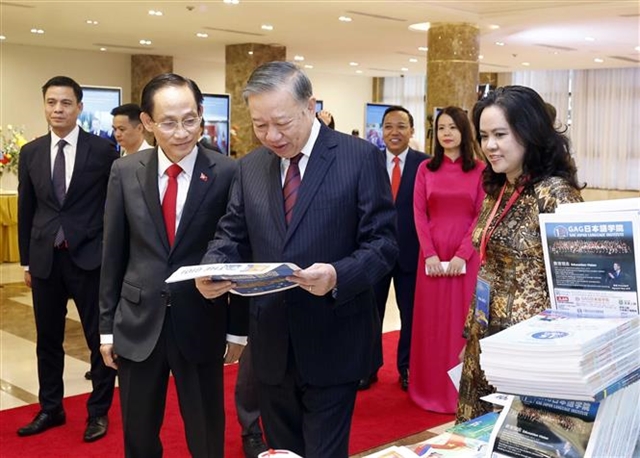 |
| Party chief and President Tô Lâm examines publications of the diplomatic sector prior to the ceremony. |
Six diplomatic priorities
The top leader urged the diplomatic sector to prioritise six key tasks in its next stage of development.
First, they should continue to improve the methods and quality of international research and forecasting to help Party and State leaders be aware early of urgent global trends, data risks and unexpected strategic situations.
Research must focus on issues that have a direct and long-term impact on Việt Nam’s security and development and on strategy adjustments of major powers, shifting from purely economic and technological issues to volatile areas such as trade, finance, energy, water resources, as well as new development fields such as artificial intelligence (AI), semiconductors, the digital economy, green stock transfers, cybersecurity and data security.
Second, the sector must deepen and enhance the effectiveness of foreign relations by actualising established and upgraded partnerships into action programmes and projects that yield measurable results.
After each high-level visit, there must be an implementation plan clearly defining the lead agency, its responsibilities, the timeline for completion, monitoring methods and expected outcomes. Maintaining the partners’ trust, sincerity and long-term interests should be the sector’s priorities, each difference should be handled properly to prevent negative impacts on the entire relationship.
Third, foreign relations must directly serve the economic development goals until 2030 and 2045, helping to improve productivity, competitiveness and self-reliance of the economy.
‘Economic diplomacy’ means closely monitoring projects until results are achieved, prioritising resources for science and technology, innovation, digital transformation, the development of the private economy, and improving the quality of foreign investment.
This includes selectively attracting high-tech projects on semiconductors, AI, clean energy, biotechnology and modern agriculture, linking investment with technology transfer and human resource training, and ensuring the participation of Vietnamese businesses in global supply chains.
Fourth, multilateral diplomacy must be elevated with effective international integration. Việt Nam’s role in the UN, ASEAN, APEC and the Mekong sub-regional cooperation mechanisms must continue to be promoted.
Fifth, the sector should innovate the mechanisms for coordination, inspection and task implementation, focussing on removing ‘bottlenecks’ that are slowing down the process.
The Central Steering Committee on Foreign Affairs and International Integration must play a leading role in strategic direction and unified coordination, handling major inter-sectoral issues that are beyond the authority of a single agency. The Ministry of Foreign Affairs, as the standing agency, must advise, monitor and coordinate with the committee to identify delays and propose solutions.
Finally, special emphasis should be placed on building a team of foreign affairs officials with sufficient qualities and capabilities to meet the requirements of the new era. The selection and training of these officials must be planned carefully, the evaluation stage should use their work results as the benchmark.
Concluding his remarks, Party and State leader Tô Lâm expressed his confidence that with the revolutionary diplomatic tradition of Việt Nam and the intelligence, courage and responsibility of the diplomatic corps and foreign affairs forces, the sector will unite and fulfill all tasks to contribute to the maintenance of peace, the protection of the Fatherland and the sustainable development of the country.
He asked that conclusions reached at the conference must be immediately translated into action plans, assigned to the right people, with a defined deadline and regular monitoring.
“Tasks that can be done immediately should be started, unresolved issues must be reported, and matters exceeding authority must be presented along with proposed solutions,” he said. — VNS
Politics & Law
 Politics & Law
 Politics & Law
 Politics & Law
 Politics & Law
 Politics & Law
 Politics & Law
 Politics & Law
 Politics & Law
 Politics & Law
 Politics & Law
 Politics & Law
 Politics & Law
 Politics & Law
 Politics & Law