 Politics & Law
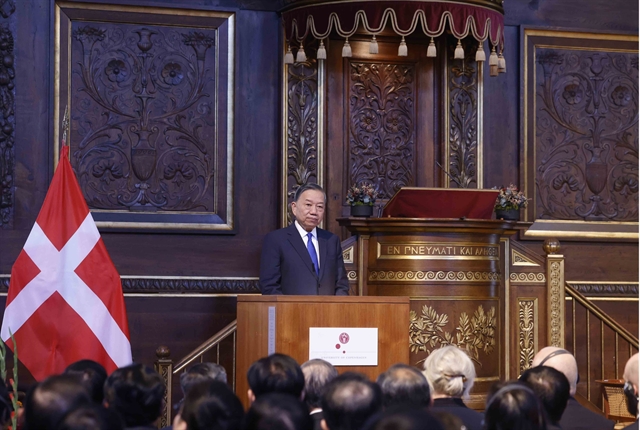
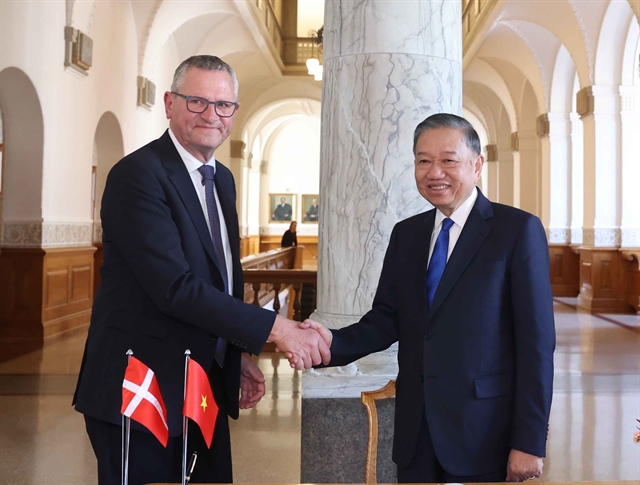
Top Vietnamese leader highlights new horizon for Việt Nam–Denmark cooperation
1.
 |
| The Tàu Hủ-Bến Nghé Canal and Võ Văn Kiệt Boulevard form an east-west transport corridor through HCM City. VNA/VNS Photo Hồng Đạt |
HÀ NỘI — The State will regulate, control and determine land prices when land is put into use, while preventing the emergence of multiple pricing mechanisms, according to a Party Central Committee resolution setting out directions for amendments to the Land Law.
Permanent Deputy Prime Minister Phạm Gia Túc presented the resolution on the guiding principles and directions for amendments to the Land Law and related legislation at a national conference on Wednesday.
The conference was held to study, disseminate and implement the resolution adopted at the third plenum of the 14th Party Central Committee.
No privatisation of land
After four years of implementing Resolution No 18, many major policies have been institutionalised through the Land Law, the Housing Law and the Law on Real Estate Business, helping to protect the legitimate rights and interests of land users and unlock resources for development.
However, the Permanent Deputy Prime Minister said land remained one of the areas facing the greatest difficulties and was particularly prone to complaints, denunciations, losses, wastefulness, corruption, misconduct and vested interests.
Several mechanisms and policies governing land-use planning, land allocation, land leasing, changes in land-use purposes, land recovery and compensation had prevented land resources from being used to their full potential.
The Party Central Committee therefore agreed to issue a new resolution replacing Resolution No 18, with the aim of introducing comprehensive, transparent and feasible reforms that would unlock resources, contribute to double-digit growth and support the country’s rapid and sustainable development.
Regarding its guiding principles, Túc said the resolution reaffirmed that land belongs to the entire people, with the State acting as their representative owner and exercising unified management.
Land must never be privatised. Foreign nationals must not be permitted to acquire or transfer land-use rights in any form, except for people of Vietnamese origin residing abroad.
The State exercises the rights of the representative owner by deciding land-use master plans and plans; recovering, allocating and leasing land; recognising land-use rights; permitting changes in land-use purposes; stipulating land-use terms; determining land prices; and deciding policies and regulating increases in land value that are not created by land users.
The distribution of land value must ensure fairness and efficiency while preventing wastefulness.
Land-use rights are a special type of asset and commodity, but do not constitute ownership rights. Land-use rights and assets attached to land are protected by law.
The State will regulate, control and determine land prices when land is put into use, while preventing the emergence of multiple pricing mechanisms.
From compensation to rebuilding people’s lives
The resolution also marks a major shift from the concept of “compensating for recovered assets” to that of “rebuilding the lives of people whose land is recovered by the State”.
It requires improvements in housing, living conditions and livelihoods for people whose residential land is recovered.
The resolution aims to turn land into a genuine strategic and domestic resource, a competitive advantage and a driver of national development in the new period.
Specifically, it calls for the development of a centralised, unified, coordinated, modern and multipurpose national land information system.
The system must be connected to and capable of sharing data with national databases on population, taxation, planning and real estate, as well as other national and specialised databases. The data must be accurate, complete, clean, up to date, consistent and shared.
By the end of 2026, Việt Nam aims to complete a digital database for all land plots for which information and data have already been collected.
By the end of 2027, the country will strive to complete cadastral surveying and mapping, cadastral records and land databases for areas not yet covered by the system.
A central task will be to promptly amend, supplement and complete the Land Law and related legislation, ensuring consistency and connectivity between the Land Law and laws governing investment, bidding, planning, housing, real estate business, public assets and taxation.
The resolution also sets out important directions for land-use planning and calls for fundamental reforms to policies on limits for rice-growing land.
The allocation and leasing of land and changes in land-use purposes for State-managed land will primarily be conducted through auctions of land-use rights or bidding for projects involving land.
The resolution also requires equal access to land for the public and private sectors.
Balancing the interests of the State, people and investors
Regarding compensation, support, resettlement and land recovery, the resolution more clearly defines the circumstances in which land may be recovered when strictly necessary for national defence and security, or for socio-economic development in the national and public interest.
Túc said the regulations should be neither so broad that they could be abused nor so narrow that they obstructed essential projects.
The State may recover the remaining land required for a project after an investor has reached agreements covering most of the project area and secured the consent of a large majority of land users within the project boundaries.
Regarding land prices, land-related finance and the regulation of land value differentials, the resolution states that land prices will be determined by the State based on the development objectives of each period.
Land prices must promote socio-economic development, keep input costs low for production and business activities, and improve the competitiveness of the economy.
Land pricing decisions must be based on comprehensive data and scientific and transparent methods. Data on land, taxation, notarisation, banking and real estate must be connected to prevent price manipulation, artificial price inflation and the emergence of multiple pricing mechanisms.
The State will issue land price tables, land price adjustment coefficients, rates for collecting land-use and land rental fees, and compensation rates appropriate to actual conditions and different categories of land.
These policies must ensure fairness, openness and transparency while balancing the interests of the State, people and investors.
Regarding financial and tax instruments, Túc said an appropriate roadmap would be studied, with a firm commitment to introducing financial and taxation measures that promote the economical and efficient use of land.
Efforts will focus on addressing abandoned land, delays in putting land into use, land speculation and land hoarding, which distort the market and push land and housing prices far beyond genuine housing demand and people’s ability to pay.
These problems must be tackled through a combination of administrative and economic measures, including taxation.
Policies should be designed to make holding land without putting it into use more costly than the potential gains from speculation.
The authorities will study policies to regulate land value differentials arising from surpluses in real estate business, as well as higher taxes on abandoned land and homes that are not put into use.
The measures are intended to improve land-use efficiency, combat wastefulness, promote a healthier real estate market and curb speculation.
At the same time, appropriate revenue policies will be introduced for land used for production and business activities and for rental housing projects.
The markets for land-use rights and real estate will be further developed to ensure greater transparency, sound operation, stability and sustainability.
Information on planning, project legality, land prices, transactions, financial obligations, mortgages, disputes and land-use status must be made public.
The registration of land-use rights transactions will gradually become compulsory, with data connected to notarisation, tax, banking, land registration and real estate business systems.
Depending on the parties and form of transaction involved, real estate transactions will be conducted through trading platforms, with payments made through banks rather than in cash. VNS
Politics & Law
 Politics & Law
 Politics & Law
 Politics & Law
 Politics & Law
 Politics & Law
 Politics & Law
 Politics & Law
 Politics & Law
 Politics & Law
 Politics & Law
 Politics & Law
 Politics & Law
 Politics & Law
 Politics & Law