 Politics & Law

European business confidence remains at historic high in Q3
1.
 |
| Former State President Trương Tấn Sang (left) and Lê Quốc Phong, Permanent Deputy Secretary of HCM City's Party Committee, cast their ballots at Polling Station 7 in Tân Định Ward, HCM City. — VNA/VNS Photo |
Compiled by Lê Việt Dũng
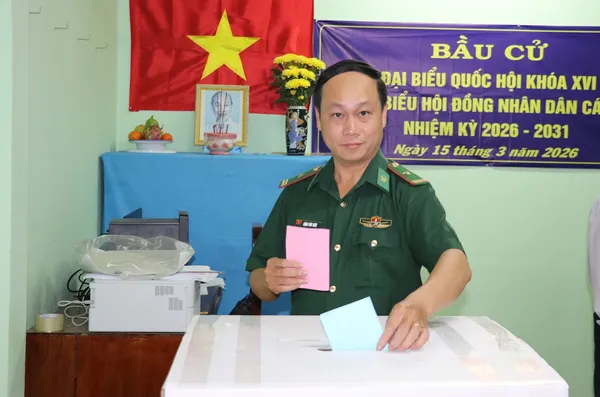
Today, March 15, nearly 79 million voters across Việt Nam are heading to polling stations to elect deputies to the 16th National Assembly (NA) and local People’s Councils for the 2026–2031 term, marking a key moment in the country’s electoral cycle.
Once the final ballots are cast later in the day, the election will move into a series of legally defined procedures that determine how votes are counted, how disputes are handled and when the official results will be announced.
Closing the polls
Polling stations operate throughout the day and are scheduled to close at 7pm this evening. Depending on local conditions, election teams may decide to extend voting hours, but not beyond 9pm on the same day.
Once the voting period ends, the heads of the polling station election teams will formally declare the end of voting.
The law requires that the counting process begin at the polling station itself immediately after the voting period concludes. Ballot boxes cannot be opened earlier and the counting must be completed within a defined timeframe, generally within 24 hours of the close of polling in that voting area.
Before the ballot box is opened, the team will undertake several preparatory steps to ensure transparency and accuracy. First, it will verify and record the number of unused and spoiled ballot papers remaining at the polling station.
These ballots will be counted, documented in writing and sealed so they cannot be introduced into the count. Only after this step is completed does the polling station proceed to the opening of the ballot box.
At this point, the head of the polling station election team will invite two voters from the polling area to witness the process. These witnesses must be local citizens of good reputation and must not be candidates for election in that polling area.
Their role is to observe the opening of the ballot box and the counting process, helping ensure the procedure is conducted publicly and in accordance with the law.
In addition to these invited witnesses, candidates, representatives of nominating agencies or nominating organisations and journalists may also be present to observe the counting.
However, only members of the polling station election team are permitted to handle ballots or participate directly in the counting process.
Opening the ballot box
When the preparatory steps have been completed and witnesses are present, the ballot box will be opened.
Ballots will be removed and sorted according to the different elections that take place simultaneously. Each voter typically receives three ballots, including those for National Assembly deputies and for People’s Councils at provincial and commune levels.
Each ballot type is printed in a different colour. The election team will separate these ballots before counting begins so that each election can be tallied independently.
After the ballots are sorted, the election team will count the total number of ballots collected in the ballot box. This number will then be compared with the number of voters who were recorded as having voted at that polling station.
Valid and invalid ballots
Before counting votes for individual candidates, the election team must determine which ballots are valid and which are not. Election law defines several conditions that a ballot must satisfy to be considered valid.
The ballot must have been issued by the polling station and must bear the official stamp of the polling station election team. It must not contain any writing other than the voter’s marks indicating their choice among the listed candidates.
The voter may select fewer candidates than the number of seats to be filled but may not select more than that number.
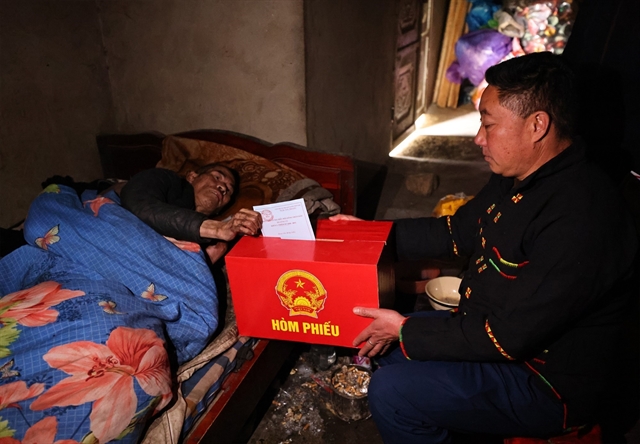 |
| An election official brings a mobile ballot box to the home of an elderly voter unable to travel so he can cast his ballot in Lũng Cú Commune, Tuyên Quang Province. — VNA/VNS Photo |
Ballots are considered invalid if they do not meet these requirements. For example, a ballot is invalid if it does not follow the official format, lacks the polling station stamp or if the voter selects more candidates than the number of seats available.
A ballot is also invalid if the voter crosses out every name on the ballot, writes additional names that do not appear on the candidate list or adds other words or symbols unrelated to the voting choice.
During the sorting process, ballots that meet the criteria for validity will be placed in the valid ballot pile while those that violate the rules will be placed in the invalid ballot pile.
The counting procedure
Once the ballots have been sorted into valid and invalid categories, the counting of votes begins.
Polling station election teams will typically divide their members into small working groups assigned to count ballots for different elections.
One member will read out the name of the candidate picked on each ballot, another will record the vote tally and another will check the tally for accuracy.
As each ballot is read aloud, the votes will be recorded on tally sheets prepared for the polling station. The process continues until every ballot has been counted.
Throughout the counting process, witnesses and observers may watch but are not allowed to interfere with the work of the election team. The law requires the counting to take place in a manner that allows observers to clearly see the process without disrupting it.
Handling complaints
If an observer raises a complaint or allegation related to the counting, the polling station election team must receive and address the issue immediately and record it in the vote-counting record.
If the matter cannot be resolved at the polling station, the team must note its opinion in the record and forward the case to the local election committee.
Separate procedures exist for complaints regarding the election results themselves. Such complaints must generally be submitted within three days after the results are announced and election authorities must issue a decision within seven days of receiving the complaint.
After all ballots have been counted, the polling station election team prepares the official vote-counting record.
This document summarises the entire counting process and serves as the official record of the results at that polling station.
The record includes the number of registered voters in the polling area, the number of ballots issued, the number of ballots collected in the ballot box and the number of valid and invalid ballots. It also records the number of votes received by each candidate.
If any complaints or irregularities occurred during the counting process, these must also be described in the record.
Sealing election materials
Once the vote-counting record has been completed, the ballots and related election materials will be transferred to the relevant election authorities for consolidation of the results.
The movement of election documents follows a defined administrative chain. Results from each polling station will first be submitted to the relevant election committees responsible for the constituency.
These committees will aggregate the results from multiple polling stations before transmitting them to higher-level election bodies responsible for verifying and compiling results across provinces and the entire country.
Official results announced
Although counting begins immediately after polling stations close, the official announcement of results requires several days of verification and aggregation.
Election law requires the National Election Council to announce the official results of the election for National Assembly deputies no later than ten days after election day.
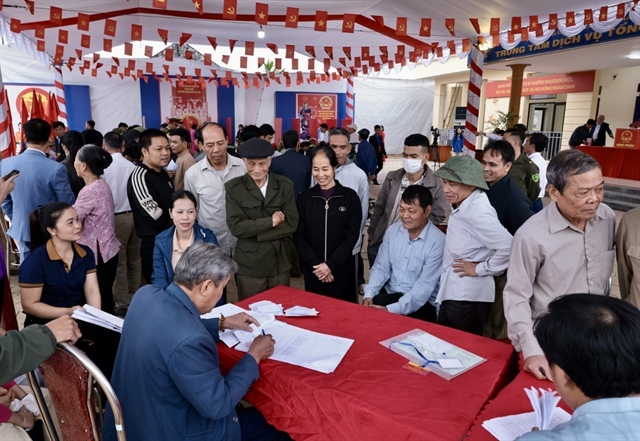 |
| Voters in Minh Châu Commune, Hà Nội, complete procedures to receive their ballots. — VNA/VNS Photo |
With the nationwide vote taking place on March 15, the final certified results are expected to be announced by March 25 at the latest.
“Under the law, the announcement of the election results and the list of elected candidates must be made no later than March 25,” Tạ Thị Yên, Vice Chairwoman of the NA Committee for Deputy Affairs and Deputy Chief of the Standing Office of the National Election Council, said at a press conference on March 12.
“However, the National Election Council expects that the results may be announced earlier.”
Provincial election committees follow the same ten-day timeframe when declaring the official results of People’s Council elections at their respective levels.
Once the results are announced and any complaints resolved, the elected deputies are formally recognised.
The newly elected National Assembly deputies will then convene for the first sitting of the 16th National Assembly, where the five-year legislative term officially begins. People’s Councils at provincial and commune levels will similarly hold their inaugural sessions.
In this way, voting on election day represents only the first stage of a process that continues through counting, verification and certification before the country’s representative bodies begin their new term. — VNS
Politics & Law
 Politics & Law
 Politics & Law
 Politics & Law
 Politics & Law
 Politics & Law
 Politics & Law
 Politics & Law
 Politics & Law
 Politics & Law
 Politics & Law
 Politics & Law
 Politics & Law
 Politics & Law
 Politics & Law