 Politics & Law

AXA Global Healthcare Mind Health Report reveals global differences in how cost and stigma affect access to professional mental health care
1.
 |
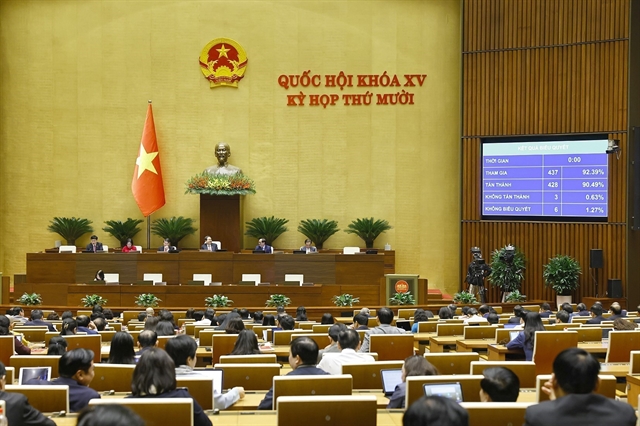
| National Assembly deputies vote to pass the Law on Specialised Courts at International Financial Centres on December 11. VNA/VNS Photo |
HÀ NỘI — The National Assembly on Thursday passed the Law on Specialised Courts at International Financial Centres, paving the way for Việt Nam to appoint foreign judges starting January 1, 2026.
The new law, approved during the 10th session of the 15th National Assembly, consists of five chapters and 44 articles, and will take effect at the beginning of next year.
Notably, it expands the pool of eligible appointees for specialised court judges to include foreign nationals.
In its explanatory report, the Supreme People’s Court said the inclusion of foreign judges is essential for ensuring the effectiveness and competitiveness of these specialised courts. Such a policy, it noted, aligns with practices in major international financial centres such as Dubai, Kazakhstan, and Singapore.
According to the court, foreign judges with deep expertise, strong reputations and experience across different legal systems will help the courts better handle diverse, highly internationalised disputes, thereby strengthening investor confidence.
It also noted in its report that ‘international investors will feel more assured when their disputes are handled by judges who share the same legal background’.
Their presence will also create a valuable learning environment for Vietnamese judges, enabling them to gain the experience and skills needed to eventually assume full adjudication responsibilities.
Another key reason cited is that Việt Nam is currently short of domestic judges with sufficient foreign-language proficiency, specialised expertise and international standing to immediately adjudicate cases under common-law frameworks once the specialised court system becomes operational.
For appellate-level cases, the Supreme People’s Court said the fixed composition of three judges is the most efficient approach, consistent with international norms at financial-centre courts. This structure, common in common-law jurisdictions, ensures both the timely resolution of cases and procedural simplicity.
It also added that maintaining the proposed number of judges also ensures the efficient use of high-quality judicial resources, avoiding an excessive financial burden for judge remuneration. It emphasises that the rigor and accuracy of appellate rulings should be guaranteed by the judges’ deep professional expertise, rather than by increasing or reducing the size of the judicial panel.
The law also stipulates that proceedings at the specialised court will be conducted in English, or in English accompanied by a Vietnamese translation.
Judgments and decisions will likewise be issued either entirely in English or in English with a Vietnamese version.
During earlier discussions, some legislators proposed allowing parties to choose either English or Vietnamese to ensure flexibility and respect parties’ autonomy. They argued that if all involved parties are Vietnamese, the use of English would be unnecessary and costly. Others suggested specifying that the English version should prevail in the event of discrepancies between the two languages, and recommended clearer rules on interpreters.
The Supreme People’s Court said these suggestions will be considered and addressed in the forthcoming Procedural Rules. — VNS
Politics & Law
 Politics & Law
 Politics & Law
 Politics & Law
 Politics & Law
 Politics & Law
 Politics & Law
 Politics & Law
 Politics & Law
 Politics & Law
 Politics & Law
 Politics & Law
 Politics & Law
 Politics & Law
 Politics & Law