 Opinion

Karate team eye medals at world youth championships
1.
|
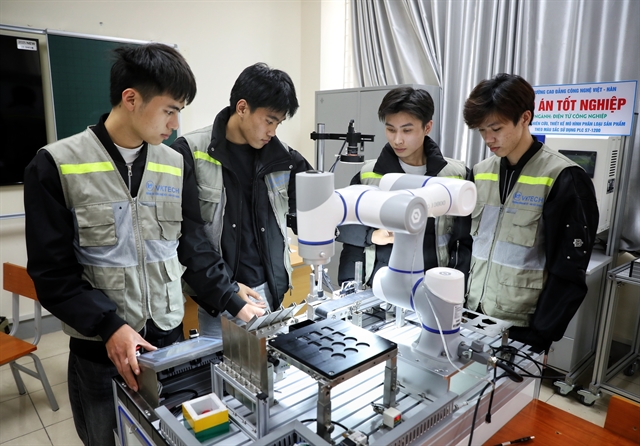
| Interns on the Microcontroller Programming course at Vietnam – Korea College of Technology. — VNA/VNS Photos |
As Việt Nam steps up efforts to develop its semiconductor industry and implement the Politburo's Resolution 57-NQ/TW on breakthroughs in science and technology, innovation and national digital transformation, building a highly skilled workforce and strengthening ties between universities, research institutes and businesses have become increasingly important.
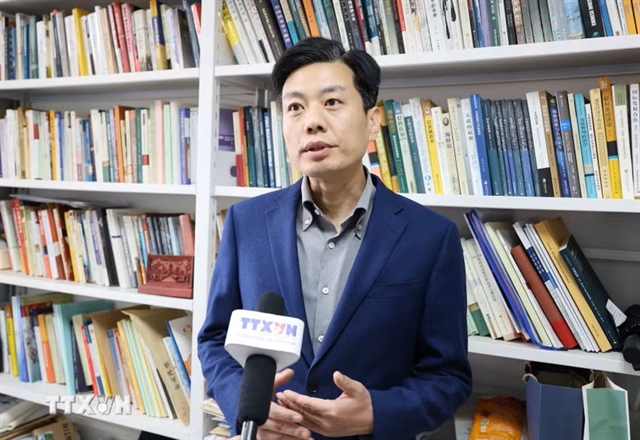
Vietnam News Agency spoke with Professor Phạm Nam Hải of the Department of Electrical and Electronic Engineering at Institute of Science Tokyo about Việt Nam-Japan cooperation and how Việt Nam can gradually build up its semiconductor capabilities.
You have spent many years teaching and conducting research in Japan. What have you done to help develop talent for Việt Nam, particularly in electrical and electronic engineering, semiconductors and advanced technology?
I have taught undergraduate students and supervised graduate research for students from many countries, including many Vietnamese students.
After completing their masters and doctoral programmes, several of my students have joined semiconductor companies such as Micron Memory, a dynamic random-access memory (DRAM) manufacturer, and ASM, which produces semiconductor manufacturing equipment.
Some Vietnamese PhD graduates have returned to Việt Nam to teach and conduct research at universities. Others have stayed in Japan and become assistant or associate professors.
Have you taken part in, or promoted, cooperation between Japanese universities, research institutes and companies and their Vietnamese counterparts? What results have these activities produced?
The Institute of Science Tokyo has been tasked by Japan’s Ministry of Education, Culture, Sports, Science and Technology with setting up a semiconductor chip-technology training network, known as enSET, in the Tokyo metropolitan area. I am a member of this programme and am working to bring a major Vietnamese company operating in Japan into the training network.
I also represent the Department of Electrical and Electronic Engineering at the Institute of Science Tokyo in a Japan–Việt Nam joint research programme on semiconductors. Our partners include the Semiconductor and Advanced Materials Institute of Vietnam National University Hà Nội; the School of Engineering at the University of Science and Technology under the University of Đà Nẵng; and the University of Natural Sciences and the International University under Vietnam National University, HCM City.
The programme focuses on edge AI semiconductors, covering semiconductor materials, memory, application-specific integrated circuit control‑chip design and edge AI software.
In addition, we are involved in a Japan-funded programme to train 250 Vietnamese PhD students in semiconductor-related fields. More than 10 Japanese professors specialising in semiconductors are participating.
With Việt Nam prioritising semiconductors and other strategic technologies, what should the country do to strengthen research and training capacity and develop its own semiconductor technology?
Việt Nam should establish a three-tier network for semiconductor training and research.
First, universities with semiconductor programmes should provide basic training for semiconductor engineers while conducting fundamental research into future technologies.
One or two leading research institutes should also focus on developing core technologies.
Finally, semiconductor companies should apply those technologies to develop commercial products.
The three tiers should be encouraged to work closely together under a university research institute-enterprise model. This would allow Việt Nam to make better use of the resources at each level for both workforce development and research into core technologies.
|
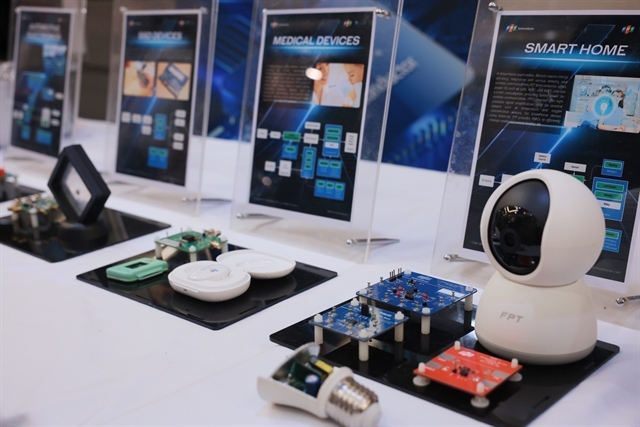
| Smart products, semiconductor chips and components on display at the launch ceremony of the National Centre for Supporting Semiconductor Chip Trial Production. |
As a Vietnamese scientist working in Japan, how do you see the role of overseas Vietnamese experts in the country’s development? What mechanisms are needed to attract and better use this talent?
In semiconductor electronics, I would divide the field into five layers from fundamental technologies to applications.
Semiconductor materials, including silicon for logic, III-V semiconductors for optical devices and power semiconductors such as GaN and SiC are the first layer.
The second is semiconductor devices, including logic transistors, RAM and FLASH memory, and optical devices such as semiconductor lasers and photodiodes.
Another layer is semiconductor circuit design, including digital, analog, memory and power-management chips.
The fourth is electronic systems, and the fifth is control software.
Việt Nam already has companies operating at levels three to five, particularly in chip design and control software.
But there are still relatively few Vietnamese universities providing training or companies working in semiconductor materials and devices, the first two layers. These are essential to semiconductor manufacturing.
As Việt Nam seeks to localise semiconductor chip production, it should draw on Vietnamese experts and scientists overseas who have experience in semiconductor materials and devices, including training, research and manufacturing.
They can work with Vietnamese universities, research institutes and companies to strengthen the country's capabilities in these foundational areas and develop the workforce that future semiconductor plants in Việt Nam will need.
What message would you like to send to young Vietnamese people pursuing careers in science and technology, so they can develop their expertise while making a practical contribution to their country?
Semiconductor technology underpins the production of chips, which are the backbone of a modern economy.
Young people seeking to enter the semiconductor field should build a strong foundation in mathematics, electromagnetics, quantum physics, semiconductor physics, digital and analog circuit theory and foreign languages.
But to truly master semiconductor technology, they also need advanced postgraduate training, both in Việt Nam and abroad.
After graduating, they can work for semiconductor companies in Việt Nam or overseas, or pursue teaching and research at universities. In either case, they can contribute directly or indirectly to the development of Việt Nam's semiconductor industry. — VNS
Opinion
 Opinion
 Opinion
 Opinion
 Opinion
 Opinion
 Opinion
 Opinion
 Opinion
 Opinion
 Opinion
 Opinion
 Opinion
 Opinion
 Opinion