 Opinion
Vietnamese community in China urged to stay united, contribute to homeland
1.
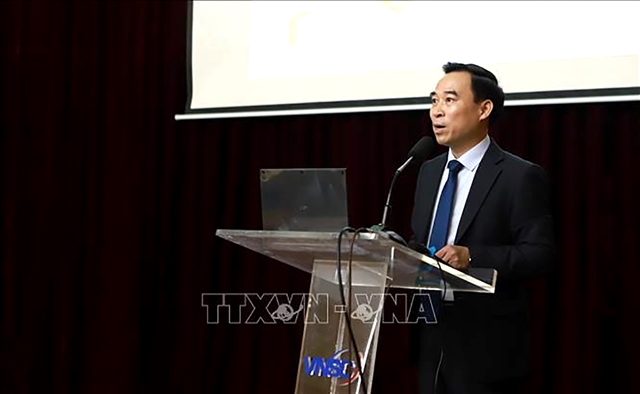
Following the successful official visit to France and attendance at the International Space Summit by Party General Secretary and State President Tô Lâm, Dr Vũ Đình Lãm, director general of the Vietnam National Space Center speaks with the Government News portal about the strategic direction and requirements for Việt Nam to develop space technology capabilities.
|
| Dr Vũ Đình Lãm, director general of the Vietnam National Space Center under the Vietnam Academy of Science and Technology. — VNA/VNS Photo Quyết Chiến |
How significant is the participation of Party chief and President Tô Lâm in the International Space Summit to Việt Nam's development of space technology capabilities?
His attendance at the summit demonstrates a strategic vision for expanding international cooperation in space technology. It affirms that this sector has been elevated to a national strategic level, linked to science, technology, innovation and Earth observation capabilities.
Amid the expanding landscape of satellite infrastructure, data sources and participating entities, Việt Nam needs to simultaneously focus on space economy development, space security and sovereignty, legal frameworks and the governance of space activities. The country also needs to engage more deeply in international activities regarding the safe and sustainable use of space, the utilisation and protection of frequency and orbital resources, and the assurance of space data security and equitable access for developing nations.
Participation of the country's leaders in international forums paves the way for aligning these strategic directions with cooperation programmes of greater scale, depth and substance. We anticipate that high-level exchanges will foster collaboration where Vietnamese personnel can directly participate in core processes such as technology transfer and specialised training, which will generate outcomes that provide a foundation for future missions.
France is a major space power with a highly developed ecosystem of research, technology and industry. Which areas should Việt Nam prioritise in its cooperation with France?
Việt Nam and France share a long-standing history of cooperation in Earth observation, most notably through the VNREDSat-1 satellite programme, which enabled Việt Nam to establish an active optical Earth observation system, develop human resources and gain experience in operating, using data and managing a complete satellite system.
Future cooperation with France could focus on three key areas. First is next-generation Earth observation technology, particularly ultra-high-resolution optical satellites and Synthetic Aperture Radar (SAR) satellites, which are vital tools for monitoring natural resources and the environment for climate change adaptation.
Second is ground and space data infrastructure, with a focus on applying artificial intelligence and big data to process and utilise multi-layered remote sensing imagery for digital economic development, while simultaneously strengthening the security and resilience of space systems. Finally, there is a need to gain access to core technologies and internationally standardised processes through satellite assembly, integration and testing within Việt Nam.
Regarding the mode of cooperation, we should aim for a co-design and co-development model. Both parties should participate in the design and testing of technological capabilities. Following each project, the Vietnamese side must retain the workforce, technical documentation, technological processes and technologies that can be reused for future missions. For core technologies that Việt Nam can't yet master domestically, technology transfer remains necessary, but must be linked to a localisation roadmap.
|
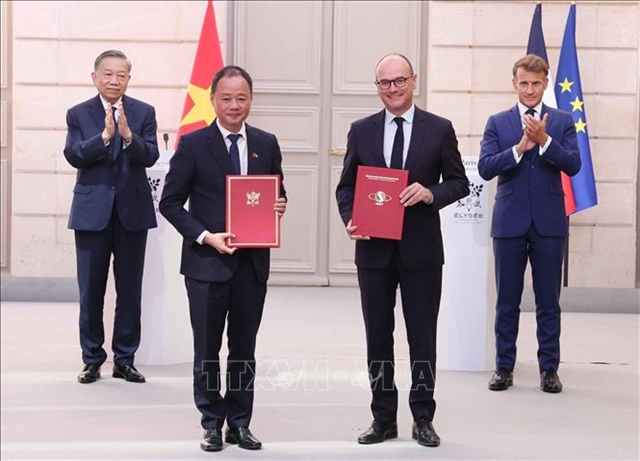
| Dr Trần Hồng Thái, President of the Vietnam Academy of Science and Technology (left front), presented a Letter of Intent on cooperation to advance the VNREDSat-2 project to Sébastien Martin, Deputy Minister of Economy, Finance and Industrial, Energy and Digital Sovereignty of the French Republic, at the witness of Vietnamese President Tô Lâm and French President Emmanuel Macron in Paris on September 10. — VNA/VNS Photo Thống Nhất |
Where does Việt Nam currently stand in the transition from simply conducting a space programme to developing a space economy?
Việt Nam is in the early stages of forming a space market, but the participation of domestic enterprises is already expanding. Beyond companies operating in satellite communications, system integration and data services, there are now enterprises involved in satellite research, design and manufacturing, and in the development of ground stations, UAVs, equipment, software and data products. VTX, VinSpace, CT Verse, Vegastar, and OSB are a few examples of business participation across various stages.
This is significant because space technology requires the involvement of multiple stakeholders. A complete satellite system comprises numerous subsystems, pieces of equipment, software components, services and verification stages. When research institutes, universities, and businesses collaborate based on their respective strengths, they will increase domestic capabilities and pave the way for the creation of commercial products.
Human resources constitute a crucial link in this process. The current barrier lies not so much in a lack of fundamental knowledge or skills, but in the gap between training, real-world experience and the lack of compensation mechanisms to retain and develop talent.
Which sectors are likely to generate significant socio-economic value from space technology over the next five years, and why has satellite data not yet been utilised to its full potential in Việt Nam?
Sectors showing potential include precision agriculture, infrastructure and marine economy monitoring, and disaster risk and climate change management.
Combining radar imagery with multispectral optical imagery can assist in crop identification and the monitoring of growth, drought conditions and changes in land cover. Satellite data can be used to track surface changes, ground displacement, and to monitor infrastructure and marine economic activities. Deep learning algorithms can aid in flood mapping, landslide warnings, search and rescue operations and damage assessment.
A current limitation is that data remains fragmented across various projects and State managing agencies, lacking standardisation and interoperability. Time-series data for many regions currently lacks continuity, and there is also a lack of ground-truth data, which hinders artificial intelligence development.
|
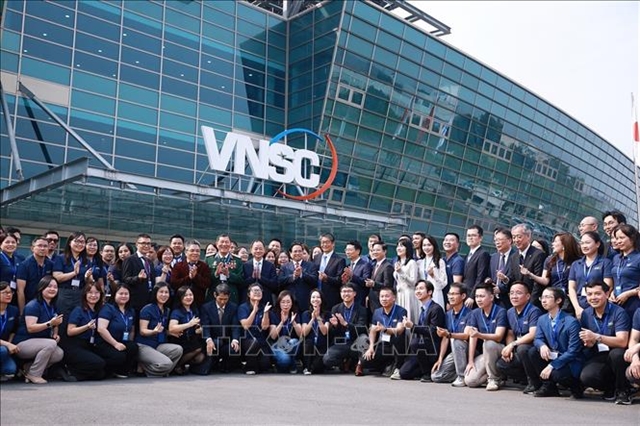
| The Vietnam National Space Center, located in Hòa Lạc Hi-tech Park on the outskirts of Hà Nội, was inaugurated on March 13. — VNA/VNS Photo Dương Giang |
Which capabilities, infrastructure and projects will the Vietnam National Space Center prioritise for development?
Our first priority is ensuring the continuity of the Earth observation satellite series, including VNREDSat-1 for optical systems. For radar systems, we will bring LOTUSat-1 into operation and prepare for the next phase. Regarding small satellites, we will maintain a series of missions to ensure the continuity of designs, processes and human capabilities.
The second priority concerns ground stations, operations and data. As the number of satellites increases, the system must be able to handle multiple missions, allocate imaging areas, prioritise urgent requests, manage telemetry, tracking and command (TT&C) and acquire and process diverse data types.
The third priority is to fine-tune our satellite assembly, integration and testing (AIT) capabilities at Hòa Lạc Hi-tech Park. We aim to establish an AIT facility that is reliably calibrated with well-maintained equipment, and suited for various tests such as vibration, thermal-vacuum, electrical-functional and radio-frequency simulations, as well as mass property measurement and other necessary assessments.
We will also refine work processes, quality documentation, configuration management and develop a team capable of organising a complete microsatellite integration testing campaign. For tests that cannot yet be conducted domestically, the Vietnamese team will still participate in the planning, supervising and evaluation stages.
Alongside satellite and infrastructure projects, we will continue to research and develop advanced technologies aligned with Việt Nam's capabilities and strategic direction. This will serve as a foundation for enhancing research capacity, preparing for future satellite generations, new missions and the expansion of research collaboration at regional and international levels. — VNS
Opinion
 Opinion
 Opinion
 Opinion
 Opinion
 Opinion
 Opinion
 Opinion
 Opinion
 Opinion
 Opinion
 Opinion
 Opinion
 Opinion
 Opinion