 Politics & Law
PM pledges favourable conditions for defence cooperation with Cambodia
1.
|
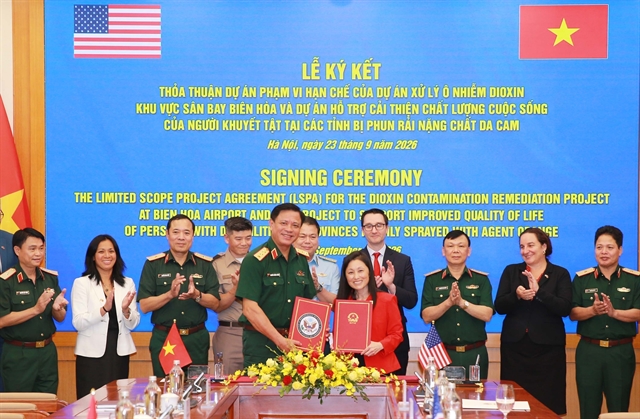
| Senior Lieutenant General Nguyễn Trường Thắng, Deputy Minister of National Defence, and US Ambassador to Việt Nam Jennifer Wicks exchanged the Limited Scope Project Agreements (LSPAs) on September 23, which provide additional US assistance for ongoing dioxin remediation at Biên Hòa air base in southern Việt Nam and expand support to improve the quality of life of persons with disabilities in Việt Nam.— VNA/VNS Photo Trọng Đức |
HÀ NỘI — The United States has committed hundreds of millions of dollars in additional resources to help Việt Nam address the environmental and human consequences of Agent Orange/dioxin and other legacies of war, under two agreements signed in Hà Nội on Wednesday.
The agreements were signed by Senior Lieutenant General Nguyễn Trường Thắng, Deputy Minister of National Defence, and US Ambassador to Việt Nam Jennifer Wicks at a ceremony at the Ministry of National Defence headquarters.
The two Limited Scope Project Agreements (LSPAs) provide additional US assistance for ongoing dioxin remediation at Biên Hòa air base in southern Việt Nam and expand support to improve the quality of life of persons with disabilities in Việt Nam.
The signing concretises the Memorandum of Understanding on strengthening cooperation in addressing war legacies, signed by the Vietnamese Ministry of National Defence, the US Department of War and the US Department of State on October 31, 2025, while contributing to the development of the Việt Nam–US Comprehensive Strategic Partnership.
Under the first agreement, the US will provide an additional approximately US$130 million for the project to remediate dioxin contamination at Biên Hoà air base, raising total US grant assistance for the project from US$300 million to approximately US$430 million.
The Biên Hòa project, which began in 2019, has so far confirmed the clean-up of about 41 hectares of soil in accordance with the project's applicable standards and regulations.
The Air Defence-Air Force Service, as the project owner, will continue working with Vietnamese and US agencies and contractors to ensure the project is implemented with quality, on schedule, safely, and effectively.
The project is expected to address approximately 500,000 cu.m of contaminated soil from the use during the war in Việt Nam, with the goal of completing the remediation by 2031.
At the signing ceremony, Senior Lieutenant General Thắng said that overcoming the consequences of chemical warfare remained a major task requiring substantial financial resources, as well as advanced equipment and technologies.
He said the two countries needed to continue mobilising resources to complete the Biên Hòa remediation project on schedule, while providing healthcare, rehabilitation and other support to victims of Agent Orange/dioxin and expanding such assistance to other priority localities.
The second LSPA provides US$91 million in US grant assistance for a project supporting improvements in the quality of life of persons with disabilities, regardless of the cause of their disabilities, in provinces heavily sprayed with Agent Orange and other priority areas.
The assistance will support healthcare, rehabilitation, social services, community inclusion and capacity-building for the implementation of disability policies.
Activities will initially be carried out in Cà Mau and Quảng Ngãi provinces before being gradually expanded to other areas, subject to the project's scope and available resources.
According to the Ministry of National Defence, US grant funding for programmes supporting people affected by Agent Orange/dioxin and persons with disabilities will total approximately US$156 million under the broader ongoing cooperation framework.
US assistance has previously supported programmes in Quảng Trị, Huế, Đà Nẵng, Quảng Ngãi, Gia Lai, and Đồng Nai, while the new agreement will expand activities to Cà Mau Province and other priority areas.
The Vietnamese side has also increased its counterpart funding for the projects to more than VNĐ350 billion and pledged to ensure sufficient counterpart resources for their completion.
Senior Lieutenant General Nguyễn Trường Thắng said Vietnamese and US agencies had worked closely together on addressing the consequences of chemical warfare, producing significant results that had been identified by the two countries' leaders as a bright spot in bilateral cooperation.
Ambassador Jennifer Wicks said that since arriving in Việt Nam three months ago, she had taken part in several activities related to addressing the legacies of war, including events marking Việt Nam's War Invalids and Martyrs Day on July 27 and mine-clearance activities in the central province of Quảng Trị.
She said she was impressed by the significant progress made by the two countries in addressing outstanding issues left by the war.
These programmes have created an important foundation for our Comprehensive Strategic Partnership and helped elevate our bilateral relationship to new heights and into new areas beyond programmes related to the war, she said.
The ambassador described the two agreements as evidence of the two countries' shared commitment to a brighter future, while thanking Việt Nam for its cooperation in addressing remaining war-related issues.
She also welcomed Việt Nam's increasingly important role in these efforts.
Since 1991, the US Government has provided support that has reached more than one million persons with disabilities, regardless of cause, in areas heavily sprayed with Agent Orange and affected by unexploded ordnance contamination, according to the US Embassy.
Ambassador Wicks also highlighted US assistance in providing modern DNA analysis technology and archival information to help Việt Nam identify the remains of Vietnamese military personel missing in action.
She said the United States welcomed and supported Việt Nam's “500-day campaign” to accelerate the search for, collection and identification of martyrs' remains. — VNS
Politics & Law
 Politics & Law
 Politics & Law
 Politics & Law
 Politics & Law
 Politics & Law
 Politics & Law
 Politics & Law
 Politics & Law
 Politics & Law
 Politics & Law
 Politics & Law
 Politics & Law
 Politics & Law
 Politics & Law