 Opinion

Viên dives again to popularise swimming passion
1.
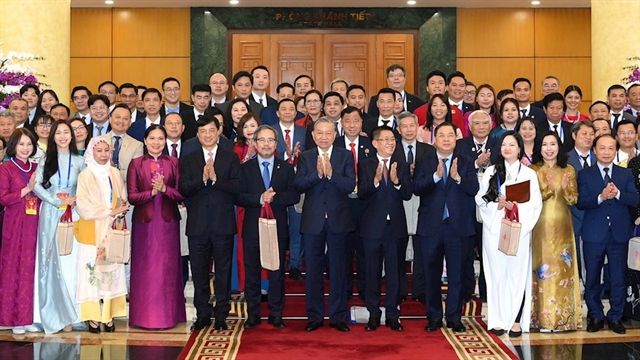 |
| Party General Secretary Tô Lâm with overseas Vietnamese attending the 2026 Homeland Spring Programme on February 8. — VNA/VNS Photo |
HÀ NỘI — The 1975 victory that ended the resistance war against the US and reunified Việt Nam was more than a military milestone, scholars say, offering a lesson in national mobilisation that remains relevant as Việt Nam looks to its diaspora to drive growth.
Phạm Thị Hồng Hà, an Institute of History scholar, says one of the central lessons of 1975 was the ability to combine domestic and international resources into a single national effort. Today, she says, that means treating the Vietnamese diaspora as a core part of the country's internal strength.
Việt Nam's overseas community is large, well-educated and globally connected, holding expertise, technology and market access that the country still lacks at home.
Some Vietnamese experts abroad have already worked directly with domestic innovation programmes, transferred technology to local firms or helped Vietnamese companies break into foreign markets.
Early partnerships between overseas specialists and domestic innovation centres have started to pay off, Hà says, sharpening the competitive edge of the businesses involved.
But the scale of that engagement still falls well short of its potential, she adds, largely because of how Việt Nam receives and deploys outside talent.
Rigid administrative procedures, inflexible research funding rules and cumbersome systems for managing high-end expertise have created an environment in which resources are underused and, in some cases, the country cannot retain the experts it does attract.
Efforts to connect with overseas intellectuals are also fragmented, Hà says, with no unified body to coordinate them. She argues that Việt Nam needs a strong central focal point capable of pulling those resources together and steering them strategically, rather than relying on scattered initiatives.
She calls for sharper policy changes: project-based hiring of experts, pay tied to capability and performance, greater autonomy for scientific institutions and pilot programmes giving emerging tech sectors greater regulatory flexibility.
Rules governing intellectual property, technology transfer and investment incentives, she says, need to be clearer, more stable and more closely aligned with international norms. Clearing those institutional bottlenecks, she argues, is key to turning the overseas Vietnamese community into a real engine of growth.
Hoàng Thị Thu Hằng, an Institute of Cultural Studies scholar, says the 1975 victory embodied the will for independence, the spirit of self-reliance and the strength of national unity, values she says must now be applied to a global competition increasingly defined by knowledge, technology and innovation, with people at the centre.
The defining feature of this stage of Việt Nam's development, Hằng says, is that national strength is no longer measured by natural resources or cheap labour but by the quality of its workforce and its capacity for creativity.
Several major policies point in that direction, particularly Resolution 57, which calls for breakthroughs in science, technology, innovation and digital transformation. The challenge, she says, is execution.
Many of Việt Nam's innovation policies are bogged down in complicated implementation, Hằng says. Systems for evaluating and using intellectuals do not reliably reward results and the research environment is not competitive enough to attract or retain top talent.
Without changes, she warns, Việt Nam will struggle to deliver the kind of breakthroughs its policy agenda envisions.
Some provinces and cities have moved on their own to build innovation networks linking research bodies, companies and government agencies. But those efforts remain scattered, she says, lacking the institutional backbone to scale or generate broader spillover effects.
Drawing on the lesson of 1975, Hằng says Việt Nam should shift from a diffuse approach to a concentrated one, channelling resources into the fields with the greatest breakthrough potential: artificial intelligence (AI), semiconductors, digital transformation and green energy.
That requires mechanisms that genuinely reward creativity: greater autonomy for researchers, evaluation tied to concrete output and a transparent legal framework.
The traditional concept of great national unity also needs to be broadened, she adds, beyond social cohesion to include public-private cooperation and stronger ties between domestic and international actors, all feeding into a single source of national strength.
What ultimately matters, both scholars say, is not how much Việt Nam has but how it organises and deploys what it has.
In a moment when opportunity and risk are deeply intertwined, awakening internal strength, placing people at the centre and creating space for creativity will determine whether the country can break through.
Translating the lessons of 1975, combined strength, self-reliance and unity, into concrete policy and substantive implementation, they say, will give the country the foundation it needs to seize new opportunities and steadily assert its position in the years ahead. — VNS
Opinion
 Opinion
 Opinion
 Opinion
 Opinion
 Opinion
 Opinion
 Opinion
 Opinion
 Opinion
 Opinion
 Opinion
 Opinion
 Opinion
 Opinion