 Opinion
VN-Index ends lower despite liquidity hit over $1 billion
1.
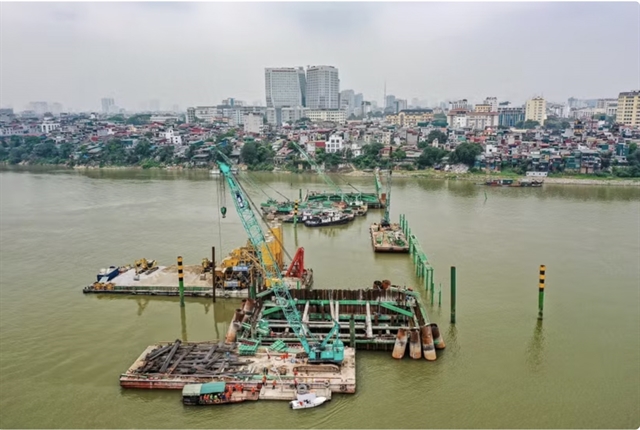 |
| TheTrần Hưng Đạo Bridge project in Hà Nội. VNA/VNS Photo |
HÀ NỘI Many key infrastructure projects have been accelerating to expand spaces for development and improve regional links, creating motivation to achieve the double-digit growth target.
According to the five-year plan for socio-economic development, national finance, public borrowing and debt repayment, and medium-term public investment for 2026-2030, linked to the goal of achieving double-digit growth, a task has been set out to 'Develop a synchronous and modern infrastructure system; promote urbanisation and urban development and regional linkages'.
Infrastructure investment is not only a solution for speeding up development in the short term, but also creates national competitiveness in the long-term.
Reporters from the Vietnam News Agency (VNA) gathered opinions from leaders of ministries, sectors, businesses and experts on solutions to enhance the effectiveness of infrastructure investment and create momentum for double-digit GDP growth.
Minister of Construction Trần Hồng Minh: Linking investment efficiency to specific targets
The Ministry of Construction identified the double-digit growth target as a strategic demand that brings the country into a rapid and sustainable development period. The ministry has focused on reviewing the portfolio of mid-term public investment in the 2026-2030 period and the scenario of the double-digit growth.
The two tasks are very urgent but require systematic implementation with specific, clear, easily understandable and comparable data.
The mid-term public investment portfolio in the 2026-2030 period also needs to be clearly and specifically structured, arranged in order from transitional projects to priority projects.
The porfolio should be categorised into groups: projects under the action programme implementing the Resolution of the 14th National Congress of the Party; key projects in the national master plan period that are likely to be completed in the 2026-2030 period; projects with spillover effects, regional linkages and promoting local economic development as directed by the Party and State leaders; and urgent projects in other specialised fields.
Reviewing and assessing the effectiveness of the project must be based on specìic targets on contribution to socio-economic development, such as Budget revenue, job creation and social security.
The double-digit growth scenario for the construction industry will clearly differentiate the industry's contribution to the overall national growth, focusing on key areas such as investment, including public investment, public-private partnerships (PPP) and private investment; transportation, warehousing, and logistics; and real estate business as a basis for building a suitable growth scenario.
Chairman of Đèo Cả Group, Hồ Minh Hoàng: assigning tasks according to capabilities
The double-digit growth target is a great requirement for the country in general and the business community, especially the private sector.
To reach the target, the transport infrastructure must be developed ahead of time. It is because it is not a condition for travel linkage but also opens a new space for development, helps reduce logistics costs, and increases the national competitiveness.
To enable domestic infrastructure enterprises to undertake large-scale projects in the coming period, they need to be assigned tasks that match their capabilities.
Once the State has a transportation network plan and identified key projects, domestic infrastructure enterprises should be given the opportunity to participate in research from the pre-feasibility stage.
This will allow enterprises to demonstrate initiative and creativity in proposing investment plans, technical solutions, construction organisation, cost control and product quality.
The government also needs to remove bottlenecks in resources, especially human resources, materials and credit.
If infrastructure businesses cannot retain employees, access medium- and long-term capital, or secure materials, sustainable development will be very difficult.
A policy of assigning jobs attached with technological transfer and human resource training is also needed.
Đồng Đăng - Trà Lĩnh Highway is a good example. As per initial planning, the project had a total investment of over VNĐ47 trillion (US$1.8 billion). After businesses participated early in the research process, proposing options, optimising routes, phasing investments and selecting appropriate technical solutions, the capital scale was over VNĐ20 trillion (US$758 million).
This proved that if businesses participate early and are allowed to propose and take responsibilities for their solutions, expenses can be effectively controlled and the investment target is ensured.
Nguyễn Minh Long, lecturer at the University of Transport: Improving mechanisms to attract investment.
Across the country, key projects such as the North-South Highway, high-speed railway, urban ring-road routes, inter-regional highways, seaports, airports and border gates have accelerated the construction progress.
The implementation and commissioning of these infrastructure projects are strategic drivers for growth, creating breakthroughs in modern infrastructure, promoting regional and inter-regional connectivity, especially for key economic regions.
The implementation and operation of the infrastructure projects are a strategic motivation for growth and creating a breakthrough for a modern infrastructure and enhancing regional linkage, especially for key economic regions.
More importantly, each work and project is not only contributing to reshape new development spaces towards modernity and synchronousity but also creating conditions for cities and provinces to bring into full play their advantages to form economic corridors, regional links and improve competitiveness and international integration.
In the future, if the capital disbursement is still maintained, Investment procedures are continuously improved, and projects are implemented on schedule, the double-digit growth target is entirely achieveable that creates a foundation for a new development period.
In order to realise the target, it is necessary to complete the investment attraction mechanism, renew bidding procedures towards transparency, efficiency and promote decentralisation.
These are considered key solutions aiming at unlocking social resources, improving investment efficiency, and creating momentum for rapid and sustainable growth in the future. VNS
Opinion
 Opinion
 Opinion
 Opinion
 Opinion
 Opinion
 Opinion
 Opinion
 Opinion
 Opinion
 Opinion
 Opinion
 Opinion
 Opinion
 Opinion