 Economy



Vietnamese Prime Minister meets Cambodian National Assembly President
1.
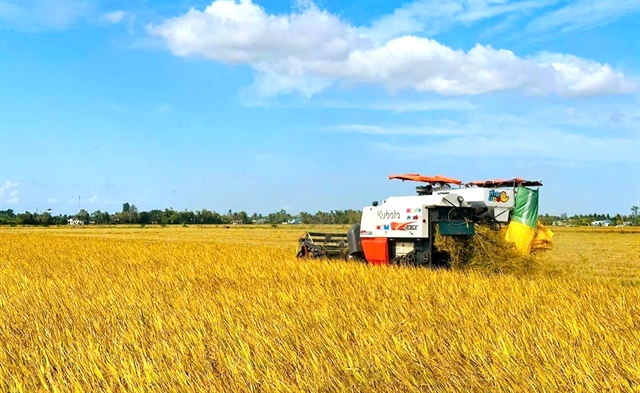 |
| A pilot site for high-quality, low-emission rice cultivation at Phước Hảo Agricultural Cooperative in Vĩnh Long Province. — VNA/VNS Photo Phúc Sơn |
HÀ NỘI — Agricultural cooperatives are emerging as key players in the country’s growing carbon credit market, as projects linked to emissions reduction and sustainable farming generate new revenue streams.
Việt Nam has registered more than 300 carbon credit projects and programmes, with around 150 initiatives already issued more than 40 million carbon credits, according to the Department of Climate Change under the Ministry of Agriculture and Environment.
Turning emissions into revenue
The expansion highlights rising interest in carbon markets across agriculture and forestry, where cooperatives are helping farmers standardise production, improve transparency and meet international certification requirements.
Nguyễn Hữu Tuệ, director of Nguyễn Gia Cooperative in Hưng Yên Province, said his cooperative has shifted most of its poultry production to cage-free farming while adopting waste treatment systems to reduce emissions.
The cooperative has begun selling carbon credits after completing certification procedures, with credits valued at more than US$2 each, Tuệ told vnbusiness.vn.
He added that the value of carbon credits in livestock farming comes not only from emission reductions but also from animal welfare standards, which are attracting growing attention from domestic and foreign organisations.
In the forestry sector, the Emission Reductions Payment Agreement (ERPA) programme in Việt Nam's north-central region sold 10.3 million carbon credits to the World Bank at $5 per credit, generating around VNĐ1.2 trillion ($46 million).
Industry experts said cooperatives are becoming essential intermediaries because farmers often lack the financial and technical capacity to meet international carbon certification standards on their own.
Experts said that when farmers work together under a cooperative model, it becomes easier to attract businesses to provide support and help implement standardised production processes. Such partnerships help ensure compliance with international standards while giving farmers greater confidence in market access.
Vũ Duy Hoàng from the Vietnam National University of Agriculture said carbon credits should be viewed as both a production model and a new form of asset, requiring transparent emissions data and strict production oversight.
He said cooperatives play a central role in maintaining those standards, creating conditions for partner companies to focus on market development and commercialisation.
When production and market access are aligned, cooperative members stand to benefit, he spoke to vnbusiness.vn.
Key hurdles persist
Despite growing interest in carbon credits, cooperatives still face significant hurdles in meeting certification standards and financing projects.
While some cooperatives receive technical and market support through partnerships, others are choosing to independently manage production and carbon certification processes, bearing upfront costs such as consulting fees and emissions assessments.
According to Bùi Quang Tuấn, director of Cây Trôm Agricultural Cooperative in Tây Ninh Province, carbon credit projects typically require investments over two to five years before credits can be sold, creating financial pressure for cooperatives in their day-to-day operations.
Market volatility also remains a major concern. Prices for carbon credits in the voluntary market can fluctuate sharply, raising the risk of losses if certification costs exceed eventual selling prices, cooperative leaders said.
Tuệ from Nguyễn Gia Cooperative said even if cooperatives meet the standards, they cannot always guarantee the sale of carbon credits. This is a market risk that participants must accept.
Experts and cooperative leaders also warned that maintaining strict compliance among members is essential. Failure by farmers to follow agreed production processes can undermine emissions targets and reduce the number of credits ultimately certified. —VNS
Economy
 Economy
 Economy
 Economy
 Economy
 Economy
 Economy
 Economy
 Economy
 Economy
 Economy
 Economy
 Economy
 Economy
 Economy