 Opinion
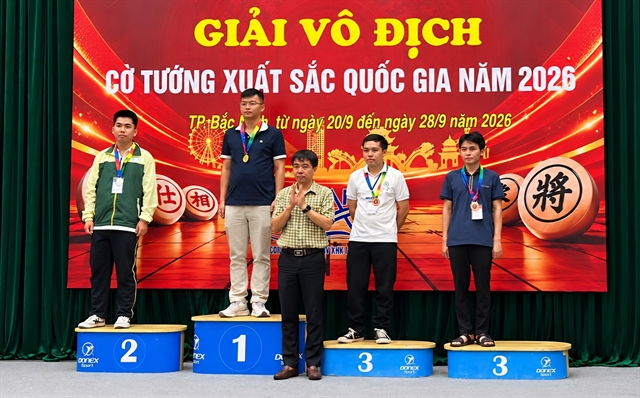
HCM City tops national Chinese chess championship in Bắc Ninh
1.
 |
| Associate Professor Dr Đỗ Văn Dũng, former rector of the HCM City University of Technology and Education. — Photo courtesy of Đỗ Văn Dũng |
The Ministry of Education and Training (MoET)’s Circular No 20/2026/TT-BGDĐT, which regulates accreditation standards for higher education institutions, officially took effect in mid-May 2026. Associate Professor Dr Đỗ Văn Dũng, former rector of the HCM City University of Technology and Education, spoke to VietnamPlus about the core criteria that are necessary to ensure universities meet the quality standards.
How do you think the MoET’s Circular No 20/2026/TT-BGDĐT will contribute to the development of Việt Nam’s higher education, particularly in helping it meet the Politburo’s goal of reaching international standards?
The issuance of Circular No 20/2026/TT-BGDĐT by the MoET is a concrete, timely and strategic step for the development of Việt Nam’s higher education system, especially in the context of implementing Politburo’s Resolution No 71-NQ/TW on breakthroughs in education and training development.
The circular marks a fundamental shift in the quality accreditation system, moving from ‘evaluation for recognition’ to ‘evaluation for continuous improvement.’ This is reflected in the introduction of ‘conditional accreditation’ status (under which institutions that fail to meet up to four standards may still receive conditional accreditation certificates valid for two years, during which they must make improvements and submit periodic progress reports).
The circular also emphasises self-assessment, the development of substantive internal quality assurance (IQA) systems, and post-accreditation monitoring through annual or biennial reporting.
Circular 20 also enhances transparency and accountability by requiring higher education institutions to publicly disclose self-assessment reports, accreditation results and improvement plans on their websites within specified timeframes. Accreditation organisations and the MoET are likewise required to publish relevant information on their online portals. It further promotes international integration by allowing foreign educational accreditation organisations (recognised by the MoET) to operate in Việt Nam.
These reforms make the accreditation system more flexible and substantive, encouraging universities to focus on actual quality rather than merely complying with formal criteria.
Circular 20 is an important legal instrument for realising the goals set out in Resolution 71.
The circular streamlines and modernises the accreditation framework, reducing the number of standards and criteria from 25 standards and 111 criteria under previous regulations to 15 standards with 60 criteria, organised into three main groups – strategy, systems and outcomes.
This helps reduce formalistic requirements, eliminate overlaps and enable universities to focus on substantive quality rather than simply meeting numerical targets, while directly supporting the international ranking goals of Resolution 71 through increased scientific publications, international cooperation and the attraction of foreign lecturers.
By assigning universities greater responsibility for self-assessment, continuous improvement and the development of IQA systems, the circular aligns with the direction of comprehensive autonomy under the revised Law on Higher Education, and the goal of enhancing university autonomy under Resolution 71.
With its mechanisms for transparency, post-accreditation monitoring and openness to foreign accreditation organisations, the circular will help improve the reputation of Việt Nam’s higher education system, attract international students, partners and investment resources, and support a stronger growth of elite research universities. In doing so, it contributes to building a culture of quality and international integration.
In summary, Circular 20 represents a transformation in quality governance in line with the spirit of Resolution 71 – from control to development, from inputs to outcomes, and from a closed system to international integration.
It provides a solid foundation for Vietnamese higher education to genuinely reach international standards, contributing to nationwide development of high-quality human resources and innovation hubs.
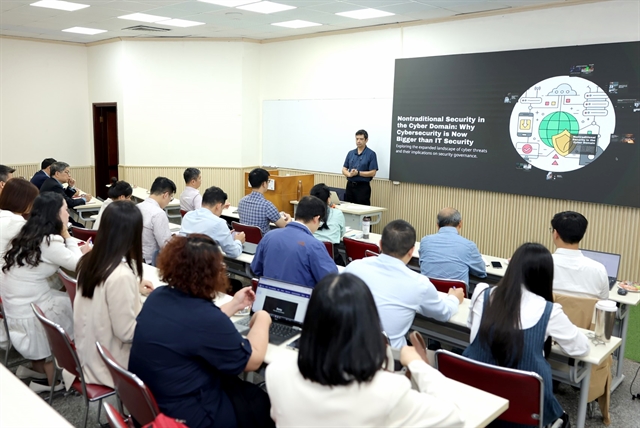 |
| A lecture at Hanoi School of Business and Management (under Vietnam National University–Hanoi), the first public higher education institution in Việt Nam to achieve QS five-star rating. — Photo courtesy of the school |
The MoET has said that Circular 20 is internationally oriented. How do you assess the standards, criteria and accreditation procedures for higher education institutions set out in the circular?
The circular’s international orientation is clearly reflected in its structure, which is organised around three main groups – strategy, systems and outcomes.
The strategy group, including vision, mission, institutional culture, governance, leadership and strategic management, emphasises long-term development orientation and leadership responsibility.
The outcomes group, including training results, research outcomes and community service, strongly emphasises output-based assessment and measuring real-world impact on learners, society and the economy.
The framework is very similar to the ASEAN University Network Quality Assurance (AUN-QA) standards, which Việt Nam has increasingly used as a regional reference point. Many of the criteria emphasise continuous improvement, stakeholder engagement and internationalisation through standards on external relations networks.
Thanks to its international orientation, the new standards are easier to compare and integrate with regional and international frameworks such as AUN-QA, ABET (Accreditation Board for Engineering and Technology), QS (Quacquarelli Symonds) and THE (Times Higher Education), thereby facilitating universities’ pursuit of international accreditation – a key factor in global rankings.
However, despite these positive aspects, Circular 20 still has certain limitations. Some criteria remain highly qualitative and require more detailed guidelines to avoid subjective assessments. The circular also does not yet fully correspond to specialised international accreditation standards such as ABET or AACSB (Association to Advance Collegiate Schools of Business) because it focuses on institutional accreditation rather than programme-level accreditation.
Overall, however, the new framework represents a significant improvement and lays a strong foundation for universities seeking international recognition. One of its highlights is the decisive shift from ‘evaluation for recognition’ to ‘evaluation for continuous improvement.’
It also aims to enhance transparency and accountability while promoting international integration by allowing recognised foreign accreditation organisations to operate in Việt Nam.
That said, the practical effectiveness of the circular will depend heavily on the capacity of accreditation organisations, the quality of external evaluators and the commitment of universities themselves to genuine improvement.
Under Circular 20, universities may still pass accreditation even if they fail a number of criteria, as there are no mandatory core criteria that must be met. Some experts warn this could result in institutions being accredited despite not meeting essential quality standards. What is your view on this concern?
This provision in Article 20(3)(a) is reasonable because it provides flexibility and encourages continuous improvement instead of forcing institutions to focus narrowly on meeting each individual criterion.
However, these concerns are well-founded and deserve attention, especially when a university could fail up to 17 out of 60 criteria (nearly 28 per cent) or fail 50 per cent of the criteria under certain two-criterion standards and still be recognised as accredited.
Do you think there should be mandatory standards or criteria? If so, which core standards or criteria should be mandatory, and why?
I believe mandatory criteria are necessary. Certain key standards or criteria should be required to meet a 100 per cent threshold, or at least a high minimum benchmark, to ensure minimum quality standards and preserve the real value of accreditation certificates.
The mandatory core standards or criteria should include strategic governance and leadership (standards 1 and 2); IQA systems (standards 9 to 11); faculty human resources (standard 3); training outcomes and graduate employment (standard 12); and financial sustainability and infrastructure (standards 4 and 15).
These are the foundational factors that determine an institution’s educational mission and its capacity to achieve international standing under Resolution 71. Without them, accreditation risks becoming superficial, weakening public trust and hindering international integration.
Based on your analysis, what are your recommendations to ensure Circular 20 effectively achieves its objectives?
I believe detailed implementation guidelines should be issued immediately, including templates on self-assessment, scoring systems and specific evaluation criteria, along with large-scale training programmes for evaluators and university staff on the new accreditation procedures.
The MoET should also supplement the implementation guidelines with a list of mandatory core criteria, including strategic governance, IQA systems, faculty resources, graduate outcomes and financial sustainability, in order to balance flexibility with substantive quality assurance.
In addition, a transparent online portal should be established to publicly disclose accreditation results and improvement plans for each institution, alongside a robust post-accreditation monitoring mechanism and technical support for conditionally accredited institutions. Cooperation with international accreditation organisations such as AUN-QA and ABET should also be strongly encouraged in order to raise substantive standards.
These measures would help transform accreditation from a formal process into one focused on genuine improvement, while effectively supporting the goal of bringing Vietnamese higher education to international standards under Resolution 71. — VNS
Opinion
 Opinion
 Opinion
 Opinion
 Opinion
 Opinion
 Opinion
 Opinion
 Opinion
 Opinion
 Opinion
 Opinion
 Opinion
 Opinion
 Opinion