 Opinion

Vietnamese Prime Minister meets Cambodian National Assembly President
1.
 |
| Former Deputy Chief of Office of the National Traffic Safety Committee Khương Kim Tạo. — VNA/VNS Photo |
Railway traffic violators are expected to face much heavier fines under Decree No. 81/2026/NĐ-CP, which will take effect from May 15. Former deputy chief of office of the National Traffic Safety Committee Khương Kim Tạo speaks to Tin tức và Dân tộc (News and Ethnic Affairs) newspaper about the complicated situation regarding railway traffic violations in Việt Nam.
Issued on March 19, 2026, Decree 81 replaces railway-related penalty provisions under Decree No 100/2019/NĐ-CP.
Accordingly, drivers of cars who cross railway barriers or shared bridges when the red signal is on will be fined approximately US$700–800 and have their driving licences suspended for between one and three months (compared with $120–200 under Decree 100). Motorcyclists committing the same violation can be fined $160–240 and face licence suspension for between one and three months (compared with $25–40 previously).
These fines are equivalent to red-light violations in road traffic under Decree No. 168/2024/NĐ-CP.
How do you view the higher penalties for railway traffic violations under Decree 81?
Today, many drivers remain careless, driving across railway crossings when the signal has turned red and the barriers are lowering, especially motorcyclists and users of rudimentary vehicles, which is very dangerous behaviour. Increasing the fines is a deterrent against such dangerous actions.
In addition to monetary penalties, Decree 81 also applies a point deduction system on driving licences. This is an effective measure because even if violators have financial capacity, repeated violations leading to a loss of all points will result in the loss of their right to operate vehicles.
In reality, many recent accidents have occurred due to drivers not complying with the law when passing railway crossings, causing serious loss of life and property. In my opinion, alongside increasing penalties, enforcement arrangements, communication efforts and strict handling of violations are extremely important.
For example, the act of illegally opening crossings or residential access points is a main cause of railway traffic accidents.
Under Decree 81, this act is subject to very heavy fines, about VNĐ20 million ($780) for individuals and VNĐ40 million ($1,520) for organisations. However, without thorough enforcement, this situation has persisted for years.
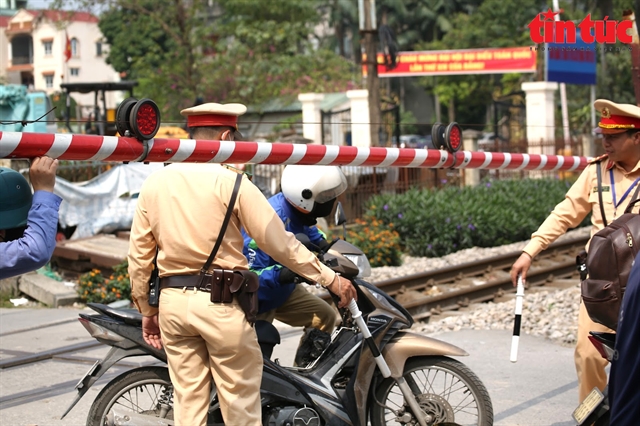 |
| Traffic police handle a motorcyclist deliberately crossing a railway barrier. — VNA/VNS Photo |
How will the expanded sanctioning powers of the chairperson of the commune-level People’s Committee under Decree 81 improve enforcement?
Chairpersons of commune-level people’s committees are authorised to sanction violations specified in Decree 81 within their local management areas.
Accordingly, they have the power to issue warnings, impose fines of up to VNĐ37.5 million ($1,425), suspend the use of driving licences or transport operations for a fixed period, confiscate exhibits and means of administrative violations, and require violators to apply remedial measures in accordance with regulations.
In my opinion, assigning this authority to commune-level chairpersons is entirely appropriate as we are implementing a two-tier local government model and promoting decentralisation. Commune-level authorities must have both the responsibility and authority to resolve all issues related to traffic safety and order in their areas, including railway traffic.
If both local authorities and the police proactively engage and strictly implement these regulations, I believe that the implementation of Decree 81 will achieve practical effectiveness.
How can violations at automated railway crossings be reduced, especially among motorcycles and rudimentary vehicles?
We are living in a digital era where technology can intervene in many aspects.
In the transport sector, AI-powered cameras can detect and warn of traffic violations, serving as a basis for administrative sanctions. There are behaviours that may be disputable when observed by the naked eye, but camera images provide clear evidence. They can record even if a vehicle crosses the red light for a fraction of a second.
In practice, cold fines for cars have been widely implemented, but there are still many challenges when it comes to motorcycles and rudimentary vehicles. We must upgrade technology so that cameras can not only recognise licence plates but also identify faces, verify the authenticity of licence plates and track vehicle movements, thereby determining violators’ identities for handling.
However, from a professional perspective, I believe we must accelerate the development of high-speed rail, separating railway safety corridors from residential routes to both ensure traffic safety and facilitate urban management. — VNS
Opinion
 Opinion
 Opinion
 Opinion
 Opinion
 Opinion
 Opinion
 Opinion
 Opinion
 Opinion
 Opinion
 Opinion
 Opinion
 Opinion
 Opinion