 Opinion

Weaving the unique heritage of the Thu Lao
1.
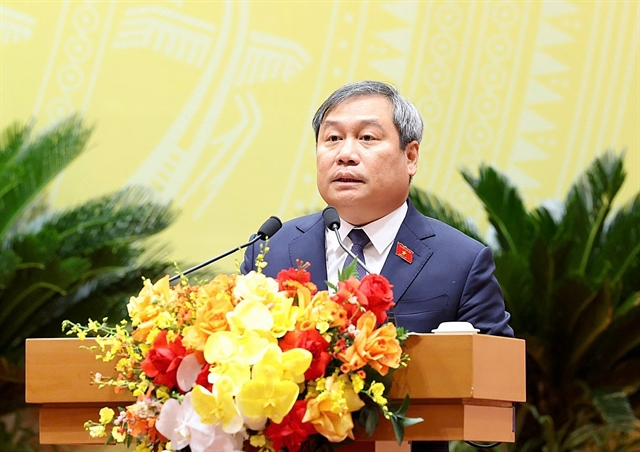 |
| Chairman of the Hà Nội People’s Committee Vũ Đại Thắng. — VNA/VNS Photo |
Vietnam News Agency speaks to Chairman of the Hà Nội People’s Committee Vũ Đại Thắng on key innovations and impacts of the freshly approved revised Capital Law.
Could you outline the main points of the revised Capital Law that was just approved with overwhelming support?
First of all, on behalf of the Hà Nội authorities, I would like to express our appreciation to the Party, the National Assembly, the Government, central agencies, provinces and cities nationwide, as well as experts, scientists and National Assembly deputies for their support in passing the revised Capital Law.
The high level of consensus reflects the shared aspiration for Hà Nội to have special mechanisms to further develop, commensurate with its position and role as the capital and to lead development nationwide.
The adoption of the law demonstrates strong political determination from the central level, the city and society as a whole, aiming to provide Hà Nội with superior institutions to realise the goal of building a cultured, civilised, modern and happy capital with regional and global standing, as set out in Politburo Resolution No. 02-NQ/TW dated March 17 and the capital’s master plan with a 100-year vision.
The amended law adopts a new approach, emphasising comprehensive decentralisation and delegation of authority alongside oversight and accountability mechanisms, ensuring the capital has sufficient powers, tools and resources to proactively decide, implement and take full responsibility for development issues. This is a breakthrough in the law.
With more than 190 powers granted to the city, what are the key breakthroughs for Hà Nội development?
The law introduces strong decentralisation in several areas.
For example, the city is granted greater autonomy in organisational structure and staffing, with the People’s Council empowered to decide staffing levels within the political system.
Authorities are also given more flexibility in recruitment, appointment and evaluation of civil servants.
The city may adopt special mechanisms to recruit, hire and manage leaders of public service units and State-owned enterprises.
The law also expands the authority to issue legal documents, allowing the city to promulgate regulations to guide the implementation of laws and National Assembly resolutions, even in areas where central regulations have yet to be issued.
In addition, the law enables Hà Nội to proactively design and pilot new or different policy mechanisms to address institutional bottlenecks.
In resource management, the city is authorised to regulate the use of land, forests and water resources, as well as compensation, resettlement, land allocation and land-use purpose conversion in line with approved plans.
In planning and construction, Hà Nội can issue its own mechanisms and policies for urban planning and development, including green and smart urban models, transit-oriented development (TOD) and urban renovation and regeneration.
In finance and investment, the city is empowered to manage its budget structure, decide on credit policies, establish development funds and approve major investment projects.
It may also apply new methods for selecting investors and contractors, promote public-private partnerships and introduce innovative models across sectors, such as science and technology, education, health care and social welfare.
These mechanisms will enable Hà Nội to innovate governance, mobilise resources effectively, improve living standards and drive development not only in the capital but also in surrounding regions and across the country.
The amended Capital Law also introduces mechanisms to attract, utilise and develop human resources, as well as to protect officials who are willing to take initiative and responsibility.
It provides for the exclusion or exemption of legal liability for those involved in drafting, promulgating and implementing the law, in cases where they act without personal gain and in full compliance with prescribed authority, procedures and processes, even if losses or damages occur in the course of performing their duties.
This is an important mechanism to attract experts, scientists and highly qualified, experienced and dedicated individuals to participate in building, managing and developing the capital, while also easing concerns among officials and public employees when implementing the law’s breakthrough policies.
With greater authority comes greater accountability and power management. What measures will the city take to ensure the right, effective and transparent implementation of the law?
The guiding principle mentioned in Resolution No. 02-NQ/TW is to strictly enforce regulations on anti-corruption, thrift and accountability, while enhancing autonomy and responsibility at all levels.
The newly adopted amended Capital Law, which grants extensive decentralisation and delegation of authority to the capital, reflects the trust placed in and the responsibility assigned to the city government to proactively carry out development, management and governance tasks.
This strong decentralisation is accompanied by enhanced oversight and inspection by competent agencies, as well as accountability at all levels of the city administration in implementing the law, in order to establish a synchronised and stringent power control mechanism throughout its execution.
At the same time, the law ensures that mechanisms and policies are applied within proper authority, aligned with their intended objectives and implemented transparently and efficiently, consistent with national interests.
To ensure the proper, effective and transparent implementation of the amended Capital Law, the city will carry out a set of coordinated measures as follows.
First, we must clearly define responsibilities in terms of personnel, tasks, timelines, accountability, deliverables and authority for agencies and units under the city in organising the implementation of the law.
Second, we will regularly conduct inspections, provide guidance and supervision and promptly address and resolve difficulties and obstacles arising during implementation.
Third, we will strengthen inspection, examination and supervision of the enforcement of the law within its management scope and strictly handle violations and shortcomings in the process of building, developing and protecting the capital.
Fourth, we plan to strictly enforce regulations on transparency and disclosure, enhance accountability in land use, investment project implementation, administrative procedures and other areas in accordance with the law, enabling the public to be informed, provide feedback and monitor the implementation of the law.
Fifth, local authorities will strictly comply with the provisions of the revised Capital Law, as well as oversight, reporting, inspection and auditing requirements by central authorities, while ensuring accountability of the city government during its implementation.
 |
| Light performance at Hoàn Kiếm Lake during Lunar New Year holiday 2026. — VNS Photo Khánh Dương |
As the capital and the country’s political and administrative centre, how do you expect Hà Nội to promote its leading and spillover role in implementing new mechanisms and policies for other localities when enforcing the revised Capital Law?
With its position as the heart of the nation, Hà Nội will not only benefit from special mechanisms for its own development.
The revised Capital Law is designed so that the capital is not only a policy implementer but also entrusted with a higher-level role as a policy designer to meet development goals, requirements and expectations in the new era.
Beyond decentralising specific powers, the law also authorises the capital to issue normative legal documents under special mechanisms, enabling it to develop to a level comparable with regional and international standards and to lead and spread development across the capital region and the country.
The revised Capital Law also allows the city to pilot mechanisms and policies that differ from existing laws or National Assembly resolutions, or that are not yet provided for in current legislation.
This reflects a high level of special authorisation granted to the capital, creating flexible institutional space to experiment with new governance and development models.
This serves as a foundation for Hà Nội to take the lead in policy innovation and meet the requirements of rapid and sustainable development.
The law permits Hà Nội to pilot new policy models in organisational structure, civil service regimes and public administration.
It also enables new economic models based on science and technology, innovation, digital transformation, education and training, culture, health care and public health.
In addition, it supports models of ecological agriculture, high-tech agriculture and urban agriculture, as well as new approaches to urban and rural management, spatial planning and sustainable development.
It also allows for innovative methods of mobilising, allocating and efficiently using resources for the capital’s development and governance.
These provisions provide a foundation for the city to implement advanced and modern governance and development models based on technology and data, helping to optimise the use of spatial resources, ensure a balance between economic growth, environmental protection and the preservation of urban identity and effectively mobilise social resources to realise the goal of building the capital.
 |
| A green corner on Kim Mã Street. — VNA/VNS Photo Vũ Quang |
The revised Capital Law will take effect on July 1. However, we will apply several specific provisions early to help drive the city’s development momentum. How is Hà Nội preparing for its implementation to bring the law into practice at the earliest opportunity?
The revised Capital Law was passed by the National Assembly and will take effect from July 1, with Clause 4, Article 8 and Clause 6, Article 36 taking effect from the date of adoption. At present, the law provides a general framework, with detailed implementation to be developed.
To prepare for its enforcement, Hà Nội is rolling out a series of coordinated measures aimed at translating the law into practice as soon as possible.
First, the city will promptly issue implementation plans covering communication, dissemination and training on the Capital Law. Particular attention will be given to the issuance of guiding documents to ensure both progress and quality in line with the spirit of the amended law.
The municipal People’s Council will hold thematic and regular sessions to review and approve documents guiding the implementation of the law, while the People’s Committee and its chairman will also develop plans to issue documents within their respective authority.
The guiding principle is to implement immediately what is clear and feasible, while more complex issues will follow a phased and appropriate roadmap.
Second, the city has reviewed and identified provisions requiring detailed regulations, including policies that will continue to be applied under the framework inherited from the Capital Law No. 39/2024/QH15 to ensure continuity, as well as new policies introduced under the amended law.
Relevant departments and agencies have also been assigned to draft implementing documents in parallel with the legislative process.
By the time the law was adopted, more than 110 of over 150 delegated provisions had already been prepared, while remaining broader and longer-term matters will continue to be studied and completed in line with the capital’s development needs.
Third, the city has prepared financial and human resources to ensure the effective implementation of policies delegated by the central authorities under the amended law.
It is also prioritising improvements in the capacity of officials and civil servants, engaging experts and scientists in both drafting and implementation, and strengthening transparency and oversight throughout the process.
In particular, coordination among key city bodies, including the Party Committee, People’s Council, People’s Committee and the Việt Nam Fatherland Front, will be enhanced to ensure consistency in drafting, issuing and implementing the law and its guiding documents. — VNS
Opinion
 Opinion
 Opinion
 Opinion
 Opinion
 Opinion
 Opinion
 Opinion
 Opinion
 Opinion
 Opinion
 Opinion
 Opinion
 Opinion
 Opinion