Life & Style
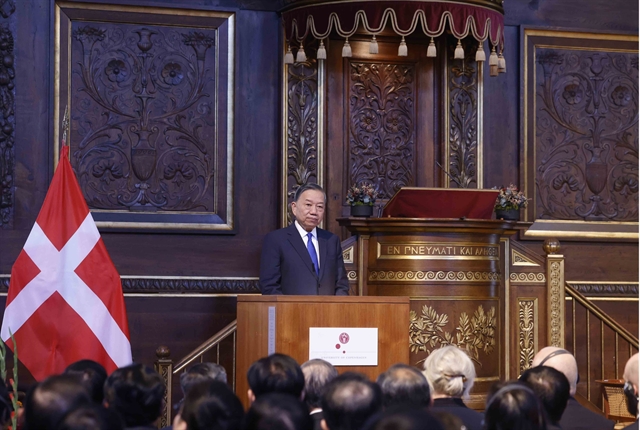
Top Vietnamese leader highlights new horizon for Việt Nam–Denmark cooperation
1.
 |
| Artist Dương Linh Đan. Photo coutersy of the artist |
HÀ NỘI — Precocious artist Dương Linh Đan has graduated top of her class from the Việt Nam University of Fine Arts. The hearing-impaired artist is presenting lacquer paintings at her first solo exhibition at the Việt Nam Women’s Museum.
Việt Nam News reporter Nguyễn Bình interviews Linh Đan about her first exhibition.
Could you introduce your first solo exhibition, and how did the idea come to you?
Touching the Silence is my first solo exhibition featuring around 30 lacquer paintings created over the past few years.
One of my paintings is Phồn Sinh (Prosperity), which is my graduation work and received the highest score in my class. It depicts women and nature, aspiration and vitality.
After completing Prosperity, I planned to organise a solo exhibition to further explore the theme of women and nature, especially the Mimosa pudica plant.
It is a wild plant that few people pay attention to. Its leaves look fragile, and when touched, they fold inward. It may appear delicate yet it has strong vitality. I want to borrow the image of this plant to portray women.
In a way, Mimosa is also how I describe my own emotions as I prepare for the exhibition. I feel both nervous and grateful. I have a greater sense of responsibility toward each of my works and I also feel happy to be walking the path I have chosen.
Over time, as I gradually developed a body of work and gained greater experience, and with the encouragement and support of my family, I was finally able to turn that long-held aspiration into reality.
You have experimented with and expressed your personal style through various media such as silk, oil on canvas, gouache and illustration. What kind of medium do you like?
Lacquer painting is the major I studied at the Việt Nam University of Fine Arts. It requires a great deal of creativity. The beauty of a lacquer work also lies in the polishing process, a completely handcrafted stage that often contains an element of unpredictability depending on the artist’s emotions at the time.
The polishing and finishing stages demand delicate technique, gradually revealing layers of colour that can appear vibrant and luminous or deep and contemplative.
The surface becomes smooth and glossy, catching the light through materials such as gold, silver or mother-of-pearl.
For my first solo exhibition, I want to begin with the medium that feels closest to me and the one I understand best.
What themes do you pursue? Is there an underlying message in your work?
I don’t confine myself to a fixed theme but I am often drawn to the inner world of people and to very subtle emotions.
Whenever I begin a painting, I usually ask myself three simple questions: what I want to paint, why I want to paint it and what I want to express through that image.
What advantages and challenges did you face while preparing for your first solo exhibition?
The greatest advantage for me has been the strong support I received from my family, teachers, friends and colleagues. Their encouragement gave me the confidence to carry out my first solo exhibition.
During the process of preparing and completing the works, I was also fortunate to have the opportunity to work with 84Space, Trần Quang Tuấn, painter Nguyễn Đình Văn and the Việt Nam Women’s Museum. With such wholehearted support from everyone involved, I was able to present my first solo exhibition in a way that feels truly fulfilling.
Of course, preparing a solo exhibition brings many challenges, not only completing the artworks themselves but also arranging the exhibition space as well as handling organisation and communication. Yet the process has also been an invaluable learning experience for me.
What inspired you to become an artist?
I have loved drawing since childhood and I was fortunate to have the support of my family, which allowed me to confidently pursue the path I wanted.
I have also been encouraged by my family, teachers and friends. Their trust and support have given me the motivation to continue painting for the long term.
Which artists influence you most?
I have observed and learned from many artists in Việt Nam and abroad. Each of them has offered me a different perspective on painting, from the way they handle materials and colour to how they construct their own visual worlds.
However, the most significant influence on me has come from my teachers during my studies at the university. They helped me gain a deeper understanding of lacquer as a medium and guided me in finding my own artistic voice.
What advice or encouragement would you offer to artists facing disabilities or other challenges in life?
Circumstances may place more obstacles in your path than in others’, but you should never see yourself as being at a disadvantage.
If you begin from a place of difference, use that difference as your own perspective. You don’t need to pretend to be strong. What matters is not giving up and continuing to do the best you can within your own abilities.
In your view, what role do artists play in society? And how might that role evolve in the future?
I think artists are observers who reflect life in their own distinctive way. Art is not only meant for decoration or appreciation, it also helps enrich people’s inner lives and deepens the way we experience the world.
In the future, I believe that role will become even more diverse. Artists may not only create within traditional spaces but also connect with communities, technology and many other fields of society.
Yet regardless of the time or context, the essence of art remains the same, the sincerity of the artist’s emotions and their personal way of seeing the world. — VNS
Life & Style
 Life & Style
 Life & Style
 Life & Style
 Life & Style
 Life & Style
 Life & Style
 Life & Style
 Life & Style
 Life & Style
 Life & Style
 Life & Style
 Life & Style
 Life & Style
 Life & Style