 Life & Style

AITO Looks Ahead to Europe, Building a Thriving Automotive Ecosystem
1.
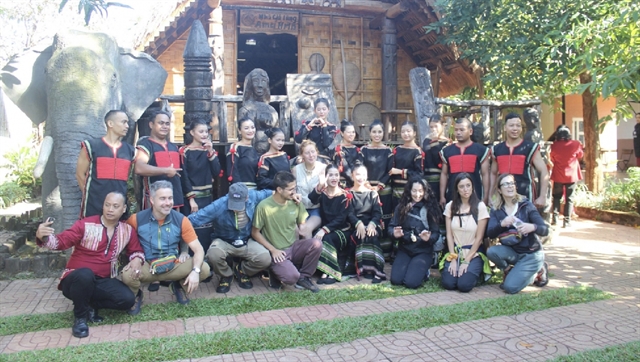 |
| Tourism staff and visitors take a group photo at a traditional cultural venue, highlighting cultural exchange within the Central Highlands–South Central Coast tourism linkage. — Photo vov.vn |
KHÁNH HÒA — Khánh Hòa Province is expected to play a leading role in strengthening the Central Highlands–South Central Coast tourism linkage, with local businesses actively developing inter-regional products to exploit a wide range of complementary tourist advantages.
While bringing his family for the first time from Buôn Đôn Commune in Đắk Lắk Province to Nha Trang for a holiday, Niê Y Trang said he was excited to experience the sea, stroll along the beachfront and enjoy seafood.
He noted that if the Khánh Hòa–Buôn Ma Thuột expressway is completed soon, travel, trade and tourist flows between the two regions would increase significantly.
From clear practical demand among travellers, tourism businesses in Khánh Hòa and Đắk Lắk have begun proactively connecting to develop inter-regional products.
Nguyễn Minh Trí from Minh Trí Travel Company in Đắk Lắk said linking destinations would create a route that combines sea, forests, culture and cuisine, forming a complete tourism product with diverse experiences.
Many enterprises in the two localities have joined hands to develop inter-regional tourism packages, expanding the experience space for visitors instead of exploiting destinations separately.
Complementary tourism space
The merger from four former provinces has created a multi-coloured tourism landscape that brings together sunshine and wind, islands and beaches, highlands, forests and diverse ethnic cultural spaces. When connected, each area complements the others, helping visitors stay longer, spend more and increase value across the tourism chain.
Lê Chí Công, PhD, head of the Faculty of Tourism at Nha Trang University, said the Central Highlands–South Central Coast is a unique development space that brings together forests, sea, highlands and ethnic cultural identities.
However, incomplete transport infrastructure linking Khánh Hòa and Đắk Lắk remains a major bottleneck, affecting the development of inter-regional tours. Limitations in human resources and the application of science and technology also continue to constrain breakthroughs in regional tourism.
According to Công, the strategic breakthroughs identified by the recent 14th National Congress of the Communist Party of Việt Nam provide the basis to address these limitations. In particular, infrastructure connectivity will help form inter-regional tourism routes and spaces, extend length of stay, increase visitor spending and enhance destination competitiveness.
At the same time, developing high-quality tourism human resources linked to the region’s cultural and ecological characteristics will help improve service quality and promote community-based tourism.
Businesses reposition
Aligning with this orientation, Khánh Hòa’s business community is proactively restructuring operations, focusing on experience-rich products, improving service quality and strengthening value-chain linkages.
Chairman of the Khánh Hòa Tourism Association Phạm Minh Nhựt said the province will focus on repositioning, restructuring, digital transformation and green, sustainable development in line with growth targets set by the 14th National Party Congress.
Although Khánh Hòa has the most developed tourism sector in the South Central Coast–Central Highlands region, its potential has not yet been fully realised, particularly in large-scale shopping centres, services and the night-time economy. While visitor numbers are high, spending levels remain relatively low compared to other domestic destinations, and the province’s leading and supporting role for neighbouring localities has not been fully leveraged.
With a target of welcoming 18.8 million visitors and generating revenue of VNĐ77 trillion in 2026, Khánh Hòa aims for tourism to truly become a spearhead economic sector, making an important contribution to the province’s double-digit growth phase.
Vice Chairman of the Khánh Hòa People’s Committee Nguyễn Long Biên stressed the need to develop products featuring two distinct identities, organise more major programmes and events, open additional flights and transport routes, and strengthen large-scale promotion and marketing.
In the new context, regional linkage between the Central Highlands and the South Central Coast is not only a short-term solution but also a long-term strategic direction.
With infrastructure constraints eased, businesses renewing their thinking and local authorities proactively creating development space, tourism in Khánh Hòa and the wider South Central Coast has a solid foundation to take off in a sustainable manner and contribute more strongly to regional and national economic growth. — VNS
Life & Style
 Life & Style
 Life & Style
 Life & Style
 Life & Style
 Life & Style
 Life & Style
 Life & Style
 Life & Style
 Life & Style
 Life & Style
 Life & Style
 Life & Style
 Life & Style
 Life & Style