 Society

Sell-off risks rise as VN-Index nears resistance: experts
1.
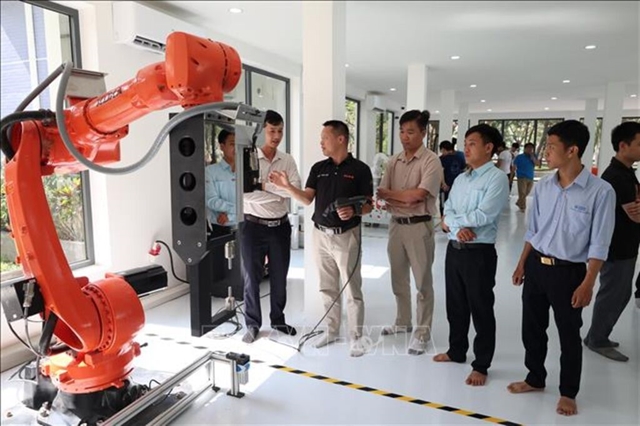 |
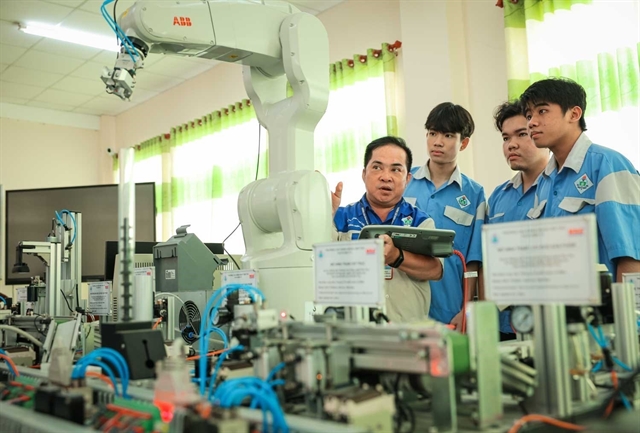
| Testing industrial robots at the University of Science and Technology – University of Đà Nẵng. — VNA/VNS Photo |
GENEVA — The World Intellectual Property Organisation (WIPO)'s Global Innovation Index (GII) 2026 report ranked Việt Nam 43rd among 139 countries and economies, making it a leading example of how to turn the index into a practical tool for action.
In an interview recently granted to Vietnam News Agency correspondents in Switzerland, Sacha Wunsch-Vincent, head of Section, Economics and Statistics Division and co-editor of the GII report, gave insights into this year's theme: "Powering Entrepreneurs at the Frontier of Science: Turning Pilots into Pipelines".
According to him, the theme underscores the need to turn scientific breakthroughs into startups and technology commercialising firms. Doing so requires countries to combine three core elements.
The first is a strong research system, where universities and scientists patent inventions and found companies around them. The second is long-term financing: a sustainable funding chain, especially late-stage venture capital, that spans 10 to 15 years and supports projects from prototype to industrial-scale production. The third is dynamic businesses with a heavy focus on research and development (R&D) to bring products to market.
Wunsch-Vincent said the GII has evolved beyond a ranking into a policy diagnostic tool used by about 70 per cent of WIPO member states, or nearly 100 countries.
Việt Nam earned "full marks" on all three criteria for using the index effectively, he said. The first is in-depth research. Việt Nam works closely with WIPO and analyses its strengths, weaknesses and long-term trends in detail.
The second is pooling resources nationwide. Việt Nam set up a dedicated GII working group linking central and local authorities and adopted ambitious targets, notably lifting R&D spending to 2 per cent of gross domestic product.
The third is systematic monitoring and promotion of innovation at the local level, shown by annual tracking of performance results. Việt Nam's creation of its own Provincial Innovation Index (PII) has burnished the capacity of individual cities and provinces.
He said Việt Nam's approach to adopting the GII and coordinating with government agencies at both central and local levels is an invaluable lesson many other countries are studying and trying to replicate. Việt Nam has thereby contributed considerably to capacity building and sci-tech cooperation, and its PII has prompted many other WIPO members to adopt similar models.
Looking ahead, he praised the close cooperation between the two sides, which goes well beyond the GII report. WIPO will keep helping Việt Nam make effective use of the IP system, including not only patents but also trademarks and industrial designs, to help local companies raise their value and move up in global supply chains, he said.
The two sides will also deepen cooperation in strategic areas, including accelerating technology transfer from research institutes and universities to companies and expanding IP-based financing, such as using patents as collateral, laying a foundation for faster growth in the years ahead, he added. — VNA/VNS
Society
 Society
 Society
 Society
 Society
 Society
 Society
 Society
 Society
 Society
 Society
 Society
 Society
 Society
 Society