 Society

Cambodian PM Hun Manet chairs welcome ceremony for Vietnamese counterpart Lê Minh Hưng in Phnom Penh
1.
|
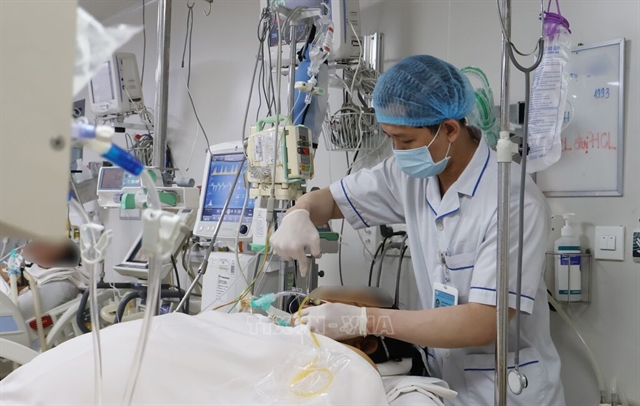
| A doctor at the Hospital for Tropical Diseases in HCM City treat a patient with severe dengue fever. —VNA/VNS Photo |
HCM CITY — Dengue fever cases are rising rapidly in HCM City, with more than 1,000 new infections reported each week, according to the HCM City Centre for Disease Control (HCDC).
HCM City has recorded 32,626 dengue fever cases since the beginning of 2026, a figure significantly higher than that of the same period last year.
During the past week, there were 1,544 cases.
Between August 3 and September 6, the city recorded more than 1,000 new cases a week.
Dr Lê Hồng Nga, deputy director of HCDC, said that dengue fever circulates year-round and affects all age groups.
The number of cases typically rises and peaks around October.
This seasonal increase is driven by the characteristics of the Aedes mosquito, the disease vector.
The Aedes mosquitoes lay their eggs exclusively in clean, stagnant water found in household items such as buckets, basins, flower vases, and water bowls, or in outdoor containers that collect rainwater, Nga said.
Therefore, it is essential to manage the environment, specifically by eliminating mosquitoes and their larvae, and to adopt measures to prevent mosquito bites, she said.
Vaccination against dengue fever helps establish active, long-lasting immunity, she added.
Dr. Nguyễn Thanh Phong, deputy director of the Hospital for Tropical Diseases in HCM City, said that the number of patients hospitalised for dengue fever has been rising over the past few months.
In June, more than 600 cases were recorded, he said.
The figure rose to nearly 1,300 in July and exceeded 1,500 in August, he added.
In the first half of September alone, the number of patients reached nearly 900.
There is a rising trend in severe cases compared to previous years, he said.
The hospital’s Intensive Care and Poison Control Department has recently been treating an average of nine to seven severe cases per week, with some weeks seeing as many as seven or eight, he said.
Patients with severe dengue fever often require intensive care, he said.
In response to local outbreaks, health stations across various localities have deployed task forces to spray chemicals, eliminate breeding sites, and clean up environments.
The Bà Rịa Ward Health Station has coordinated with local authorities to eliminate mosquito larvae and spray insecticide immediately after a dengue fever outbreak was detected in Long Tâm quarter.
Bà Rịa Ward alone has recorded 28 dengue cases and eight outbreaks, prompting immediate response.
HCDC recently dispatched a task force to coordinate with the Hồ Tràm Commune People’s Committee in monitoring and managing outbreaks and effectively controlling the local dengue situation.
Hồ Tràm Commune recorded 100 dengue cases and 49 outbreaks in the area during the first eight months of the year.
Đông Hòa Ward has taken measures to address high-risk sites, eliminate larvae, and improve environmental sanitation across 16 quarters, in response to a rapid rise in dengue cases.
The ward recorded more than 525 cases, an increase of 303 compared to the same period last year. —VNS
Society
 Society
 Society
 Society
 Society
 Society
 Society
 Society
 Society
 Society
 Society
 Society
 Society
 Society
 Society