 Society
Incentive policies drive robust sales growth for automobile sector
1.
|
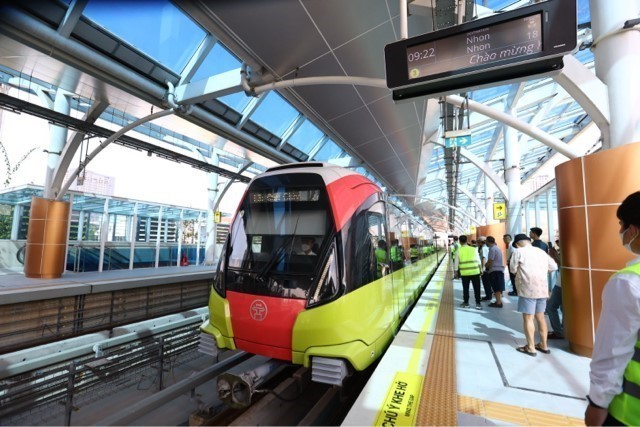
| Hà Nội operates commercial passenger services on the elevated section of the Nhổn–Hà Nội Railway Station urban railway line, which runs 8.5km from Nhổn to S8 Station. — VNA/VNS Photo |
Khánh Linh
HÀ NỘI — The Moov’Hanoi project, a technical assistance programme aimed at improving and promoting the development of a multimodal transport network in Hà Nội, was wrapped up on Friday after two years of implementation.
The project, co-financed through a non-refundable grant from the Île-de-France Region of France and implemented under the framework of decentralised cooperation between the Île-de-France Region and Hà Nội, was carried out in 2025–26 with total funding of nearly VNĐ33.2 billion (US$1.26 million).
The project aims to enhance the attractiveness of public transport in Hà Nội and support the city in establishing an integrated multimodal public transport network.
It focuses on improving passenger travel routes and accessibility across different modes of transport, particularly pedestrian access to stations, while reorganising the existing bus network to improve the overall efficiency of public transport.
The project was implemented in close coordination with relevant Vietnamese agencies through field surveys, data collection and technical studies.
|
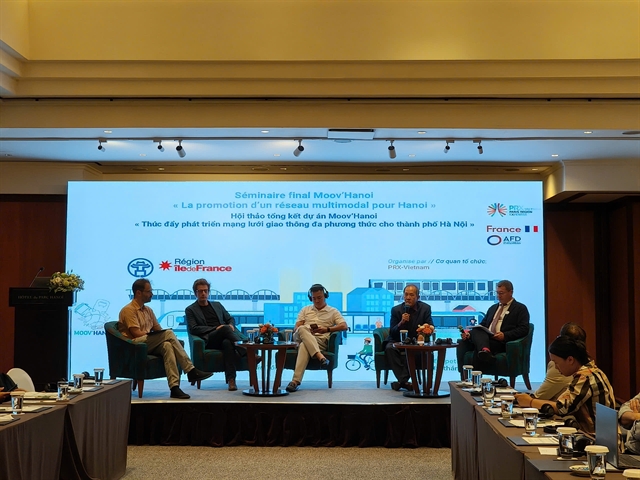
| Delegates at the seminar. — VNS Photo Khánh Linh |
Hà Nội is experiencing rapid urbanisation and population growth, placing increasing pressure on its transport system. Traffic congestion, air pollution, road safety concerns and pressure on public spaces remain major challenges, while motorcycles and cars account for more than three quarters of all trips in the city.
Against this backdrop, shifting travel patterns towards public transport and active modes of mobility such as walking and cycling is considered an important means of promoting more sustainable urban mobility.
The approach is based on three main priorities: strengthening the backbone of the public transport network, particularly metro and bus services; improving their attractiveness and competitiveness; and gradually reducing the share of carbon-intensive trips in the city.
Metro is expected to serve as the backbone of this transformation. Hà Nội currently has two metro lines in operation, while other projects are under development or being planned.
The long-term goal is to establish a comprehensive interconnected network capable of meeting the growing travel demand of a rapidly developing capital. Buses will play an important complementary role, with network restructuring helping improve services to residential areas and connections with urban rail.
|
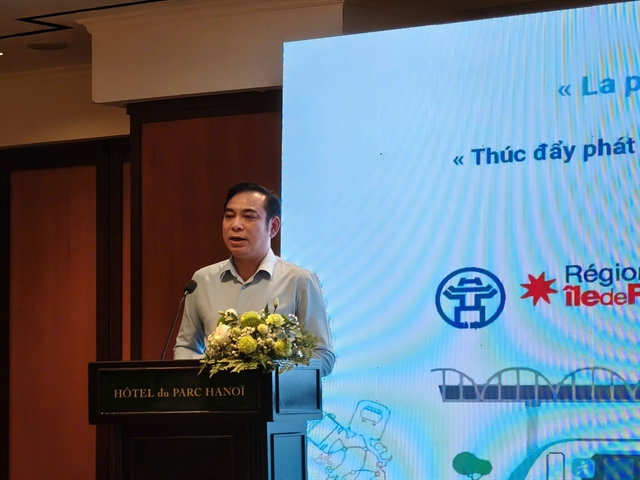
| Đào Duy Phong, Deputy Director of the Hà Nội Department of Construction, speaks at the seminar. — VNS Photo Khánh Linh |
Speaking at the seminar, Đào Duy Phong, Deputy Director of the Hà Nội Department of Construction, said the project had contributed to strengthening the city's public transport network, including transport services serving cultural and heritage sites, while studying bus networks to support urban rail.
He said Hà Nội would continue restructuring its public transport network in line with the city's master plan, which sets out a 100-year vision, while strengthening technical capacity in the operation and management of the public transport network.
“Hà Nội is facing new requirements for transport infrastructure development, improving air quality and enhancing people's quality of life. On that basis, the city wishes to continue listening to proposals and cooperation initiatives from international partners,” Phong said.
Stéphane Beaudet, Vice President of the Île-de-France Region, said the partnership between Île-de-France and Hà Nội dated back to 1989 and had developed across a wide range of areas, including heritage preservation, university cooperation and sustainable development.
“Three years ago, on the occasion of the Cooperation Conference held in Hà Nội, we launched this new project,” he said.
Beaudet said Île-de-France had experience in developing and managing a dense public transport system, with 200km of new metro lines being built and a network comprising more than 10,000 buses, 14 tramway lines and more than a dozen RER lines.
He said the three-year cooperation with Hà Nội had focused on looking towards the city's future development and regeneration, while facilitating transfers between different modes of transport and improving connections with the city's bus network.
“We have worked together on the development of a multimodal site. Together, we have undertaken a great deal of research and studies, particularly mobility studies,” he said.
Beaudet noted that the multimodal approach was particularly relevant to Hà Nội's newly approved master plan, with its 100-year vision, which places the multimodal transport network at the heart of the capital's long-term development.
Julien Seillan, AFD Country Director in Việt Nam, said transport was considered one of the strategic pillars of cooperation between Việt Nam and France as Việt Nam undertakes a profound transformation of its transport system to support economic growth and its carbon-neutrality ambition.
He said AFD intended to continue supporting Việt Nam's transport transition, including through the European Union's Transport Facility for Việt Nam, scheduled to be launched in October.
The facility involves a €40 million grant delegated to AFD to help prepare infrastructure projects through 2035 in areas including rail transport, inland waterways and urban mobility. It is expected to leverage around €1 billion in investment, he said.
Several projects are already under discussion, including the rehabilitation of Long Biên Bridge, the extension of Metro Line 3, modernisation of the Hà Nội–Hải Phòng railway line, the establishment of a railway training school at the University of Transport and Communications, and the Hà Nội Sustainable Mobility project aimed at developing intermodal transport hubs.
Seillan said the Moov’Hanoi project was based on the conviction that effective cooperation could be built through peer-to-peer exchanges between professionals and local authorities facing similar challenges.
“Hà Nội and the Île-de-France Region have worked together to explore what multimodality means in practical terms, to better understand travel patterns and users, to rethink urban planning, to connect buses and metro systems, and to think about the city from the perspective of its transport infrastructure,” he said.
He added that the experience gained through the programme would continue to inform future transport projects and cooperation between Vietnamese and European partners.
“Cooperation like this has sown the seeds of more sustainable mobility for Hà Nội,” Seillan said.
At the meeting, delegates stressed that the shift towards public transport depends not only on the availability of transport services but also on how public space is allocated among different modes.
Giving buses dedicated lanes and priority at intersections could make them a more competitive and reliable alternative to private vehicles, while better pedestrian access to bus stops and railway stations is also essential.
Measures include improving sidewalks, addressing encroachment and inappropriate parking, and providing suitable parking spaces for two-wheelers. Better-designed areas around stations can also improve the urban environment and facilitate transfers between walking, cycling, buses and motorcycles.
Passenger information and ticketing systems within stations were identified as other important elements in ensuring seamless connections between different modes.
The discussion also highlighted the need to reconsider the role of cars in urban public space. Redesigning streets, reducing road widths where appropriate, reorganising road hierarchies and creating traffic-calmed areas where pedestrians take a central role could help ease traffic pressure while improving the urban environment.
Experiences from the Île-de-France region, including measures to restrict highly polluting vehicles and parking policies designed to discourage private car use, could provide useful references for Hà Nội as it considers the development of low-emission zones and measures to encourage public transport use. — VNS
Society
 Society
 Society
 Society
 Society
 Society
 Society
 Society
 Society
 Society
 Society
 Society
 Society
 Society
 Society