 Society
Bắc Ninh and Samsung launch new business support programme
1.
|
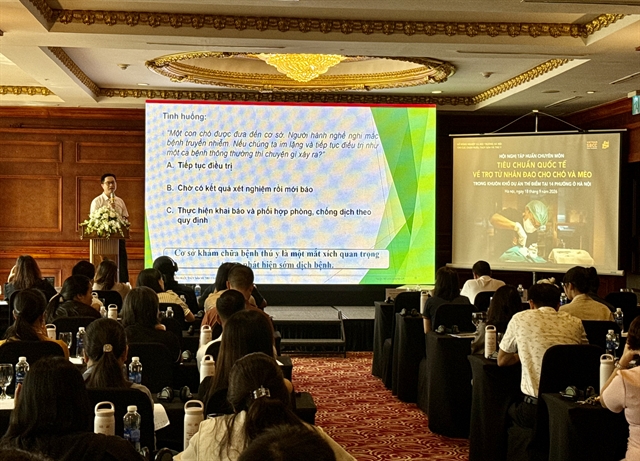
| Attendees at the workshop learned about Việt Nam's legal framework for the management of veterinary medical care. — VNS Photo Thanh Hải |
HÀ NỘI — About 120 ward officials and staff at veterinary clinics in 14 pilot wards in Hà Nội were trained on international standards for the humane euthanasia of dogs and cats at a workshop on September 18.
The event, entitled 'International Standards in Humane Euthanasia for Dogs and Cats,' was jointly organised by Hà Nội's Department of Livestock, Fisheries and Veterinary Medicine, the Soi Dog Foundation and the social enterprise SBCC Vietnam.
It was designed to help veterinary staff in Hà Nội become familiar with international practices, conduct community outreach and implement new standards as soon as conditions allow.
The training focuses on enhancing animal welfare, controlling rabies and standardising professional decision-making processes.
During the workshop, participants were provided updates on the legal framework and the current state of animal management in Hà Nội.
They were also trained in animal population management, as well as animal welfare standards, biosecurity practices and infectious disease control.
|
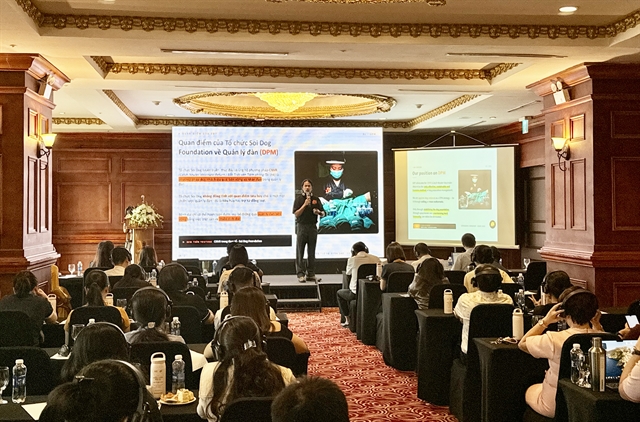
| Dr Winn Ularn Kanyook, Sanctuary Veterinary Manager at Soi Dog Foundation, speaks at the workshop. — VNS Photo Thanh Hải |
At the event, Dr Winn Ularn Kanyook, Sanctuary Veterinary Manager at Soi Dog Foundation, said: “Humane euthanasia is never the first solution, nor is it a population management tool. It is a last resort, and it is only appropriate within a system that includes vaccination, sterilisation, care and a transparent decision-making process. Soi Dog Foundation is committed to continuing to support Hà Nội through the most important phase: putting this into practice on the ground.”
Nguyễn Văn Hoan, a veterinarian and technical lead at VIET PET Veterinary Clinic, commented: “Today's training helped me see humane euthanasia as part of an overall strategy for animal welfare and rabies control, in which the foundational measures that come first -- vaccination, sterilisation and proper care -- play a key role.
"That is why I signed up to have my clinic provide after-hours sterilisation services for the pets of low-income households, take in, care for, vaccinate and treat animals and offer professional support to local veterinary teams whenever needed.”
The activity is part of a pilot project on promoting the transition to sustainable livelihoods for dog- and cat-meat traders in Hà Nội. The project aims to contribute to Việt Nam's national target of zero human deaths from rabies by 2030, while supporting sustainable livelihood transitions for households engaged in the dog and cat meat trade, and progressively raising animal welfare standards in line with international norms.
Building on this foundation, the project is now expanding towards long-term animal welfare goals under a One Health approach: promoting responsible pet ownership and the registration and management of dog and cat populations in the community, and scaling up rabies vaccination and sterilisation to humanely control free-roaming dog populations, thus gradually reducing the need for euthanasia.
SBCC Vietnam Director Bùi Thị Duyên said: “SBCC Vietnam will connect volunteer clinics into a public-private humane veterinary network, laying the groundwork for the project's next steps in 2027.
"This is not only about improving animal welfare, but it also helps realise the goal of zero human deaths from rabies by 2030 and supports the livelihood transition of households involved in the dog and cat meat trade.”
Following the conference, the project will help pilot wards finalise their internal operating procedures and establish a list of volunteer veterinary clinics joining the project's support network. The organiser will also conduct research and propose a specific legal framework for humane euthanasia in the context of urban veterinary management in Việt Nam.
The pilot model carried out in 14 wards of Hà Nội is expected to serve as a reference for other cities across the country in establishing animal welfare standards, controlling zoonotic diseases and fostering community responsibility regarding pets. — VNS
Society
 Society
 Society
 Society
 Society
 Society
 Society
 Society
 Society
 Society
 Society
 Society
 Society
 Society
 Society