 Society

Việt Nam-Cambodia trade expo to draw over 160 businesses
1.
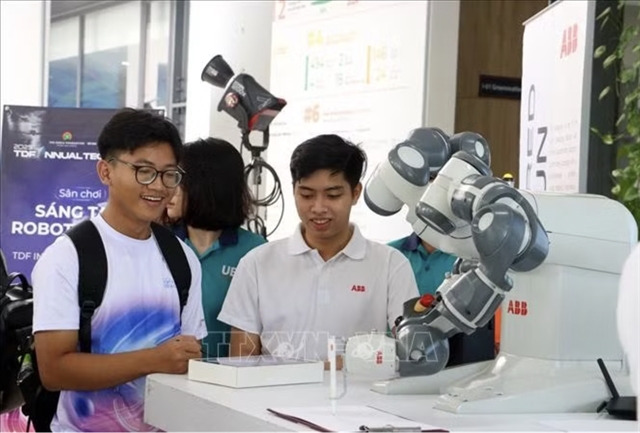 |
| Students experience robotics, AI/IoT, and MakerLab technologies at a Digital Technology Festival. — VNA/VNS Photo |
HÀ NỘI — Science, technology, innovation and digital transformation are being called upon to deliver tangible value for national development.
From data infrastructure for management and research to regulatory sandboxes for new technologies and applications in industry, the marine economy and education, recent initiatives point to practical ways of translating the spirit of Politburo Resolution No. 57-NQ/TW into action.
A foundation for innovation
The Ministry of Science and Technology has officially launched the National Information System on Science, Technology and Innovation.
It is one of the shared digital platforms being developed to establish a unified and reliable information hub that can connect and share data nationwide.
Available at www.sti.gov.vn, the system provides 137 sectoral statistical indicators and 17 national statistical indicators in science, technology and innovation.
It links data on science and technology organisations, scientists, science and technology tasks, and scientific publications. It also collects citation data and calculates indicators to assess the quality of Vietnamese scientific journals and papers.
The system has been connected to and integrated with the National Data Centre.
It supports single sign-on through VNeID and is ready to connect and share real-time data with the National Population Database.
According to Trần Đắc Hiến, director of the Department of Information, Statistics and Scientific Evaluation, the system’s goal is not simply to collect data, but to make that data usable and create value from it.
“For management agencies, it provides a more comprehensive evidence base for policy-making, implementation and evaluation, as well as for assessing the capacity, activities and results of science, technology and innovation,” Hiến said.
“Scientists will have better access to information, resources and research cooperation opportunities. Businesses can search for technologies, experts and research findings suited to their production and business needs,” he said.
Meanwhile, Deputy Minister of Science and Technology Lê Xuân Định said that the system was important for reforming state management, accelerating digital transformation and developing the sector’s data infrastructure. Notably, it is designed to manage groups of activities, tasks and organisations throughout their entire life cycle – from inputs and outputs to results and impact.
“This marks a shift from management focused mainly on monitoring tasks and products to an approach based on results and impact,” Định said.
“The launch was only the first step. Its long-term value will depend on data quality, connectivity, the extent to which the system is used, and its practical effectiveness,” the deputy minister said.
“In the coming period, the ministry will improve data in line with the criteria of being 'accurate, complete, clean, live, consistent, shared and reusable', while strengthening the verification and validation of key data to ensure the reliability of the system’s information,” he said.
Sandboxes create space for technology
Alongside the development of data infrastructure, the establishment of controlled testing mechanisms is opening up more opportunities for new technologies to be tested in real-world conditions.
Recently, the Hà Nội People’s Committee has authorised controlled trials for two technology projects: an intelligent autonomous transport system developed by Phenikaa-X Joint Stock Company, and a semi-industrial scale production technology for total rare-earth oxides with a purity exceeding 95 per cent, that were developed by the Mining Technology and Construction Consultancy Joint Stock Company.
According to Hà Nội People’s Committee vice chairman Trương Việt Dũng, the significance lies not only in the decisions or the technologies involved, but also in the city’s trial of a new governance approach.
“Rather than waiting for technologies to mature before adapting the law, the city is proactively creating a limited space for testing, where risks can be controlled, data generated and policies refined based on practical experience,” Dũng said.
The trial of the intelligent autonomous transport system is expected to last 24 months.
It must clarify the system’s safety, stability, ability to respond to different situations, and compatibility for existing infrastructure.
The process will also provide a basis for identifying the conditions required to commercialise and scale up the technology.
Associate Professor Dr. Lê Anh Sơn, director of Phenikaa-X JSC, said the city’s decision followed more than five years of research, thousands of test runs and tens of thousands of kilometres of trial operation.
Vietnamese engineers have mastered and continue to develop the entire autonomous software system, integrating digital maps, high-precision positioning, route planning, control and related components, he said.
The trial of the rare-earth mixed-oxide production technology is expected to last 18 months.
The company will continue upgrading its workshop, installing equipment and completing its automation system at Hà Nội’s Hoà Lạc Hi-Tech Park.
The city requires the trial to clarify the company’s mastery of the technology, the production line’s stability, product quality, and the efficiency of raw material, chemical and energy use.
Waste, environmental and radiation-safety factors must also be strictly controlled.
“The success of a sandbox should not be measured merely by the number of projects authorised for testing. More importantly, it should be measured by how many promising technologies can move from the laboratory through validation and into the market, creating value for society,” the vice chairman said.
Applying science and technology to concrete development needs
The spirit of Resolution No. 57 is also reflected in plans to develop the digital technology industry and artificial intelligence, and to apply science and technology across local sectors.
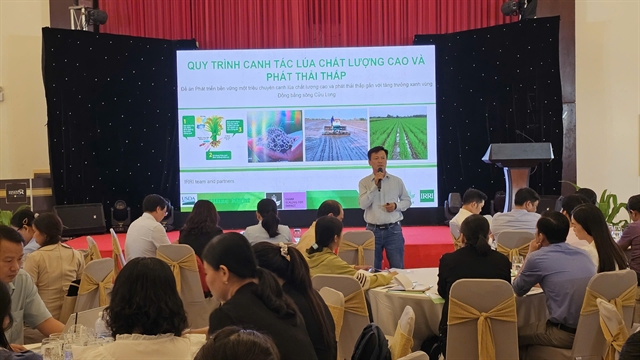
In Cần Thơ, a workshop titled “Connecting Supply and Demand between Digital Technology Enterprises and Businesses Applying Digital Technology”, held this month, focused on connecting technology providers with users.
It gave management agencies an opportunity to hear about difficulties faced by localities and businesses, helping them advise on improvements to mechanisms, policies and testing arrangements to create favourable conditions for the development and practical application of digital technology and AI.
According to Đinh Thị Linh Hương, deputy director of the Department of Information Technology Industry under the Ministry of Science and Technology, Việt Nam’s digital technology industry generated about US$198 billion in revenue in 2025 and comprised more than 80,000 businesses with over 1.9 million workers.
However, the requirements of the new period go beyond expanding the industry’s scale.
They include a strong shift towards higher added value, stronger research and design capacity, mastery of technology, the development of “Make in Việt Nam” products and deeper participation in global value chains.
The Law on the Digital Technology Industry, which took effect on January 1, 2026, has established a legal framework for the development of digital technology businesses, products, services and human resources.
It also provides mechanisms to promote application, expand markets and strengthen links between technology solution providers and agencies, organisations and businesses that need such solutions.
In Cần Thơ and the Mekong Delta, digital technology and AI are expected to address specific needs in agriculture, logistics, trade, education, healthcare, urban management and business operations.
These technologies can both generate productivity gains and create new value for the region and provide a real-world market in which technology businesses can develop, test and improve their products.
The development of data systems, the opening of controlled testing mechanisms and the promotion of technology applications across sectors and localities are creating more favourable conditions for science and technology to address practical development needs.
These efforts are gradually translating the spirit of Resolution No. 57 into everyday life.
The initial results also show that more technologies and solutions are gaining opportunities to be tested, refined and applied more widely in practice. — VNS
Society
 Society
 Society
 Society
 Society
 Society
 Society
 Society
 Society
 Society
 Society
 Society
 Society
 Society
 Society