 Society

Việt Nam-Cambodia trade expo to draw over 160 businesses
1.
|
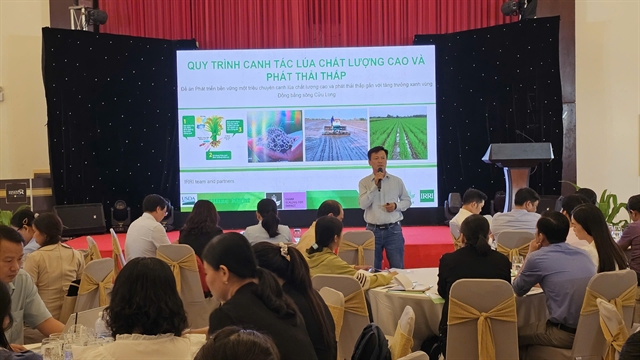
| Participants at a training course. — Photo courtesy of IRRI |
AN GIANG — A programme in An Giang Province is building a network of trainers to help farmers adopt high-quality, low-emission rice production under the country's one million hectares rice project.
The International Rice Research Institute (IRRI), the An Giang Province's Department of Agriculture and Environment and the Vietnam Rice Industry Association (VIETRISA) held a training-of-trainers (TOT) course on Wednesday, the third in the Mekong Delta after Cần Thơ City and Cà Mau Province.
Another course is planned for Đồng Tháp Province.
Participants learned about precision nutrient management (PNM), fertiliser use, water and straw management, as well as compliance with the project's production requirements.
In An Giang, the project is expected to cover 86 communes and wards, targeting more than 351,360ha by 2030.
PNM focuses on applying the right type and amount of fertiliser at the right time and in the right place. The approach aims to match fertiliser use with the needs of rice plants and individual fields, reducing costs and nutrient losses while helping lower emissions.
Participants practised using the rice crop manager, which recommends fertiliser quantities and application times based on field conditions.
Nguyễn Văn Hiếu, an IRRI consultant, said the training was intended to equip participants to guide cooperatives and farmers in applying the techniques.
The important thing is to turn the knowledge and tools into effective practices in the fields, he said.
The course also introduced Viricert, a tool for collecting data and monitoring compliance with technical requirements.
Đinh Kim Dung, chief of the IRRI Office, said standardised data would help local authorities track implementation and identify areas requiring further support as the project expands.
The data is also linked to the low-emission green Vietnamese rice brand introduced by VIETRISA, connecting production practices with compliance assessment and product identification.
Director of Bình Thành Cooperative in An Giang Province, Nguyễn Thành Giang, said the training had helped the cooperative better understand how to tailor fertiliser use to individual fields.
The knowledge could help members reduce input costs while maintaining rice yields and quality, he said.
Nguyễn Hữu Diễm Hà, an IRRI expert, said developing a local network of trained officials was important for a programme of the project's scale.
When local officials understand both the technical requirements and how to organise implementation, they can be more proactive in providing guidance and addressing difficulties arising from actual production, according to Hà.
Participants received certificates as trainers of trainers at the end of the course.
The network is expected to help turn the project's requirements on quality, efficiency and lower emissions into practical changes across Cần Thơ, Cà Mau, An Giang and Đồng Tháp's rice fields. — VNS
Society
 Society
 Society
 Society
 Society
 Society
 Society
 Society
 Society
 Society
 Society
 Society
 Society
 Society
 Society